Severance Payroll: Turn the Agreement Into a Verified Payment Schedule


The severance agreement is signed, the employee has left, and five payments still need to happen. Payroll has to know which version controls, when the first payment becomes due, what each installment covers and who will report a change before another payment goes out. A termination date and a gross amount cannot carry all of those instructions.
For a U.S. employer, build the payment schedule from the approved obligation, then follow every installment through payroll and actual delivery. Keep earned final wages, additional severance, benefit subsidies and any disputed or contingent amounts identifiable. The result should explain both what remains authorized and what has happened to the money.
This guide is for implementing an approved severance arrangement. It does not set an employee's entitlement, draft a release or decide a disputed contract. Legal, tax and benefits reviewers supply those decisions. The Severance Payment Register below turns their instructions into a continuing operating record; its examples use fictional people and businesses.
Contents
Separate the obligations before building the schedule
Start with a component list. Identify earned wages through separation, any leave payout or earned incentive, additional cash severance, continued insurance support, outplacement services and other promised items. Record the authority, owner and payment route for each. A single budget total can include obligations with different deadlines, recipients and tax treatment.
The Department of Labor's severance explanation says the FLSA itself does not require severance pay. That does not establish whether this employer owes a payment under a policy, agreement or another applicable rule. Obtain the responsible reviewer's instruction rather than translating that federal statement into a decision that every severance payment is discretionary.
Determine what is already owed independently of a proposed release. EEOC guidance on severance agreements distinguishes additional consideration for a waiver from an employee's existing entitlement. Payroll needs that distinction in the component list, particularly when earned wages and additional consideration will pass through the same system.
Keep the earned-wage payment on its own governing deadline. A pending additional-severance agreement is not an operational instruction to move every separation payment to a later run. If the reviewer approves combining components in one delivery, retain their separate amounts and the evidence that the combined date satisfies each obligation.
Also distinguish ordinary agreed severance from a settlement allocating wages, damages, interest or attorney payments. The IRS's settlement guidance describes different reporting questions for different components. Ask for the approved allocation and reporting route; do not make a mixed settlement into ordinary severance by changing its payroll-code label.
For example, a fictional employer owes $2,400 of final earned wages and separately offers $15,000 of additional severance. Legal review supplies the wage deadline and confirms when the additional arrangement may begin. Preserve two obligations even if both eventually use payroll. The $15,000 should not be entered as a replacement for the $2,400, and the employee's receipt of earned wages does not establish acceptance of the additional agreement.
Read the dates from the effective agreement
Obtain the final approved document and a short payment instruction that references it. Keep the agreement version, authorized gross amount or formula, payment frequency, first and last dates, conditions and approving owner together. If the instruction and document differ, resolve the difference before converting either into a recurring code.
Some agreements promise a fixed amount; others refer to a number of weeks of a defined salary. Have the owner resolve the calculation basis, including the relevant salary date and whether another component belongs in that definition. Multiplying the current payroll rate by an assumed number of periods can produce the wrong obligation after a recent pay change.
Check whether the agreement specifies actual dates, a period following effectiveness or a particular payroll cycle. Every four weeks, twice monthly and monthly produce different calendars. If the language needs interpretation, the agreement owner must provide the resulting dates. The operator can then work backward from those dates to review, funding and submission cutoffs.
The date a person signs is not necessarily the date the arrangement becomes effective. For certain waivers of claims under the Age Discrimination in Employment Act (ADEA), the applicable regulation sets consideration periods of at least 21 days, or 45 days for specified group programs, and a seven-day revocation period. Those requirements are not a universal waiting-period formula for every employee, agreement or payment. Obtain the actual reviewed effectiveness and release instruction.
Record who confirms that any applicable condition has been satisfied and by when. A personnel-system field marked signed is weak evidence if nobody has confirmed the controlling version, relevant revocation result or another required condition. Use a clear hold on the affected severance item until the authorized owner provides the missing decision; keep unrelated earned-pay obligations separate.
Preserve the original due date if a payroll cutoff is missed. A missed submission window creates an exception to resolve, not permission to edit the agreement's calendar to the next convenient payday. Identify the available lawful payment route, the agreement owner's decision and the employee communication. Do not record a rescheduled obligation merely because the operator changed a date in the payroll application.
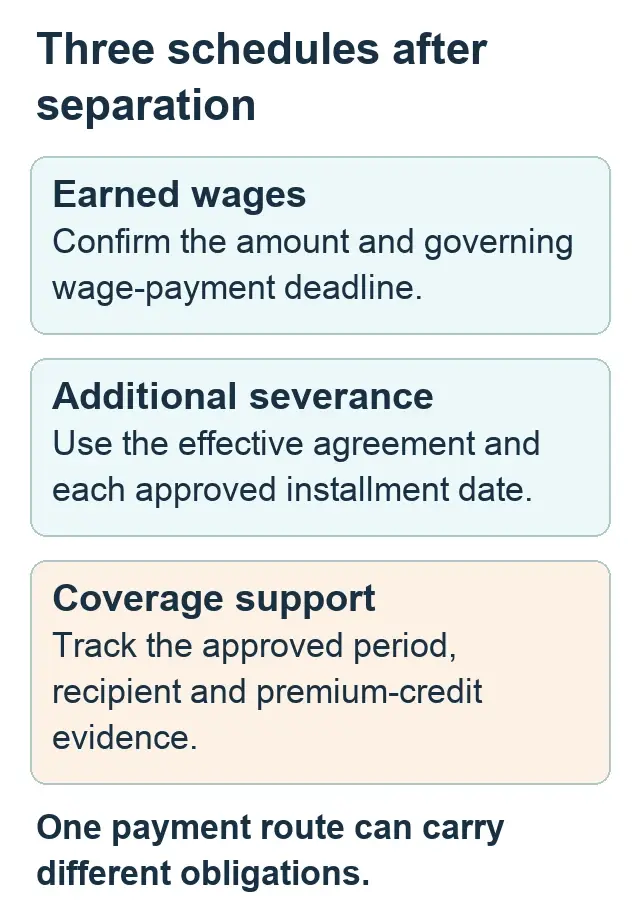
Put each obligation on its own schedule before choosing a common payment route.
Give installments an identity that survives a reissue
Create one obligation reference for the arrangement and one installment reference for each authorized payment. Add a separate attempt reference when a bank instruction is canceled, returned or replaced. This lets the team investigate a failed delivery without accidentally creating an additional installment.
List each scheduled gross amount and the total before entering the recurring instruction. Resolve rounding explicitly. If the approved obligation is $10,000 divided into three payments, three amounts of $3,333.33 leave a cent unassigned. Obtain and record the authorized allocation, such as $3,333.33, $3,333.33 and $3,333.34. The last amount should be deliberate, not an unexplained adjustment discovered after the arrangement ends.
If the agreement promises a net amount, have the authorized owner specify which taxes or deductions the employer will absorb and approve the resulting gross-up method and cost. Do not quietly turn a fixed gross promise into a net guarantee when explaining the employee's deposit.
Keep the contractual payment dates separate from the payroll earning-period fields. A payment date may be approved while the system still needs a defined period or code for calculation and reporting. Ask the provider and tax reviewer what those fields should contain for this arrangement. Do not enter fictional worked hours to make a payment screen accept a former employee.
Use payment states with operational meaning: awaiting authorization, scheduled, submitted, confirmed delivered, or exception under review. Record the evidence supporting each transition. Submitted means an instruction was sent; it does not by itself mean the employee received usable funds. An exception should identify the issue, responsible person and next decision rather than disappearing from the remaining schedule.
Retain the original installment when making an authorized replacement. Link the old attempt, the confirmed failure or cancellation, and the replacement instruction. Determine whether the repair is a payment-only reissue or a payroll calculation correction. Repeating the full gross earning can duplicate wages and tax reporting when only net cash needs to be delivered.
Separate the contract balance from the bank investigation. The contract owner and payroll reviewer must decide which amount has been discharged and which reporting record remains correct. A returned deposit is not, by itself, a complete instruction to reverse gross wages, taxes, a benefit payment or a previously filed return.
Set up payment after departure without restoring unrelated activity
Ask the provider how its current workflow pays a former employee, preserves the termination record and produces the required statements. A system may have a specific post-termination payment process. Confirm the supported route for the actual account rather than assuming that changing an employment-status field is harmless.
Review the effect of the selected code and employee settings on more than gross pay. Inspect ordinary salary, leave accruals, benefit deductions, retirement elections, recurring reimbursements and employer contributions. A continued severance payment does not supply an instruction to restart every item that was active before departure.
Build a representative preview before the first live installment. Compare the approved gross amount, tax bases, withholding method, authorized deductions, employer costs and net cash. Also inspect any separate benefit or accounting output. A preview with the correct net deposit can still contain an unintended recurring deduction or duplicate employer expense.
Check the last installment as well as the first. Record the recurring instruction's stop date, number of payments and handling of an approved final rounding amount. Where the system cannot enforce the complete schedule, assign a specific recurring review with an independent count of payments already processed. Do not rely on the original operator remembering to turn a code off several months later.
Protect delivery and statement access after the employee's normal workplace access ends. Use the established bank-change verification process for a requested destination change; a severance email thread is not a substitute. Confirm how the former employee receives statements and year-end forms, and which contact channel remains available if access fails.
Limit the working register to the information needed to execute and review payments. Reference the controlled agreement and specialist decisions instead of copying sensitive dispute details into a broadly shared payroll tracker. The reviewer needs a reliable evidence location and clear authority, not unrestricted access to every document in the separation file.
Attach the tax, deduction and order instructions
Use the instructions for the actual payment year, especially when installments cross January. For ordinary severance, 2026 IRS Publication 15 identifies the payment as wages subject to federal income-tax withholding, Social Security, Medicare and FUTA taxes. It also places severance within the supplemental-wage rules. Leaving employment does not automatically turn those wages into a contractor fee or remove their payroll-tax treatment.
Record the permitted federal withholding method for each payment. Separately identified supplemental wages can qualify for the optional 22% method when this employer withheld income tax from regular wages in the current or preceding calendar year; the aggregate method is another route. If that regular-wage withholding condition is absent, follow the applicable aggregate rules. Publication 15 imposes mandatory 37% withholding on supplemental wages exceeding $1 million in the calendar year, including the relevant common-control history. Apply the actual facts and current instructions rather than treating 22% as a severance tax rate or an all-in deduction.
Have the reviewer specify state and local treatment separately, including relevant work and residence facts. An employee who moved after departure may require a jurisdiction-specific review. Do not infer the correct withholding or reporting location solely from the mailing address used to send the agreement.
Resolve each continuing deduction. Ask whether the payment is eligible compensation under the applicable retirement plan and whether an employee election remains applicable. Identify the authority and collection route for insurance premiums or an approved repayment. A taxable-wage label alone does not answer those benefit-plan and authorization questions.
Review support orders before releasing a lump sum. Montana's employer instructions, for example, list severance among relevant lump sums and direct employers to report the payment to the agency that issued the support order. Obtain the reporting, holding and withholding instructions applicable to the actual jurisdiction and order. Give the order owner enough lead time to obtain the applicable instruction. Do not copy the last regular-pay deduction or withhold an entire severance amount without checking the controlling order and limits.
Escalate arrangements that may involve nonqualified deferred compensation. The section 409A regulations contain specific separation-pay exclusions and conditions. Calling a payment severance or splitting it into installments does not establish an exclusion. Obtain tax counsel's treatment and approved schedule before promising an acceleration, a delay or a new employee election about timing.
Keep coverage support on a separate payment trail
Read what the agreement actually promises about benefits. Continued active coverage, an employer subsidy for continuation coverage, reimbursement of a premium and an unrestricted cash allowance are different instructions. Identify the recipient, evidence needed, covered period, amount or cap, tax treatment and owner for the selected arrangement.
The Department of Labor's COBRA guide explains that termination other than for gross misconduct can be a qualifying event for applicable continuation coverage. The plan's coverage-loss facts and applicable rules matter. The existence of more payroll payments does not, by itself, establish that the person remains on active-employee health coverage.
Have the benefits owner confirm the active-coverage end date, continuation process, notices and any employer-funded period. If another administrator collects premiums, identify how payroll or finance will verify that the intended coverage payment was credited. A severance installment successfully reaching an employee's bank does not prove that an insurer or continuation administrator received a separate premium.
For a fictional agreement promising three months of employer-paid continuation premiums, track the three coverage months and the approved premium obligations independently from five cash-severance installments. The counts need not match. If cash payments are amended, do not automatically extend or end the premium support without the agreement and benefits owners' instruction.
When a reimbursement or subsidy depends on evidence, define who checks it and what happens if it arrives late. Keep any unresolved benefit amount visible without silently reducing cash severance to fund it. Communicate the exact affected benefit item and next action rather than telling the former employee that the whole arrangement is on hold.
Follow a five-payment arrangement through a failed transfer
Assume a fictional employer, Marlow Studio, has separately paid the earned wages due to Eli. Its authorized agreement then provides $15,000 gross additional severance in five $3,000 installments every four weeks. The reviewed dates are December 11, 2026, then January 8, February 5, March 5 and April 2, 2027. Legal and tax reviewers have approved the effectiveness conditions, schedule and relevant treatment for this example.
The register identifies installments SP-01 through SP-05. After the first two have been confirmed delivered under the reviewed process, the schedule accounts for $6,000 gross. SP-03 has been submitted but its delivery remains unresolved. SP-04 and SP-05, totaling $6,000 gross, have not yet been submitted. The $15,000 total is therefore explained by $6,000 confirmed, $3,000 in the unresolved installment and $6,000 in future scheduled installments.
Those are schedule-control amounts, not a tax return or a calculation of net cash. The employee's deposit is affected by the approved taxes and deductions. A reviewer should be able to trace the installment's gross payroll result to its net payment attempt without treating the two figures as interchangeable.
Suppose the payment team confirms that the SP-03 transfer was returned and authorizes a payment-only replacement after checking the original wage and tax record. Keep SP-03 as the same installment. Record attempt A's confirmed result and attempt B's approved net delivery. Do not create SP-06 or add a new $3,000 gross earning merely to produce another bank file.
If the original wage calculation was wrong too, record that separate correction and its effect on withholding and reporting. The fact that the first transfer failed does not decide which payroll fields need correction. The replacement record should explain the approved repair, not just show a second transaction with a similar amount.
Before March's installment, confirm whether the authorized schedule changed or February only needed a delivery repair. A payment-only replacement should not push every later due date forward. Preserve the original five-payment schedule unless the responsible owners approve a change that is permissible under the agreement and applicable rules.
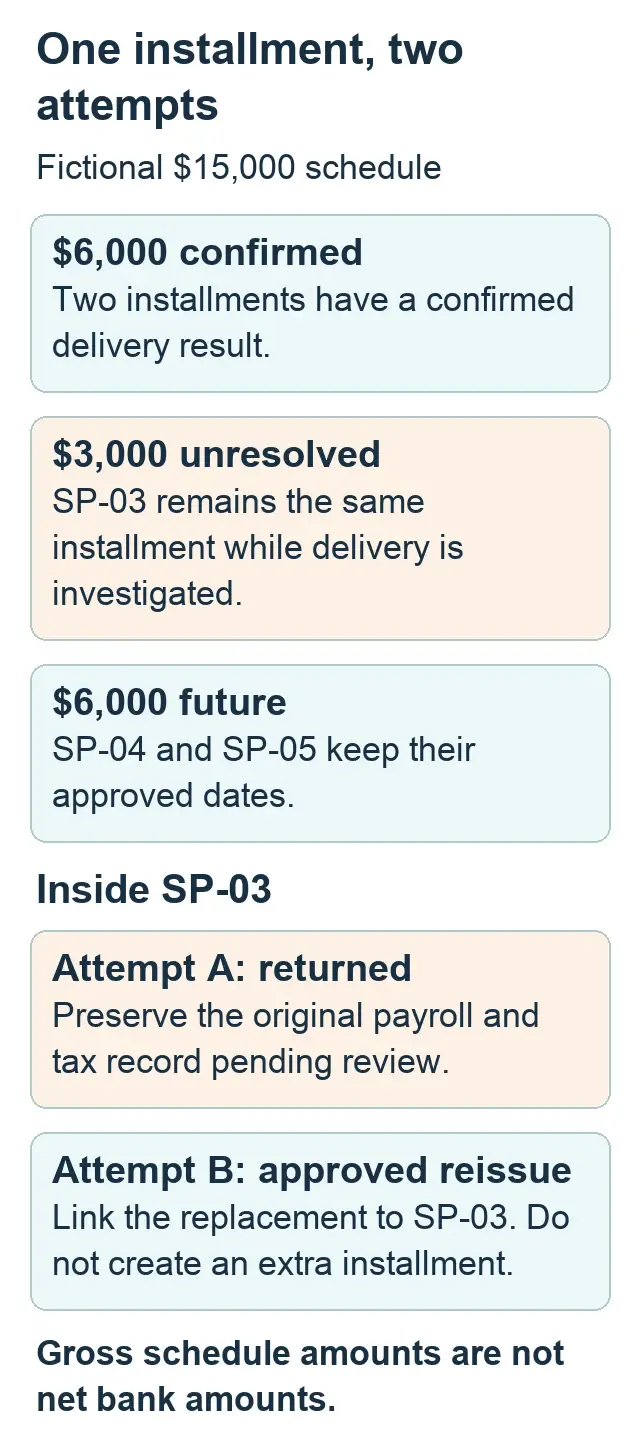
An installment identifies the obligation. An attempt identifies a delivery instruction. Reconcile both before changing the remaining schedule.
Approve changes before they reach the next installment
Name the person responsible for monitoring conditions that can affect future payments. The condition might concern reemployment, a specified notice, a negotiated amendment or another reviewed event. The payroll operator should receive the authorized operational result and effective installment, rather than deciding a contested contract from an informal message.
A report that the former employee has a new job is an exception to route to the agreement owner. It is not automatically an instruction to terminate severance, recover prior payments or apply a deduction. Preserve the original report, the reviewer decision and what it changes. Keep a disputed condition separate from a payment whose obligation remains established.
When an amendment is approved, create a new schedule version. Show the original total, confirmed payments, installments already in flight, approved changes and revised remaining amounts and dates. Reconcile the new version to the agreement amendment. Do not overwrite the old schedule or erase the reason an earlier payment differed.
Review whether a proposed acceleration or deferral needs renewed tax advice before changing the dates. A request to pay the remaining amount in December instead of January is more than a calendar edit. The responsible reviewer needs the actual agreement, payment rights and tax facts; payroll needs the resulting written instruction.
For a missed payment, first determine whether the cause was an unmet condition, an operator error, a funding failure or an uncertain bank result. Each requires a different next action. Retain the due date, affected installment, current status, person resolving it and the employee message. Do not describe every delay as a bank problem when the payment was never authorized or submitted.
Use the Severance Payment Register
Use one arrangement record and repeat the installment fields for every authorized payment. Give payment attempts their own references under that installment. Keep the register in an approved secure system and retain links to the controlled evidence. The blanks below can be copied as separate field rows; they are operating prompts, not a severance agreement template.
A. Preserve the approved obligation
Arrangement identity: Employer, employee reference, agreement version and controlled evidence location: ______.
Component boundary: Additional cash severance covered here; separately tracked earned wages, benefits or other items and their owners: ______.
Authorized gross: Fixed amount or approved formula and calculation basis; rounding allocation; reviewer: ______.
Effective payment instruction: Reviewed conditions, confirmed effectiveness, first and last dates, frequency and release owner: ______.
Change authority: Person monitoring conditions; required notice route; authority for a revised schedule: ______.
B. Repeat for each installment
Installment reference: Unique reference, schedule version, approved gross and contractual due date: ______.
Payroll specification: Code, required period fields, tax bases and approved withholding method; review reference: ______.
Other instructions: Benefit or retirement treatment, lawful deductions, orders and any required prepayment action: ______.
Release plan: Review, funding and submission cutoffs; authorized release person and backup: ______.
Preview result: Actual gross, taxes, deductions, employer costs and net cash compared with the instruction; exception: ______.
Payment attempt: Attempt reference, destination-verification evidence, submission reference and observed result: ______.
Resolution: Confirmed delivery or unresolved issue, authorized replacement or correction, owner and next decision: ______.
C. Reconcile the remaining arrangement
Schedule balance: Original authorized gross ______; approved amendments ______; revised authorized total ______.
Installment allocation: Confirmed installments ______; submitted or exception installments ______; future scheduled installments ______; unexplained difference ______.
Coverage support: Separate benefit periods, recipient, approved amounts, credited payments and remaining exceptions: ______.
Year and statements: Payment-year totals, wage and tax reporting references, statement delivery or access evidence: ______.
Final review: Last recurring instruction stopped, all installments resolved, amendments and benefit exceptions closed or assigned; reviewer and date: ______.
The revised authorized total should be explained by the installment allocation on the same gross basis. Do not add net bank amounts to gross payroll amounts. An unresolved installment stays in the register, and a replacement attempt does not increase the authorized total. Let the responsible reviewer decide the correct contractual credit and any separate tax adjustment when a result is disputed.
Reconcile the year and the last payment separately
An arrangement can continue beyond the year in which employment ended. For ordinary wage reporting, the W-2 instructions direct employers to report taxable wages paid during the year. Keep actual payment-year records; the date the agreement was signed does not by itself place every future installment on that year's statement. Obtain separate specialist instructions where deferred compensation or another exceptional rule applies.
For Marlow's fictional schedule, the December payment and the four next-year installments need their own payment-year detail. Do not load all $15,000 as current cash wages merely to establish a future recurring amount. Likewise, do not delete a remaining obligation when the employee disappears from an active-payroll roster at year-end.
Reconcile each year's processed payroll results to the arrangement register and the relevant liability, tax and payment records. Investigate differences caused by a canceled attempt, an actual wage correction or a benefit item posted through another route. A gross contract balance and an unpaid net bank item can be related without being the same accounting balance.
When a payroll provider changes during the arrangement, identify who owns the remaining installments and each year's reporting. Transfer the approved schedule version, payment and correction history, tax instructions and outstanding exceptions. Test how the new provider loads history without paying it again. Retain access to the old provider's statements and evidence needed to explain earlier payments.
At the last installment, verify the actual final amount and stop the recurring instruction. Then reconcile the arrangement total and any separate benefit support, confirm the former employee's statement route, and assign unresolved reporting or delivery work. A zero scheduled balance is not evidence that a returned final transfer was received or that an outstanding premium was credited.
Answer the former employee with the specific payment record
Give the employee the information needed to understand the next action: the installment reference, gross amount, scheduled date, actual payment status, statement access and contact for an exception. Avoid sending the internal legal review or sensitive payroll evidence when a clear payment explanation will answer the question.
Explain whether a figure is gross severance, federal withholding, total deductions or net cash. Withholding is a collection toward tax, not a promise about the employee's final personal tax liability. Direct personal tax planning questions to the employee's adviser while providing accurate employer payment records.
If the employee asks why severance has not arrived, locate the specific installment before offering a replacement. Confirm what was authorized, what was submitted and what the payment team can establish about delivery. State which team owns any unresolved agreement condition or benefit matter. The employee should not have to guess whether HR, payroll, finance or the administrator is investigating the same issue.
Questions before combining, continuing or accelerating payments
Can we put all separation amounts in one payroll line?
Only implement a combined calculation when the approved specification preserves each component's amount, deadline, tax and deduction treatment. A single bank deposit does not require losing that detail. Keep an independently due wage payment and conditional additional severance distinguishable even if the chosen delivery route is shared.
Does salary continuation mean the employee is still active for benefits?
The payment label does not establish coverage. The benefits owner must confirm the plan treatment, coverage-loss facts, any continuation process and employer subsidy. Keep that result separate from the payroll status required to make an authorized payment.
Can we pay the remainder early to finish the arrangement?
Get the agreement owner's and tax reviewer's instruction before accelerating payments. Confirm permission, affected dates, calculation and reporting, including any deferred-compensation issue. Update the schedule only after that decision and preserve its prior version.
Continue with payroll operating resources:

About the author
Ben Scott writes and maintains payroll decision guides for founders and operators. His work focuses on execution realities and how decisions hold up under growth, complexity, and controls and documentation pressure. He works hands-on in HR and leave-management roles that intersect with payroll-adjacent workflows such as benefits coordination, cutovers, and compliance-driven process controls.