
Employee Payroll Records: Keep Hires, Changes, and Departures Consistent


A new hire has an approved start date and no payroll record. A departing employee has a closed HR record and an unpaid adjustment. A returning employee has two active profiles because someone treated the return as a first hire. Those are three different record problems, even if each appears in the same employee export.
Keep a supported account of who the employee is, which employment period the record represents, and what payroll still needs to do. A status such as active or terminated cannot answer all three questions. The useful check is whether the record supports the next intended payment and preserves the history needed to explain it.
Use this guide to review genuine employee records across hires, ongoing changes, departures and returns. The Employee Record Continuity Sheet below compares an expected state with the state actually visible to payroll. It gives an unresolved record a named next step without treating a missing field as permission to delay wages.

A return recorded against an old employment period is a useful question to take to SelectSoftware Reviews. Its free advisor consultation can help you discuss HR and payroll options; confirm how a prospective provider would distinguish the new period and preserve earlier records.
Separate the person, employment period and payroll obligation
Start with three identifiers in your review design: the person, the employment period and any assignment that affects pay. Use internal references that let an authorized reviewer follow the relationship. A company may have one person with two concurrent assignments, or a returning worker with an earlier closed employment period. Counting profile rows alone can misstate either situation.
Keep the identifier's meaning stable. If an employee number changes after a transfer, retain an accessible cross-reference rather than replacing the old number everywhere. If two employers use the same number, include the employer in the comparison key. A display name is useful for a human check but weak as the sole matching rule because names can change and different people can share them.
Do not use Social Security numbers as general worksheet identifiers. The FTC's business guidance recommends limiting collection and access to sensitive information to a legitimate need. Store references to restricted evidence in this review, with the underlying documents available only through their approved access route.
Give employment status and payment eligibility separate fields. A person can stop working and still have an approved payment due. Someone can remain employed during unpaid leave without current earnings. The reviewer needs the relevant employment facts, the pay instruction and the remaining obligation, rather than one overloaded status that silently controls everything.
Document the meaning of each status your organization actually uses. For example, inactive may mean no scheduled hours in one application and no payroll processing in another. Record that difference before comparing exports. Agreement on the word alone does not establish agreement on the record's effect.
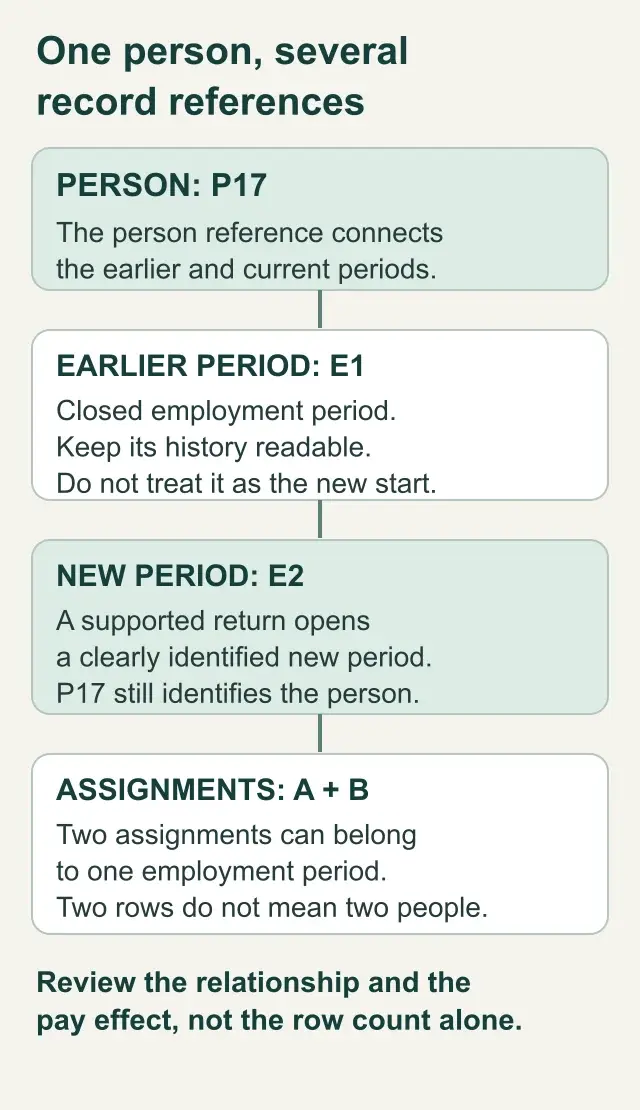
Match the person, the employment period and the assignment separately. A returning worker can keep a person reference while needing a clearly identified new employment period.
Find the events that should have changed the record
Build the review population from the employment events that should affect the period, not solely from payroll's current active list. A missing hire cannot appear in an export from a system where the hire was never created. Obtain the dated hire, return, transfer, leave and departure records from the owners who maintain them, including rescinded or corrected events.
Assign one reference to each event and preserve revisions beneath it. A manager moving a start date twice should not create three new hires in your control count. Conversely, two genuine assignments should not disappear because a reviewer deduplicated every row with the same person identifier. Define the event being counted before deduplication.
Set the observation cutoff explicitly. An event effective next Monday may already appear in an HR screen today but should not change the current run. A change entered after cutoff may belong to an earlier effective period and require a separate adjustment decision. Capture effective date, recorded time and the payroll period affected as different facts.
Ask for the event population even when the source owner reports no changes. A dated no-change confirmation is more useful than assuming an empty spreadsheet was complete. Identify which locations, employers or employee groups the confirmation covers so an unreported business unit does not disappear behind a clean total.
Include canceled starts and superseded departure instructions in the review. They explain why an expected record was deliberately not opened or closed. Retain the canceled event reference and its replacement decision; otherwise a later comparison can mistake a justified absence for a failed handoff.
Check a hire before the first expected payment
For each hire, match the supported start and employer to the payroll employment period. Confirm that the record uses the intended pay group, earnings basis and applicable assignment. Then inspect a preview or other available calculation evidence to see whether those facts produce the expected treatment for the first period. A saved employee profile and an included payment are different observations.
Define completeness by the decision being made. A missing emergency contact does not have the same payroll effect as an unresolved employing entity or pay rate. Identify the missing fact, its owner and the consequence for this payment. Escalate a legal or tax determination to the qualified person responsible for it, with the actual payday and evidence gap visible.
Use the applicable source requirements for identity and withholding information. IRS Publication 15 explains employer name/SSN reporting and Form W-4 instructions, including special handling when information is missing. Do not invent a tax identifier or substitute a preferred display name for the reporting name. A general onboarding checklist cannot settle every case.
A work location also needs its own supported assignment. A home mailing address change does not establish where services are performed. If the hire's location remains uncertain, send that specific question to the responsible payroll tax or HR reviewer. Keep the answer and its effective period attached to the assignment rather than copying assumptions from another new employee.
Before accepting the hire handoff, record where the employee appeared in the actual intended run. If the record exists but was excluded, capture the exclusion reason. If a separate payment route was approved, retain that reference and the expected follow-through. Close the missing-record question only when the affected pay outcome is accounted for.
Preserve the before and after of an ongoing change
For an existing employee, compare the supported new fact with the prior record and the period each should govern. A future rate can be saved correctly while the current rate remains in use. An earlier effective rate can be correct in the profile while the prior-period adjustment is still absent. Review both the standing record and any resulting payment work.
Keep an understandable history of old value, new value, effective date and the source reference supporting the transition. This guide's check begins with an established instruction; the separate approval process determines who may authorize it. If authority is missing or contradictory, return that question to the approval owner rather than manufacturing agreement in the employee record.
Trace the consequence across relevant fields without assuming that every field should change. A department transfer may change cost allocation while leaving employer and tax location intact. A transfer between employing entities is a different boundary and needs its own review. A reviewer should be able to explain which facts changed and why the others stayed as they were.
Treat legal reporting names, personal display names, mailing addresses and work locations as distinct data. IRS Publication 15 instructs employers to continue reporting wages under the old name until the employee provides an updated Social Security card with the corrected name. Apply that instruction to the reporting field while managing other names under the organization's appropriate process.
If the source was corrected after payroll used it, preserve both observations. Record what the run used, what the later evidence establishes and which payment or reporting periods need follow-up. Editing the current profile alone cannot explain a historical payment calculated from the earlier value.
Close the employment period without losing unfinished pay
A departure creates several related questions: when employment ended, which regular payments should stop, what remains payable and which records must stay accessible. Assign those questions separately. Turning off future recurring earnings should not erase an approved adjustment, and retaining a payroll history should not preserve unnecessary administrator access.
Confirm the actual departure instruction and its effective date, then compare the payroll status with the intended next run. List remaining earnings or adjustments individually, including their covered period and decision owner. If an amount is disputed or awaits calculation, keep that distinction visible instead of marking the whole employee record complete.
Final-pay deadlines depend on applicable law and circumstances. The Department of Labor explains that federal law does not generally require an immediate final paycheck, while some states do. Check the relevant requirements rather than applying an internal close date as a universal deadline.
Arrange a supported route for later payroll questions and documents after ordinary employee access ends. Identify who can provide a pay statement or reporting correction and how the former employee can contact that team. Verify this route in the actual arrangement; do not promise that a portal will remain available simply because it worked before departure.
Keep the approved record-retention and access decisions connected. DOL's recordkeeping guidance identifies payroll data employers must maintain for covered nonexempt workers and distinguishes payroll records from supporting wage-computation records. Retention periods and other obligations need the applicable policy and legal review. That guidance is a starting source, not permission to delete a particular personnel file.
For a return, check the earlier employment period before creating another profile. Confirm whether the system's supported rehire process preserves the required history and separates the new period appropriately. Do not assume that using the same person identifier permits every earlier pay, deduction or access setting to resume. Each continuing or restarted item needs a supported basis.
Define what this cycle's comparison can prove
A review can cover every event in a period, selected high-risk events, or a particular exception population. State which one you performed. Checking three complicated departures may answer those cases well while saying nothing about whether every hire reached payroll. Keep the population definition beside the results so another reviewer does not mistake a sample for a complete record reconciliation.
For a complete event review, account for each source reference once. Include the event in the current comparison, carry it to a named future period, or retain the supported cancellation. Keep unresolved events in their own visible category. If one source event affects two assignments, retain the relationship and verify both consequences without silently counting it as two people.
For a targeted review, explain the selection rule before seeing the results. You might choose all returns after a prior departure, all effective dates entered after cutoff, or all hires assigned to a newly opened employer. Record the unreviewed population and what evidence would justify expanding the check. A clean targeted result supports the selected population only.
Use different measures for missing events and conflicting values. An omitted hire is a completeness exception; two records with different effective dates are a consistency exception. A record that was correct at cutoff and then properly changed is neither automatically wrong nor directly comparable with the earlier export. Capture the observation times before counting differences as defects.
Report the unresolved work in terms a responsible owner can act on: two unsupported start dates, one missing employment period, or three closed periods with payment follow-through outstanding. Count a record once within a defined measure, and explain when one record appears in more than one issue category. Do not add those category totals together as though they were distinct employees.
Save the source extraction criteria, cutoff and event references with the comparison. An export name alone may not explain whether future starts or inactive profiles were included. If the application cannot produce the required population, obtain a supported alternative from its owner and record the limitation. Treat that as a defined evidence gap rather than labeling the population fully reviewed.
Reconcile the events instead of trusting the headcount
The opening list at a fictional employer contains 240 employment periods. Four supported starts or returns and three supported departures produce an expected closing count of 241. This is a comparison of employment periods within one defined employer and cutoff, not a universal formula for headcount or payment recipients.
The payroll export contains 240 open periods. It would be tempting to search for one missing employee. The event comparison instead finds two missing starts and one departure that remains open. Correcting the two omissions adds two periods; closing the stale departure removes one: 240 + 2 - 1 = 241. A one-record net difference concealed three distinct exceptions.
One omitted start is a first hire, and the other is a rehire whose old employment period was mistaken for the new one. Their next steps differ. The first needs the missing supported record created and its payment accounted for. The second needs the person-to-employment-period relationship repaired without duplicating prior pay history. The stale departure needs recurring pay stopped and any remaining obligation reviewed.
Identify every expected event as observed, not yet applicable, canceled with support, or unresolved. Then test whether the resulting state appears in the intended payroll evidence.
Compare like populations. An active-employment export, a list of employees paid and a file of assignment rows may each be correct and have different totals. Explain included leave cases, concurrent assignments, future starts and former employees receiving adjustments. Do not force the numbers to agree by deleting legitimate records from the comparison.
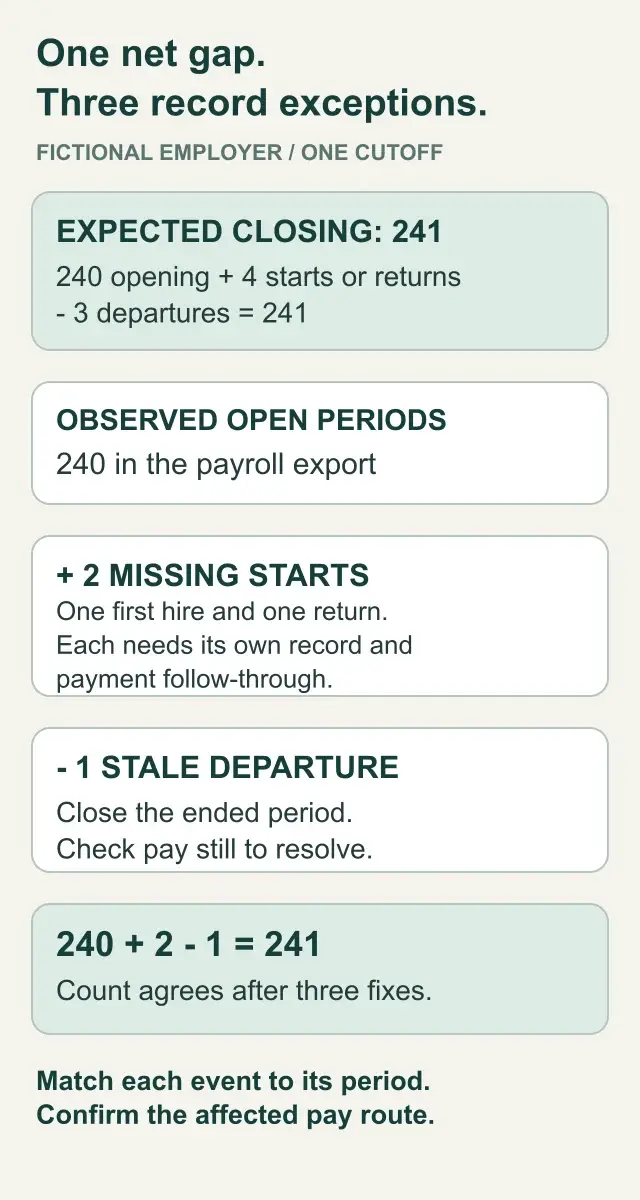
The example needs three fixes: create the missing first-hire period, identify the new period for the return, and close the stale departure. Each event also needs its payment follow-through.
Bring an effective-dated record history, using fictional data, when you speak with a SelectSoftware Reviews advisor. The consultation is free. Ask which payroll options may suit your review needs, then verify how the proposed configuration preserves the old value, the new value and the run affected.
Use the Employee Record Continuity Sheet
Complete one sheet for an employee event whose record needs a decision. Start from the source event and compare expected state with observed state; use the fifth group to document acceptance or a specific unresolved handoff. Store the sheet in your approved restricted workspace.
Record boundary
Review reference: ____.
Employer reference: ____.
Internal person reference: ____.
Employment-period reference: ____.
Assignment reference, if needed: ____.
Payroll period and cutoff: ____.
Reviewer: ____.
Use references rather than copying tax or bank numbers. If identifiers differ between applications, retain the cross-reference used for this comparison.
Supported event
Event type: ____.
Source event reference: ____.
Evidence location: ____.
Effective date: ____.
Recorded time: ____.
Revision or cancellation reference: ____.
Source owner: ____.
Missing or conflicting fact: ____.
State the unresolved fact plainly. A late entry, an unsupported instruction and a future event require different follow-up.
Expected and observed state
Expected employment state: ____.
Expected payroll treatment: ____.
Expected first affected run: ____.
Observed record state: ____.
Observation time: ____.
Run or calculation evidence: ____.
Difference requiring action: ____.
Related historical period: ____.
Keep the standing record and its payment consequence distinct. A correct profile does not establish that the intended run used it.
Pay still to resolve
Remaining payment or adjustment: ____.
Period the amount covers: ____.
Due-date basis and reviewer: ____.
Required decision owner: ____.
Approved payment route: ____.
Follow-through evidence: ____.
Next employee update: ____.
Record actual requirements and authorized instructions. An internal hold on a record issue does not create authority to withhold wages.
Acceptance and follow-through
Record correction reference: ____.
Accepted state and evidence: ____.
Open task and owner: ____.
Next check time: ____.
Closure reviewer: ____.
Closure time: ____.
Accept a resolved record only when the required comparison and affected-pay follow-through are supported. Keep an open decision assigned even if the data entry is complete.
Route an unresolved record to the person who can answer it
Send a focused question with the smallest necessary evidence set. For a conflicting start date, ask the employment-event owner which instruction governs and from when. For an unclear pay treatment, ask the responsible payroll specialist to determine the treatment and affected period. A request to check everything gives the recipient no clear acceptance condition.
Set the response time from the actual payment or reporting deadline. If the evidence cannot be resolved before that point, escalate the payment consequence to an authorized decision maker. Separate what is known, what is disputed and what can still be paid correctly. Do not allow a generic incomplete-profile flag to make that decision invisibly.
Where the records suggest an unauthorized change or an unexplained person, preserve the relevant observations and use the separate investigation route. A routine completeness review is not an identity investigation. Avoid drawing a misconduct conclusion from a missing handoff, and limit sensitive evidence to those responsible for resolving it.
For a recurring mismatch between applications, distinguish a wrong source fact from a transmission failure or a different field definition. Correcting one employee may be necessary for payday while leaving a wider population issue open. Give that wider issue a defined population, owner and next test so it is not hidden by the individual sheet's closure.
Verify both the corrected record and the intended outcome. A reviewer might confirm that the new employer assignment is present, then separately confirm the affected run or adjustment. Record the evidence for each. An administrator's saved confirmation or a service ticket marked done cannot replace the observation the original question required.
Ask a provider to demonstrate record continuity
If you are evaluating software or outsourced support, bring a fictional sequence with a hire, an effective-dated transfer, a departure with an adjustment and a later return. Ask the provider to show the record relationships and payroll results at each point. Require the demonstration in the proposed service and configuration; broad marketing descriptions cannot establish how your arrangement will behave.
Ask where a reviewer can see the prior value, the effective date, the recorded time and the source reference. Then ask what the export contains when a future change is saved or a departure is entered after payroll cutoff. Review the output rather than accepting that an audit log exists somewhere. Confirm who can obtain it and under which access restrictions.
Use a canceled start to test how the arrangement avoids creating an unwanted current record while retaining the explanation. Use a returning employee to test whether the earlier period remains readable and the new period can be recognized. No single preferred identifier design fits every provider; the test is whether the relationships and outcomes are understandable and supportable.
Confirm responsibilities for record entry, exception review and payment follow-through in the actual service agreement. A provider may supply software while the employer retains source verification, or support only specified administrative tasks. Record the boundary for the proposed arrangement, including how an employer obtains evidence when the usual contact is unavailable.
Use fictional data in demonstrations and training. FTC security guidance describes the risks of unnecessary real personal information in those settings and recommends restricting access according to need. A useful demonstration does not need a real employee's tax number or banking record.
Former employees may need adjustments after their regular access ends. For a software search centered on that handoff, ask SelectSoftware Reviews about HR and payroll options through its free advisor service. Establish the former employee support route and the employer’s remaining work with the provider.
Continue with Payroll Operations & Controls. Explore the full Decision Guides library.

About the author
Ben Scott writes and maintains payroll decision guides for founders and operators. His work focuses on execution realities and how decisions hold up under growth, complexity, and controls and documentation pressure. He works hands-on in HR and leave-management roles that intersect with payroll-adjacent workflows such as benefits coordination, cutovers, and compliance-driven process controls.


