Form 8027: Reconcile Receipts, Reported Tips and Allocations


A server can appear on one payroll record while working in two separately reported dining rooms. Adding that employee's yearly tips together does not establish what belongs on either establishment's Form 8027. The employer needs a reporting map before it needs a percentage calculation.
Prepare Form 8027 by reconciling three records for each reporting establishment: the relevant food and beverage receipts, the tips employees reported for the covered periods, and any allocation produced by the applicable method. Carry the resulting employee allocation into the correct wage statement without treating it as another payment of tips.
This guide is for U.S. employers coordinating restaurant operations, payroll, accounting and an authorized tax preparer. It uses the 2026 Form 8027 and instructions for returns filed in 2027. The examples are fictional. Use the rules and filing dates for the actual reporting year, and obtain qualified review of establishment coverage, allocation methods and corrections. The reconciliation sheet below organizes the work; it does not replace the official return or an employee's personal tax advice.
Contents
Start the return with an establishment map
Identify the legal employer, its EIN and the food or beverage operations it runs. Then ask the tax reviewer to determine which operations are reporting establishments. A payroll department, POS outlet, physical address and tax-reporting establishment may not describe the same population. An unexplained mismatch between those lists can move receipts or employees into the wrong return while leaving the combined totals unchanged.
The federal filing requirement concerns large food or beverage establishments in the 50 states or District of Columbia where tipping is customary. The employer's 10-employee test looks to the preceding calendar year's typical business day. The definition also addresses on-premises consumption and excludes qualifying fast-food operations. Obtain the determination from the current instructions rather than assuming that every business with a tip screen must file.
The service model matters to that determination. The instructions generally do not consider tipping customary in cafeteria-style operations or where at least 95% of sales other than carryout carry a service charge of 10% or more. Ask the reviewer to apply those conditions to the actual operation. A restaurant's marketing description or a button added to the payment terminal is not the supporting analysis.
The 10-employee test is based on employee hours, not the number of Forms W-2 or the number of people working one dinner shift. The IRS worksheet considers employees across the employer's food or beverage operations, including employees who do not receive tips. It does not apply the test independently to each operation. Preserve the included operations, the relevant employee-hours records and the reviewer's result. The instructions contain additional exclusions and a separate new-business test; a business without a preceding-year operating history needs that review.
For 2026, the optional IRS worksheet uses 2025 records, including the months with the greatest and least aggregate food and beverage receipts. A year-end employee list cannot reconstruct that evidence. Ask accounting for the relevant monthly receipts and payroll or timekeeping for the associated hours and business days. Have the reviewer resolve missing months or a changed business population before anyone records the test as complete.
A new business without food or beverage operations in the preceding year has a different timing rule. The instructions examine average daily employee hours over two consecutive calendar months and specify when the covered reporting period begins after the test is met. An existing employer opening another outlet should not assume it qualifies for that new-business treatment. Supply the operating history so the reviewer can choose the right test.
Once the employer meets the test, an individual qualifying operation can require its own Form 8027 even when that operation alone employs fewer than ten people. Separate locations generally need separate reporting. Distinct activities within one building can also be separate operations under the instructions' customer-area and separately recorded receipts rules. A hotel restaurant and a separately accounted lounge therefore need a reasoned mapping decision, not an automatic one-building, one-form assumption.
Maintain a crosswalk from each accepted establishment to its POS codes, accounting locations and employee work records. Use the establishment number consistently with the official instructions. Record openings, closings and renamed outlets without casually reusing an old establishment's identity. If staff move between locations, preserve the establishment attribution behind their receipts and reported tips. Their payroll employee ID alone will not supply it.
Sort the sales before using the tip percentage
Start with the POS and accounting source records for the defined establishment and year. Retain the report name, date range, filters and version. Explain how the source total reaches the receipts used on Form 8027. Bank deposits, total card settlements and a revenue account can each contain amounts with different reporting treatment.
Classify tips and service charges before building the bridge. A customer-selected voluntary tip and a mandatory charge distributed to staff have different federal tax treatment. A POS label such as gratuity does not decide the issue. Have the responsible reviewer identify the charge rules, how the customer can change the amount and how distributed charges enter wages. Preserve that instruction beside the affected sales and pay codes.
For the form's gross-receipts calculation, address nonallocable receipts, state and local taxes, merchandise and other required adjustments. Carryout sales and receipts with service charges of 10% or more are important exclusions under the Form 8027 instructions. The rules also address packages and some complimentary items. Do not remove all discounts or all complimentary food under one unsupported adjustment code; retain the reason each category receives its treatment.
Keep the form's charged-receipts subset distinct from total establishment receipts. Line 1 concerns charged tips. Line 2 concerns charge receipts showing charged tips, with the instructions' exclusions. A card batch containing sales with no charged tip is not automatically the line 2 amount. Nor should a payment processor's net settlement become the sales denominator after it has deducted fees or paid out tips.
Line 3 has a separate purpose: service charges of less than 10% that were distributed as wages. Those amounts do not become employee-reported tips merely because they reached an employee through payroll. Reconcile the applicable wage code and underlying charge category separately from the tip totals. A single combined gratuities export is insufficient when it conceals these different inputs.
Write a short adjustment explanation that another reviewer can reproduce. For example, identify the source food and beverage receipts, each supported exclusion, and the resulting line 5 amount. Keep the charged-receipts calculation beside it with its own filters. When the two results differ, explain the population difference rather than inserting an unexplained balancing amount.
Rebuild the tips employees actually reported
Collect the employee tip reports that belong to the establishment and reporting periods. Compare them with the POS evidence, tip-sharing records and amounts carried into payroll. The IRS treats electronic and card tips as cash tips for these reporting purposes; cash is not limited to bills handed directly to a server. The allocation percentage does not limit the tips an employee must report.
Assign each employee's reporting role correctly. Directly tipped employees receive tips directly from customers; indirectly tipped employees generally receive tips through other tipped workers. The instructions treat an employee who receives tips both directly and through sharing as directly tipped. Keep role changes and establishment assignments traceable rather than inferring the category from a payroll department name.
A pool transfer is not another customer tip. Establish what each employee actually reported after the applicable tip-sharing movements, and retain the supporting distribution record. Adding a server's original collection to the amounts passed to bussers can count the same money twice if the reporting records have not been interpreted consistently. A tax or payroll reviewer should resolve the discrepancy instead of selecting whichever total avoids an allocation.
The reporting year also needs a bridge. The 2026 instructions include tips received in December 2026 and reported in January 2027, while excluding tips received in December 2025 and reported in January 2026. A report filtered only by payroll processing date can miss that distinction. Identify the receipt period, employee report date and processing date separately, then document the adjustment that places the amount in the correct establishment year.
Reconcile directly and indirectly reported tips to lines 4b and 4a, then add those supported amounts for line 4c. Keep an exception list for missing employee reports, unresolved establishment attribution and corrected amounts. A missing report is a question to investigate, not proof that the employee received no tips. Do not silently replace it with a fixed percentage of sales.
Preserve the employee-level detail even if the preparer asks only for establishment totals. Payroll needs it again when allocations are assigned and W-2 information is reviewed. Use controlled employee identifiers in working schedules and restrict access to the underlying personal information. An annual total without its population and source trail is difficult to correct after employees have received their statements.
An annual total can conceal a period allocation
Record the allocation period and method before running the calculation. The instructions permit annual allocation or another reasonable division of the calendar year, with the chosen period approach effective for the year. If allocations were calculated for shorter periods, the annual return follows those records. A fresh subtraction of two annual totals can produce a different result.
Consider a fictional establishment using two allocation periods that together cover its calendar year. The first period has $200,000 of relevant receipts and $19,000 of reported tips. At 8%, its benchmark is $16,000, so that period produces no allocation. The second period has $300,000 of relevant receipts and $17,000 of reported tips. Its $24,000 benchmark leaves a $7,000 allocation.
The establishment's period allocations total $7,000. Combining the year's $500,000 of receipts and $36,000 of reported tips would instead produce a $4,000 annual difference. That is not the same calculation. Do not use the first period's excess reported tips to erase part of the second period's allocation when the approved records use the shorter-period approach. For allocations made using a period other than the calendar year, the form directs the filer to mark an X on line 6 and enter the allocated amount from those records on line 7.
Confirm the applicable rate for the establishment and periods. The normal allocation benchmark is 8%; an IRS-approved lower rate requires the relevant determination and effective period. A manager's belief that customers usually tip less, or an old spreadsheet from another location, does not establish a lower rate. Keep the determination letter with the filing support and check whether it covers the establishment and year being reported.
The benchmark is a reporting calculation. It is not permission to report only 8% of actual tips, a promise that employees received that amount, or an employer minimum-wage calculation. If the operating records suggest missing tips or a wage shortfall, assign those issues for their own review. Changing the Form 8027 allocation does not settle them.
Allocate the shortfall to the right employees
The official methods are the gross receipts method, the hours-worked method where available, and a qualifying good-faith agreement. The hours method has its own establishment-size condition: fewer than the equivalent of 25 full-time employees, expressed in the instructions through average employee hours per business day during the payroll period. It is a different test from the employer-level 10-employee filing test.
A tip-pool policy is not automatically a qualifying good-faith allocation agreement. Have the reviewer establish that the applicable agreement satisfies the written-agreement, employee-adoption, timing and other requirements. Keep its effective version. If using the gross receipts method, preserve the employee receipt attribution and shortfall steps rather than dividing the establishment allocation equally among everyone on the payroll.
Here is a fictional gross receipts example for one accepted allocation period at Poppy Room. Assume the establishment is covered, its reviewer has approved this method and period, and 8% applies. Relevant receipts are $125,000. Directly tipped employees reported $7,000; indirectly tipped employees reported $1,500. Total reported tips are therefore $8,500.
The establishment benchmark is $125,000 multiplied by 8%, or $10,000. Subtracting all $8,500 of reported tips leaves $1,500 to allocate. The indirectly tipped employees' $1,500 of reported tips also reduces the benchmark share used to calculate directly tipped employees' individual shortfalls: $10,000 minus $1,500 equals $8,500.
Use each directly tipped employee's share of the relevant receipts to divide that $8,500 benchmark share:
Employee A: $62,500 of receipts, or 50% of the direct employees' total. Benchmark share $4,250; reported tips $5,000. A has no shortfall.
Employee B: $37,500 of receipts, or 30%. Benchmark share $2,550; reported tips $1,000. B's shortfall is $1,550.
Employee C: $25,000 of receipts, or 20%. Benchmark share $1,700; reported tips $1,000. C's shortfall is $700.
The positive employee shortfalls total $2,250. Allocate the establishment's $1,500 in those proportions. B receives $1,500 multiplied by $1,550 divided by $2,250, or $1,033.33 at cents precision. C receives $466.67. A receives no allocation. The two allocations total $1,500.
Notice what the method did. It did not allocate $1,500 to each employee, pay another $1,500 through payroll, or turn A's result into a negative allocation that could be deducted from B. It used the positive shortfalls to divide the establishment's separately calculated allocable amount. The reported-tip amounts remain their own records.
Keep enough calculation precision to explain the result and apply the official form's rounding instructions consistently. Record any rounding difference and how it was handled. Reproduce the employee allocations from the retained inputs before approving the handoff. A spreadsheet that agrees only because someone typed an adjustment over a formula has not passed that review.
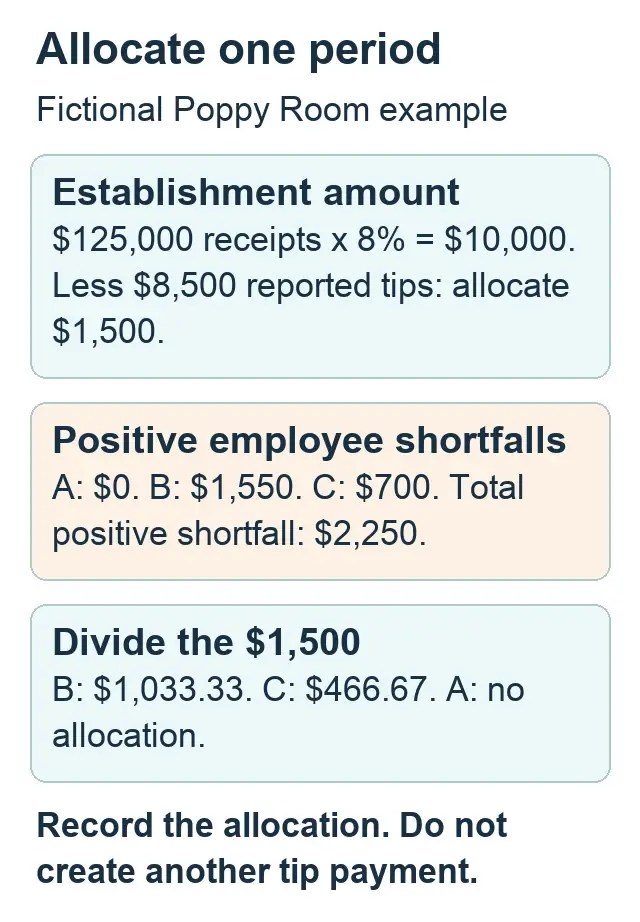
The diagram summarizes this one fictional period. Retain the employee receipts, reported-tip evidence and calculation alongside it; the image alone is not an allocation record.
Carry allocated tips to Box 8 without creating wages
Allocated tips belong in the employee's Form W-2 box 8. The W-2 instructions exclude those allocated amounts from boxes 1, 3, 5 and 7. They are not subject to income-tax, Social Security or Medicare withholding as allocated tips. Do not create a paid earning, additional net payment or reimbursement simply to move the allocation into a year-end field.
Employee-reported tips and distributed service-charge wages keep their separately applicable payroll treatment. Preserve those amounts rather than reducing them to make room for box 8. The employee may need advice about actual tip income and their own return; the employer's allocation record does not settle that personal determination.
Build a handoff by employee, legal employer and reporting year. Show the supporting establishment and period allocations, the approved employee total, the target W-2 field and the person authorizing the entry. An employee working in several establishments needs a traceable rollup into the appropriate employer statement. A conversion to a new payroll ID must not create a second person or drop the earlier allocation history.
Reconcile in both directions. Employee allocations for an establishment and period should recover the approved allocation for that period. The annual establishment rollup should recover the amount reported on the return. Employee totals should then recover the box 8 handoff for the appropriate statements. Investigate a difference at the level where it arose; a matching grand total does not prove that each employee received the correct amount.
Line 8 of Form 8027 has another distinct population: directly tipped employees who worked at the establishment during the year. It is a cumulative employee count, not the 10-employee filing test. Preserve who was counted and why. Do not substitute the number currently active in the last payroll or a company-wide W-2 count.
Keep the 2026 qualified-tip deduction reporting and occupation-code work separate from this allocation. An allocation is not automatic evidence that the same amount belongs in a qualified-tip deduction field. Use the relevant W-2 instructions and the employer's supported reporting map for each subject. Combining them under one tips total can hide a wrong field even when the employee's name and annual amount look familiar.

Three records answer different questions: what the employee reported, what the employer allocated, and what money was actually paid. Reconcile their relationships without forcing them into one identical amount.
Set a 2026 filing plan that is ready for IRIS
For 2026 Form 8027, the IRS instructions identify IRIS as the only electronic filing system and say the former FIRE route is retired for this form. Check the named filer's process, access and readiness for the relevant filing season. A prior-year checklist that ends with a FIRE upload is not a sufficient 2026 plan. The general IRIS landing page is useful for access information; use the current Form 8027 instructions for this form's year-specific requirements.
The 2026 form also adds line B about participation in a voluntary tip reporting program. Obtain the actual establishment's answer and supporting program information. Record line A's answer about charge transactions as well. Where line A is yes, the instructions require the applicable amounts on lines 1 and 2, including zero when appropriate. Do not leave an expected field blank because an export did not produce a row.
Use a calendar that separates the related submissions. For 2026 reporting, the ordinary W-2 furnishing and SSA filing date is February 1, 2027. Form 8027 is due March 1, 2027 on paper or March 31, 2027 electronically. These are different obligations. A later Form 8027 date does not authorize waiting until March to resolve an allocation needed for an employee's W-2.
Determine whether electronic filing is required using the applicable information-return rules, not the number of establishments or the 10-employee coverage test. The general threshold is ten or more covered information returns in the aggregate, and the employer's Forms W-2 and each Form 8027 count toward it. Have the filer check the included return types and any approved waiver. If eligible paper filing involves multiple Forms 8027, the instructions call for Form 8027-T; do not add that transmittal to an electronic filing merely because a prior paper packet contained it.
Name the person responsible for the return, the authorized signer and the person who will obtain acceptance evidence. A payroll provider's W-2 service does not by itself establish that Form 8027 preparation and filing are included. Ask what records it needs, what it will calculate, what the employer must approve and what filing result it will return.
The CPEO arrangement needs particular attention. For Form 8027, the instructions treat the customer operating the large food or beverage establishment as the employer required to file, with the CPEO furnishing necessary information. Obtain a clear division of responsibilities instead of assuming that another employment-tax service transfers this specific obligation. Route contract and tax-responsibility questions to the appropriate reviewers.
Establishment Tip Reporting Reconciliation Sheet
Use one sheet for each reporting establishment, with supporting detail for its allocation periods and employees. Copy the rows into a controlled worksheet or case system. Record evidence references and reviewer decisions, not only a completed checkbox. Keep personal identifiers and detailed employee records in the restricted supporting schedule.
Establish the reporting population
1. Reporting year: Record the year on the form and the official instruction version used.
2. Legal employer: Record the employer name, EIN and owner of the filing responsibility.
3. Establishment identity: Record the location or activity, establishment number and POS/accounting crosswalk.
4. Coverage determination: Reference the 10-employee or new-business test and the reviewer's establishment decision.
5. Employee attribution: Reference employee identities, establishment work and direct or indirect reporting roles.
6. Source population: Record the receipt reports, employee reports, date filters and retained versions.
Classify the source amounts
7. Nonallocable receipts: List the excluded receipt categories, amounts and approved reasons.
8. Charged tips: Record the supported line 1 amount and its source reconciliation.
9. Charged receipts showing tips: Record the line 2 subset and explain its filters.
10. Service-charge wages: Record the line 3 amount and separate wage-code support.
11. Indirectly reported tips: Record the line 4a total and employee schedule reference.
12. Directly reported tips: Record the line 4b total and the resulting line 4c reconciliation.
Preserve the allocation calculation
13. Period and method: Record the allocation periods, method and supporting approval or agreement.
14. Applicable rate: Record 8% or the IRS-approved lower rate and its determination reference.
15. Relevant gross receipts: Record the line 5 amount after the supported classification bridge.
16. Benchmark: Record the applicable calculation and any required line 6 period annotation.
17. Establishment allocation: Record each period's allocation and the annual line 7 rollup.
18. Employee allocation detail: Reference the shortfalls, proportions, allocations and rounding reconciliation.
Complete the reporting handoff
19. Annual establishment review: Record the approved totals and the distinct line 8 employee-count support.
20. W-2 box 8 handoff: Record employee totals, the authorized field entry and the statement reconciliation.
21. Filing plan: Record the filer, authorized signer, submission method and separate due dates.
22. Acceptance or correction: Reference the submitted version, acknowledgment and any open replacement or amendment case.
23. Unresolved difference: Record the amount or population affected, next owner and decision deadline.
24. Final review and retention: Record the reviewer, evidence location and applicable retention or hold instruction.
Use two closing checks: establishment-period allocations recover the annual establishment amount, and the approved employee allocations recover the W-2 handoff. An unresolved difference should retain its owner and deadline even if another establishment is ready to file. The sheet does not authorize replacing a missing employee report or making a personal tax determination.
Correct the complete allocation when an input changes
A corrected receipt classification, employee report or establishment assignment can affect more than one box 8 amount. Keep the prior approved version and calculate the effect across the relevant establishment and period. Changing only the employee who reported the problem can leave the remaining shortfall proportions wrong.
Suppose an employee's receipts were assigned to the wrong dining room. The reviewer may need to revisit both establishments' denominators, employee shares and reported-tip attribution. Keep the operational source correction separate from the tax-reporting decision. Have the preparer identify which returns and statements require correction, and retain the relationship between the original and revised versions.
The Form 8027 instructions have specific rules for correcting allocations, including an employee allocation differing from the correct amount by more than 5% and reviewing other employees in that establishment for distortion. That provision is not a general payroll materiality policy. Do not use it to ignore a missing return, wrong employee identity, unsupported receipt population or another kind of wage-statement error.
The W-2 correction route depends in part on whether the statement has been filed with the SSA. Preserve that status and follow the applicable instructions for a corrected employee copy, an original SSA submission or Form W-2c. Do not send wage statements to the IRS merely because the related Form 8027 goes there. The tax preparer should also determine the correct amended Form 8027 process when the establishment return is affected.
Give employee communications their own review. Explain which employer record changed, what replacement statement is being supplied and where the employee can obtain advice about their return. Do not describe an allocated amount as cash the employer has now paid, or state that the employee necessarily failed to report tips. Keep the corrected evidence available to the people handling follow-up questions.
Make the filing handoff prove what was accepted
Release the filing package with the accepted establishment map, classified receipt bridge, reported-tip schedules, period and method decision, employee allocation detail and W-2 handoff. Identify any limitation explicitly. A preparer receiving only a net allocation total cannot independently reconstruct the reporting population or know whether shorter-period allocations were preserved.
Retain the submitted version and the filing acknowledgment. Distinguish an upload attempt, a rejected file and an accepted submission. Assign the next action for each unresolved status, and verify that the actual accepted return is the version the reviewer approved. Keep corrected submissions connected to the original case so a later operator can tell which version controls.
The Form 8027 instructions require supporting records to be kept for three years after the relevant return or statement due date. Other wage, employment-tax and personnel records can have different requirements, and holds may affect disposal. Have the responsible owner apply the retention schedule to the actual evidence instead of deleting the entire working packet when the portal reports success.
Close the work when the establishment inputs reconcile, employee allocations reach the right statements, and the required submissions have evidenced outcomes. Carry any remaining issue with a named owner. That gives the next reviewer a defensible trail from the dining room's source records to the accepted return and the employee's allocation, without confusing a reporting calculation with another payroll payment.
Explore the next payroll decision:

About the author
Ben Scott writes and maintains payroll decision guides for founders and operators. His work focuses on execution realities and how decisions hold up under growth, complexity, and controls and documentation pressure. He works hands-on in HR and leave-management roles that intersect with payroll-adjacent workflows such as benefits coordination, cutovers, and compliance-driven process controls.