FUTA Credit Reduction: Check the Year, State and Wage Base


An October FUTA estimate can be wrong even when payroll's employee totals are right. For 2026, the final federal determination gives California a 1.5% credit reduction. The U.S. Virgin Islands repaid its outstanding advances before the deadline and has no 2026 credit reduction. Carrying forward last year's rate, or using a potential-rate column instead of the final column, changes the employer's bill.
The next question is which wages receive that rate. A state's unemployment wage total, an employee's W-2 wages and the federal FUTA wage base can be different amounts. A correct percentage applied to the wrong population still produces the wrong Schedule A.
Use this guide to prepare an ordinary employer's annual FUTA reconciliation: establish the tax year and filing employer, build employee-level federal wages, identify the state overlap, calculate the additional tax and connect it to fourth-quarter liability and deposits. The Employee-State FUTA Wage and Credit Bridge below gives payroll and the tax reviewer a shared workpaper. Household employment, agricultural coverage, exempt employers and special third-party arrangements require their own eligibility review.
Contents
Read the final determination for the actual tax year
The Department of Labor's FUTA credit-reduction page distinguishes potential reductions from final determinations. A state's outstanding federal advances, repayment and any approved relief determine the result. Do not turn an early-year forecast into a year-end instruction simply because it contains the year you need.
The IRS explains the ordinary credit against the 6.0% federal tax: a maximum 5.4% credit can leave a 0.6% net rate on the federal wage base. A credit reduction reduces that available credit, increasing the federal tax. It does not reduce employees' wages, replace the state unemployment rate or make the additional amount an employee withholding.
The final 2026 DOL table, updated November 10, 2026, supports these two different outcomes:
California: final credit reduction 1.5%, written as 0.015 for multiplication. Its benefit-cost-rate add-on waiver was approved. The table's 3.5% potential BCR add-on is not an extra final charge to add to the 1.5%.
U.S. Virgin Islands: final credit reduction zero after repayment before November 10. Its 4.8% outstanding-advance column does not override the zero in the final column.
For an otherwise ordinary California employee with the full $7,000 federal base also subject to state unemployment tax, the additional credit-reduction amount is $105: $7,000 × 0.015. With the usual 0.6% net FUTA calculation before this adjustment, the total is $147. Those amounts assume the normal credit is otherwise available; excluded state wages, late contributions and special arrangements need separate treatment. An employee below the federal base generates a smaller amount.
Keep the rate evidence with its tax year. The table is a 2026 determination, not a permanent California rate or a prediction for 2027. A provider's estimate should identify whether it used a potential or final determination and whether the final result has reached your configuration.
There is also a forms-version boundary. On November 14, 2026, the IRS Form 940 current-revision page still linked the released 2025 return and Schedule A. Their printed 2025 rates are not the 2026 determination. Prepare the 2026 reconciliation with current official evidence, then obtain the final forms and instructions for 2026 before filing. Do not file a draft, relabel a 2025 schedule or treat an IRS electronic-filing test scenario as a released tax form.
Establish the employer before totaling payroll
FUTA is an employer tax. The 2026 IRS employer guide says it is not withheld from employees. A credit reduction increases the employer's federal unemployment obligation; it does not authorize an extra employee deduction.
For ordinary nonfarm, nonhousehold employment, that guide's 2026 general test covers employers that paid at least $1,500 of wages in any calendar quarter of 2025 or 2026, or had at least one employee for part of a day in at least 20 different weeks in either year. Coverage is the first decision. A small year-end wage balance does not by itself establish that no return is needed.
Different populations need a deliberate route. Household and farmworker tests differ from the general test. Organizations described in section 501(c)(3) and exempt under section 501(a) generally are not subject to FUTA, subject to the exceptions in the Form 940 instructions. A state unemployment obligation does not by itself prove a federal FUTA obligation. Have the responsible reviewer document the employer and worker categories instead of enabling every tax because a state account exists.
Name the filing employer and EIN, calendar year, state unemployment accounts and every payroll record source. Include prior-provider history, manual or off-cycle payments, voids, corrections and taxable items processed outside an ordinary run. Ask who will prepare Form 940, calculate Schedule A, initiate deposits and retain agency acceptance. A contract that says payroll taxes are included should still identify those actions.
Outsourcing changes who performs work, but the IRS distinguishes the liabilities of different third-party arrangements. Preserve employer access to return copies, confirmations and account records. A debit on the provider's invoice is not evidence that the correct employer, tax type and year received the deposit.
Use a separate review when the legal employer changed. Acquisition, qualifying successor, common-paymaster and CPEO rules can affect wage-base treatment. A shared owner or a new payroll login does not establish continuity. Obtain the tax reviewer's instruction before combining or resetting histories, and keep the federal decision separate from each state's unemployment treatment.
Build capped federal wages before sorting by state
Start with each employee's payments for the calendar year. Identify payments exempt from FUTA, then identify the remaining wages above the $7,000 federal base. The resulting taxable FUTA wages are the input to the federal calculation. The Form 940 instructions show these separate categories and special successor treatment. Gross pay minus one company-wide allowance is not an adequate substitute for employee detail.
Keep the employee identifier, employer, pay date, pay component, FUTA treatment and accumulated federal base together. A salary employee who reached the base early in the year and a seasonal employee who earned $3,200 do not contribute the same capped wages. Multiplying year-end headcount by $7,000 overstates some people and can omit employees who left before December.
Benefits and unusual payments deserve their own classification evidence. A label such as reimbursement, fringe or severance does not determine every employment tax. Use the approved treatment for the component and payment year. When the tax reviewer changes that treatment, update the affected employee history and show how the change affects the cap; do not patch only the final annual total.
A provider change under the same employer needs a full-year history. Check whether the new system imported prior taxable wages, which payroll periods it will report, and whether its annual return includes the old provider's amounts. A file can contain history for calculations without assigning every filing duty to the receiving provider. Resolve that distinction before accepting either party's proposed Form 940.
A transfer can change the state share without changing the federal cap
Consider a fictional employee paid $4,000 in California and then $5,000 in Nevada by the same ordinary employer during 2026. Assume all $9,000 is ordinary compensation subject to FUTA and to the applicable state unemployment law, with no other wages, exemptions or special employer arrangement.
The federal taxable total is $7,000. The first $4,000 belongs to the California segment; only $3,000 of the subsequent Nevada pay remains inside the federal base. California's 2026 credit-reduction calculation therefore uses $4,000 × 0.015 = $60. It does not use all $9,000, a fresh $7,000 in each state or the state taxable-wage total without checking the federal cap.
If the order were reversed, with $5,000 paid in Nevada first and $4,000 in California afterward, only $2,000 of California wages would remain inside the federal base. The additional California amount would be $30. The Schedule A instructions' multistate example illustrates why the sequence and remaining federal base matter. Its printed state rates are year-specific; the example here uses the separately verified final 2026 determination.
Do not allocate the federal base in proportion to annual state gross wages merely to make the totals reconcile. Preserve the actual paid-wage sequence and approved state unemployment attribution. If a location correction changes that attribution, rerun the affected employee-state calculation. An unresolved work-state or employer-history question belongs with the qualified reviewer before the annual schedule is approved.

Illustrative 2026 transfer: $4,000 California plus $3,000 Nevada fills one $7,000 federal base. California's eligible $4,000 produces $60 of additional tax at 1.5%. The selectable example above contains the same amounts and assumptions.
Separate the federal base from state credit eligibility
The amount in a Schedule A credit-reduction wage box is not simply the state unemployment wage report. The IRS credit-reduction explanation requires FUTA taxable wages also subject to that state's unemployment tax. Wages excluded from state unemployment tax are excluded from this credit-reduction population, even when they remain taxable for FUTA.
For example, suppose a review has established $6,000 of capped FUTA taxable wages attributable to a credit-reduction state, including $800 excluded from that state's unemployment tax. The overlap for the credit-reduction calculation is $5,200. At an explicitly assumed 1.5% rate, the additional amount is $78. This arithmetic does not establish the employee's exclusion, the correct state or entitlement to the ordinary credit. Those are separately supported inputs.
Keep the $800 exclusion visible. Removing it from the credit-reduction population does not remove it from FUTA or make it tax-free. The Form 940 adjustment instructions distinguish wages excluded from state unemployment tax from late state contributions. They also distinguish a genuine state-law wage exclusion from a state-assigned experience rate of zero. The latter does not automatically make otherwise subject wages excluded wages.
If all taxable FUTA wages are excluded from state unemployment tax, the current instructions route the calculation through the all-wages-excluded adjustment and skip the credit-reduction line. If only some are excluded, or state unemployment tax was paid late, the review uses the applicable separate worksheet. Do not add a generic credit-reduction surcharge to every wage and then add another adjustment without checking how the instructions interact.
Schedule A also identifies states beyond those with a positive reduction. A multistate employer checks the required states even when their reduction is zero; an employer with wages in one credit-reduction state may need the schedule as well. Preserve the complete state list and explain any difference between the overall federal taxable amount and the smaller set of wages used for a positive credit reduction.
Walk three employees into one annual bridge
A small employer can reconcile this without treating the state summaries as separate federal wage bases. Assume this fictional 2026 employer has three employees, no FUTA-exempt payments, no special employer arrangement and no other payroll. All wages are subject to the applicable state unemployment law, all required state contributions are timely, and the ordinary maximum credit is otherwise available. These assumptions are necessary for the simple tax calculation.
Employee A: $4,000 paid in California in the first quarter, followed by $5,000 in Nevada in that quarter. Federal taxable wages are $7,000, split $4,000 California and $3,000 Nevada. The final $2,000 of Nevada pay is above the employee's federal base.
Employee B: $3,000 paid in California in the second quarter, with no other wages for the year. Federal taxable wages are $3,000, all assigned to the California segment. Do not increase this employee's contribution to $7,000 simply because that is the annual limit.
Employee C: $9,000 paid in Nevada in the third quarter. Federal taxable wages are $7,000, all assigned to Nevada. The other $2,000 is above the federal base.
The population totals $21,000 in payments, no FUTA-exempt payments and $4,000 above the employee-level federal bases. That leaves $17,000 of taxable FUTA wages. The state split reconciles to that total: $7,000 California plus $10,000 Nevada. Both state accounts remain in the multistate reporting record even though only California has a positive final 2026 credit reduction.
With the stated assumptions, ordinary FUTA before the credit-reduction adjustment is $17,000 × 0.006 = $102. The California additional amount is $7,000 × 0.015 = $105. Total annual FUTA after this adjustment is $207. The $105 is added once; applying a combined 2.1% rate to the entire $17,000 would incorrectly charge the Nevada share as well.
The liability timing gives another useful check. Ordinary FUTA is $42 in the first quarter, $18 in the second and $42 in the third. The $105 credit-reduction liability belongs in the fourth quarter. Those four amounts total $207. If there were no previous deposits or credits, the unpaid annual amount would also be $207, but the fourth-quarter liability would still be $105. Confirm the permitted year-end payment route under the applicable final instructions instead of relabeling all unpaid tax as fourth-quarter liability.
If an employee-state exclusion, a late state contribution or missing earlier payroll is discovered, this simple bridge is no longer sufficient as written. Keep the population totals, add the supported correction and have the reviewer calculate any separate credit adjustment. Do not preserve the $207 answer by inserting an unexplained offset.
Use the Employee-State FUTA Wage and Credit Bridge
Copy the following fields into a controlled document or payroll workpaper. Keep the explanatory notes beside the entries. Use an internal employee reference in shared review copies, and keep identifying payroll records in their normal restricted location. This workpaper organizes the reconciliation; it does not replace the tax return or decide an uncertain tax treatment.
Year and employer record
Tax year and filing employer: ____________________
EIN and state account references: ____________________
Included payroll sources and pay-date range: ____________________
Coverage, special arrangement and wage-history instruction: ____________________
Official final rate source, year and date checked: ____________________
Return and Schedule A version reserved for filing: ____________________
Keep a pending entry for an unreleased final form. A completed rate calculation does not authorize filing the wrong revision.
Repeat for each employee and state segment
Employee reference and state unemployment attribution: ____________________
Pay dates and payments in this segment: ____________________
FUTA-exempt payments and approved reason: ____________________
Prior federal taxable wages and remaining annual base: ____________________
FUTA taxable wages in this segment: ____________________
Of those wages, amount excluded from state unemployment tax: ____________________
Eligible overlap for credit reduction: ____________________
Final reduction rate and calculated additional amount: ____________________
Repeat segments in pay-date order. Reconcile each employee's capped total across all states before summing by state. Keep separate review of excluded wages and late state payments; do not hide them by reducing the state summary without explanation.
State totals, fourth quarter and filing handoff
Each state's eligible overlap, final rate and additional tax: ____________________
Total credit-reduction amount across applicable states: ____________________
Other annual FUTA tax and separately reviewed adjustments: ____________________
Fourth-quarter liability, including credit reduction: ____________________
Prior-quarter amount carried forward and deposits already applied: ____________________
Remaining deposit or permitted return-payment amount and due date: ____________________
Deposit confirmation, employer, tax type and tax year: ____________________
Open difference, owner and required correction: ____________________
Reviewer approval and final return/schedule version: ____________________
Accepted return evidence and retained workpaper location: ____________________
The state calculation is eligible overlap × final reduction rate. Sum those additional amounts once. The cash reconciliation then starts from liabilities and applied payments, with prior-quarter carryover identified separately. Do not count a carried amount as new fourth-quarter liability simply because it will be paid with the fourth-quarter deposit.
Put credit reduction in the fourth quarter without duplicating cash
The 2026 employer guide's FUTA section treats the additional liability from credit reduction as incurred in the fourth quarter. An employer may deposit an anticipated extra amount earlier, but early funding does not move the associated liability into an earlier quarter. Preserve that distinction when reconciling the annual return to treasury's payment history.
Ordinary FUTA deposit rules also differ from a Form 941 monthly or semiweekly schedule. If the accumulated undeposited FUTA liability is more than $500 at quarter end, the general FUTA rule requires a deposit by the last day of the following month. An amount of $500 or less carries forward until the threshold is exceeded. For the final quarter, the instructions permit the small remaining amount to be paid with the return or deposited. Verify the actual year's instructions, weekend and legal-holiday rule, payment method and any applicable relief before setting the calendar.
For a fictional fourth-quarter close, assume $250 of ordinary fourth-quarter FUTA, $300 of additional credit-reduction liability and $100 carried unpaid from the third quarter. Assume no other adjustments, deposits or applied credits affect this example.
New fourth-quarter liability is $550, consisting of $250 plus $300.
The unpaid amount to fund is $650, including the earlier $100 carryover.
The $650 exceeds the $500 deposit threshold. Treating the deposit as only the $300 credit-reduction amount leaves other unpaid tax behind.
Conversely, if treasury already deposited part of the anticipated additional tax, reconcile that actual payment before making another debit. A provider's request for extra funds, a bank withdrawal, a tax-deposit confirmation and the liability on the return are four different records. Assign the correct tax type and period to each one.
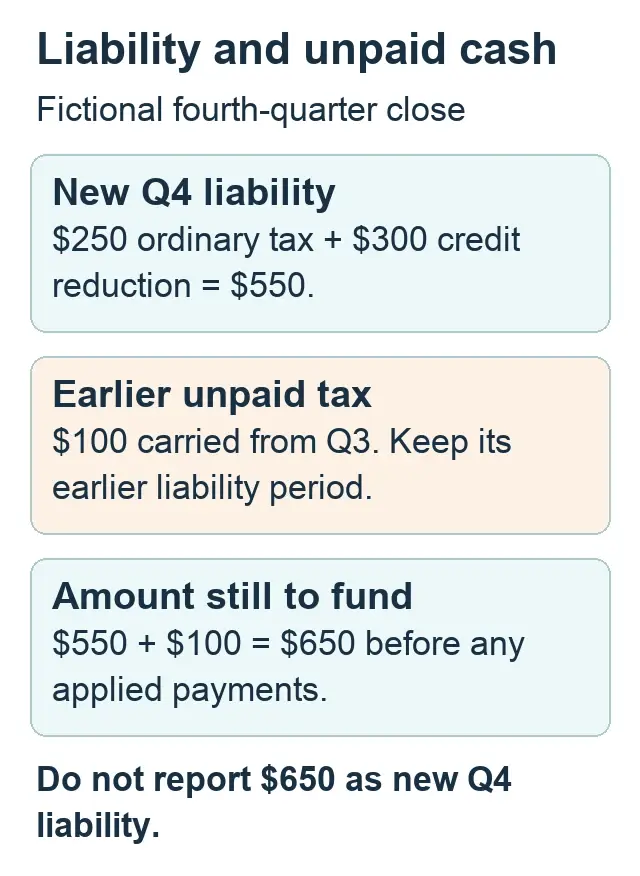
Fictional cash example: $250 ordinary fourth-quarter tax plus $300 credit reduction creates $550 of new fourth-quarter liability. Adding $100 of prior unpaid tax produces a $650 deposit need before any applied payments. Carryover is not new liability.
Reconcile the sum of the quarterly liabilities to the annual tax after adjustments, then reconcile annual tax to deposits, applied credits and any remaining balance or overpayment. A balanced bank account does not establish the annual liability, and a correct annual return does not establish that deposits were timely. Retain both conclusions.
Challenge the provider's annual calculation with three records
Request employee-level FUTA wages, the state credit-reduction calculation and the annual return/deposit reconciliation. The first should identify the federal cap and history used. The second should show the eligible state overlap and final rate. The third should show how the liability and payments reach the intended employer and year. A summary headed tax adjustment does not explain all three.
Use a few deliberate challenge cases rather than comparing only totals. Include a midyear state transfer, a person paid by two providers under the same employer, a person below the annual federal base and any approved state-wage exclusion. Add a special employer-history case only when it actually applies to the business. Ask the provider to show the supporting record and correction path, not merely confirm that it supports multistate payroll.
If the state summary disagrees with the employee detail, locate the first differing segment. Check duplicate history, missing former employees, payment order, a tax exemption or a state assignment. If the annual tax agrees but cash does not, investigate applied deposits, carryover, duplicate funding or a tax-period assignment. Sending every difference back as a rate error can delay the correction that matters.
For a provider switch, name one owner who can reconcile both parties' records. Confirm which party files, whether it received complete prior wages and whether an outgoing provider will still make a year-end deposit. Preserve written answers with the reconciliation so a second operator can explain why the annual figures are complete.
Close the filing record and preserve the correction trail
Before release, the reviewer should be able to trace the state amounts back to capped employee wages and the official determination, explain separate state-credit adjustments, and match the planned payment to unapplied liability. Resolve an unidentified state or employer-history issue before accepting the schedule, rather than giving a blank amount the meaning zero.
Obtain the final return and Schedule A for the actual tax year, confirm the filing deadline and compare the prepared values with the approved bridge. Preserve the filed version, submission acknowledgment or other accepted-filing evidence and the deposit confirmations. If an electronic submission is rejected, the attempted transmission is not the same record as an accepted return.
When a discrepancy emerges after filing, preserve the original calculation and establish what changed: rate year, employee cap, state overlap, excluded wages, provider history or applied cash. The Form 940 instructions describe the amended-return process. A correction to Form 941 uses its own route; it does not automatically correct the annual FUTA return or a state wage report.
Assign the response to any resulting agency notice, including its due date and evidence requested. If a state recertification is involved, reconcile the relevant state account and federal employer identity as well as the amounts. California's FUTA recertification guidance describes how state and federal records can produce an out-of-balance notice. Its historical tax-rate discussion remains labeled for 2025 and is not the source for the 2026 rate used here.
Keep the workpaper and underlying tax evidence under the applicable retention schedule and any hold. The useful final record is a connected explanation: which employer and year, which employee-state wages, which final determination, which additional liability and which accepted filing and payment. That explanation is what lets the next reviewer distinguish a real tax change from a repeated estimate.
Explore more HR and payroll guides in the Decision Guide library.
Visit the Payroll Operations and Controls guides.
Use the Payroll Operations Resource Library for practical payroll tools.

About the author
Ben Scott writes and maintains payroll decision guides for founders and operators. His work focuses on execution realities and how decisions hold up under growth, complexity, and controls and documentation pressure. He works hands-on in HR and leave-management roles that intersect with payroll-adjacent workflows such as benefits coordination, cutovers, and compliance-driven process controls.