
RSU Payroll Withholding: Reconcile Stock Releases With Wages

Updated: 4 days ago

An RSU release is complete for payroll when the approved wage event, employee-tax collection and payroll posting agree. A stock-administration portal can show a completed release while the wage record is still missing, the tax cash is still in transit or the same event has reached payroll twice.
The employer needs a connected record of what became taxable, how withholding was calculated, who supplied the cash and what actually reached payroll and the tax-payment process. A share count alone cannot answer those questions. Neither can a payroll register that has no reference back to the equity event.
This guide is for U.S. payroll, equity-administration and finance teams handling employee restricted stock units, or RSUs. It focuses on ordinary stock-settled releases, with a worked reconciliation, a funding-shortfall example and a copyable RSU Release Reconciliation Card. Deferred, private-company, cross-border and cash-settled arrangements need their own approved treatment before the ordinary example is used.

If equity releases keep creating manual payroll fixes, describe the stock administrator, noncash wage entries and tax-funding handoff to SelectSoftware Reviews. Its advisor-led payroll software matching can help you explore providers; ask each proposed provider to demonstrate the specific equity-to-payroll process you need.
Contents
Define the event payroll is being asked to record
Start with the award agreement and the actual release record. An RSU is generally a promise to deliver stock or cash after specified conditions are met. It differs from restricted stock that has already been transferred subject to restrictions. Grant, vesting, release and brokerage settlement are separate fields in the intake record, even when some dates coincide.
For stock-settled RSUs, the IRS describes the general income-tax event as the transfer of the shares; cash-settled RSUs generally enter income when cash is paid. Many ordinary releases occur at vesting, which can make the dates look interchangeable. Preserve the actual transfer or payment evidence so the process still works when they differ.
Social Security and Medicare (FICA) timing needs a separate determination. The IRS explains that an RSU arrangement can fall under the special timing rule for nonqualified deferred compensation, with FICA recognition before the later income-tax event. Payroll should receive an approved date and basis for each tax, including any amount already taken into account. A single column labelled vest date is inadequate for that decision.
Ask the tax owner to approve the award type, recognition dates, valuation method, employing entity and relevant jurisdictions. Keep the approval with the event. A release file can carry the approved result into payroll, but its column headings do not establish the legal treatment.
Route unusual cases explicitly. A valid section 83(i) election can defer federal income inclusion for eligible qualified equity grants while leaving Social Security, Medicare and FUTA treatment unaffected. Deferred settlements, changed vesting conditions and releases after employment ends also deserve a documented review. Do not process those cases by copying the ordinary release's tax settings.
For an employee who worked in multiple jurisdictions during the award period, obtain the approved sourcing and withholding instructions before posting. Record the work-history information supplied to the reviewer and the allocation returned. The employee's current address is useful evidence, but it is not a substitute for the equity award's jurisdiction analysis.
Join the stock record to the wage entry and cash receipt
Use a durable event key that connects the equity administrator's release, the payroll entry and finance's funding record. An employee ID plus a grant ID may still be insufficient: one grant can vest in multiple tranches, and a tranche can generate an original release followed by a correction. Include the release identifier or another approved sequence that distinguishes those events.
Retain the source file's version, receipt time and owner. Record whether it is a forecast, an approved instruction or a final settlement result. Forecasts help treasury prepare cash; they should not become wage entries merely because their layout resembles the final file.
Before an import, compare the event keys with the posted-event register. A rerun should identify existing events rather than silently create another wage payment. If a file has been corrected, identify what it replaces and whether the instruction is a replacement value or a change amount. Preserve the earlier version and the connection between them.
For example, an approved wage amount changing from $5,000 to $4,800 requires a supported $200 reduction if the original $5,000 was already posted. Loading the full $4,800 as another positive event produces $9,800. The correction record must tell the operator which method the receiving system expects and show the result after processing.
Keep the three owners visible. Equity administration confirms the award and release facts. Payroll confirms the wage, tax and employee cash-pay effects. Finance or treasury confirms the cash route and tax payment. One person can hold more than one role in a small organization, but the evidence still needs to answer all three sets of questions.
Build withholding from the employee's actual tax position
An RSU withholding percentage in a stock portal is an instruction to examine, not proof that the payroll result is correct. Confirm the applicable wage bases, withholding method, year-to-date amounts and approved jurisdiction treatment. The employee-tax amount and the employer's additional tax cost belong in separate columns.
For 2026 federal income tax withholding, separately identified supplemental wages may qualify for the optional flat 22% method when the regular-wage withholding condition is met. The condition concerns income tax withheld from regular wages in the current or immediately preceding calendar year. The aggregate method is another permitted route; the chosen method must fit the actual circumstances.
The mandatory rule for supplemental wages above $1 million is different: the excess is subject to the highest federal income tax rate, 37% for 2026. Review the employee's applicable supplemental-wage history rather than testing this release alone. Include relevant payments from businesses under common control, as the IRS requires. A large release can cross the threshold partway through the payment.
Under the optional flat method, 22% is the specified rate, not a starting point for an arbitrary percentage. Handle requests for additional federal withholding through a permitted payroll method and the appropriate employee instruction. Explain that withholding is a payment toward the employee's eventual tax liability; it does not determine the final tax on the award.
Social Security, Medicare and any Additional Medicare Tax require their own calculations. Consider the employee's relevant wage history and the approved recognition dates, including prior FICA inclusion under a deferred arrangement. Do not assume the federal income-tax wage amount is automatically the incremental Social Security wage amount.
The release reconciliation should show each employee withholding component and the employer charges separately. This makes a difference in a funding conversation: shares or employee cash intended to cover employee withholding do not, by themselves, supply the employer's own tax contribution.
Identify who supplies the tax cash
Fidelity describes three common award-withholding methods: net shares, sell to cover and cash payment. The employer's plan determines which methods are available and whether the participant can choose. Read the actual plan instructions, including rounding and any excess-cash treatment, before converting a tax amount into shares.
With net shares, the company retains shares from the release and delivers the remainder. The retained shares represent the employee's tax funding under the arrangement. Treasury still needs a cash route for the tax deposit. A record showing shares retained is different from a bank confirmation showing dollars available to pay the tax authority.
With sell to cover, shares are sold and sale proceeds help fund the withholding. Reconcile the actual execution price, shares sold, fees and cash remitted. The price used to calculate the wage event can differ from the later sale price. Keep those values separate so a cash difference does not silently change the approved compensation.
With cash payment, identify who collects the cash, where it arrives and how it is matched to the release. A participant's statement that money was sent is a lead to investigate. The completion record needs receipt evidence and the amount actually credited to the event.
Use a funding route with named accounts, deadlines and owners. Specify whether the broker sends money to the employer, a payroll provider or another authorized party, and which party makes the tax deposit. Verify the actual arrangement instead of assuming that a stock administrator also performs the employer's payroll-tax work.
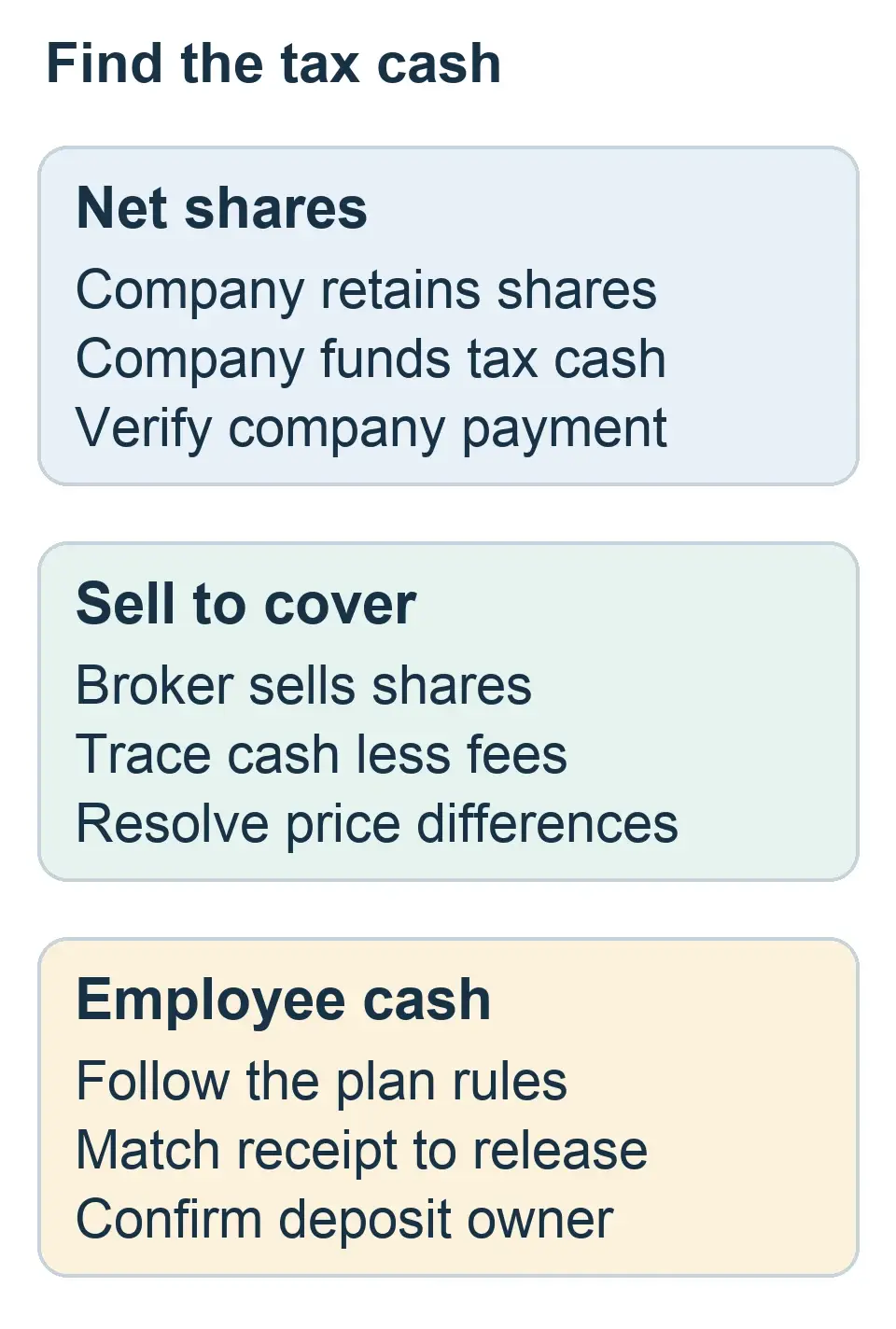
Each method needs cash evidence matched to the event. A share status or an employee payment instruction does not establish a completed tax deposit.
Work through a release with whole-share withholding
Consider a fictional ordinary release of 100 RSUs settled in shares at an approved fair market value of $50 per share. The employee paid nothing for the shares. The tax reviewer has confirmed that the income-tax and FICA recognition dates coincide for this event, with no earlier FICA inclusion or deferral election to account for.
Assume the entire release qualifies for the optional 22% federal supplemental-wage withholding method. The employee remains below the applicable Social Security wage base and Additional Medicare withholding threshold after this release. For illustration, the approved state withholding amount is $250; this is an assumed amount, not a statement of any state's rate or sourcing rule.
The approved wage value and employee withholding are:
Compensation: 100 shares × $50 = $5,000.
Federal income tax withholding: $5,000 × 22% = $1,100.
Employee Social Security: $5,000 × 6.2% = $310.
Employee Medicare: $5,000 × 1.45% = $72.50.
Assumed state income tax withholding: $250.
Total employee withholding: $1,732.50.
These federal rates are the 2026 rates used under the stated assumptions. The employer's Social Security and Medicare contribution in this example is another $382.50. That figure illustrates employer FICA only; it is not a complete calculation of unemployment taxes or every possible employer cost.
Now assume the plan permits whole-share withholding rounded up, followed by a cash return of the excess to the employee. The share calculation is $1,732.50 ÷ $50 = 34.65 shares, rounded to 35 retained shares. The employee receives 65 shares. The retained value is $1,750, which exceeds the employee withholding by $17.50.
The record should therefore connect $5,000 of wages, $1,732.50 of employee withholding, 35 retained shares, 65 delivered shares and the separately verified $17.50 cash return. At the example's $50 valuation, the delivered shares plus the cash return total $3,267.50, equal to $5,000 less $1,732.50.
That equality is a reconciliation of this hypothetical plan's treatment. Another plan may handle fractional shares or rounding differently, including a different treatment of excess value. Record the authorized treatment actually used. Do not adopt the example's cash-return rule just to make a worksheet balance.
For the example's tax components, $2,115 of total funding is needed: $1,732.50 for employee withholding plus $382.50 of employer FICA. Other employer liabilities would be additional. Confirm who supplies that cash and who returns the $17.50. Posting $1,750 as employee taxes solely because that is the retained share value would overstate the approved withholding.
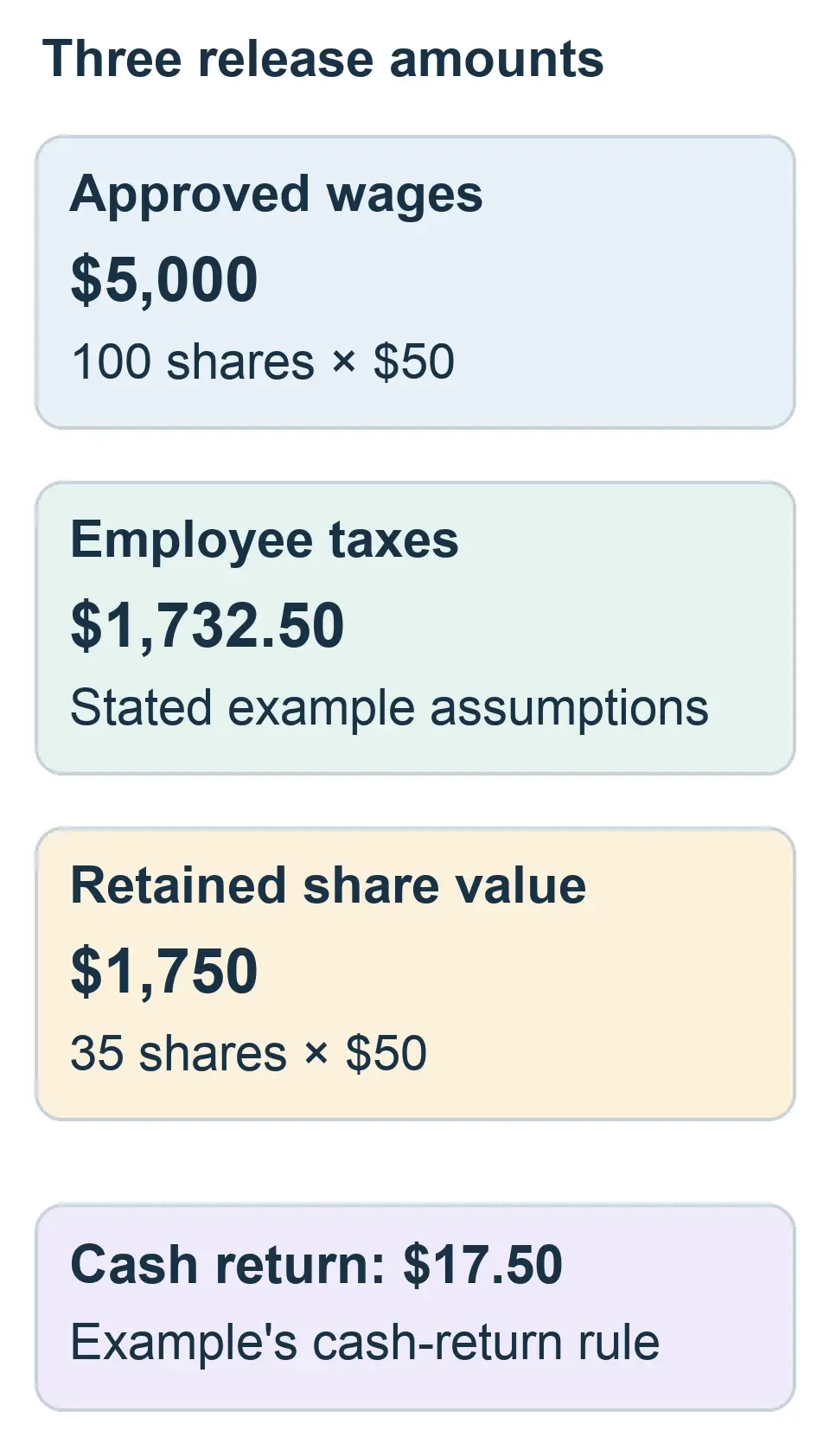
The tax amount, retained share value and wage value have different jobs. The example assumes whole-share withholding and an authorized cash return of excess value.
Resolve a sell-to-cover shortfall before closing the event
Keep the same $5,000 wage value and $1,732.50 employee-tax requirement, but change the funding method. Suppose the broker sells 35 shares at $48 and deducts $10 in transaction fees before remitting the proceeds. The cash received is 35 × $48 less $10, or $1,670.
The employee-tax funding difference is $62.50. The approved wage value does not become $4,800 merely because the later sale price is $48. Record the sale's price and fees in the funding reconciliation while preserving the approved wage valuation unless there is evidence that the wage valuation itself was wrong.
Assign the shortfall to an owner before calling the event complete. The company may need to supply temporary cash to meet its obligations while the permitted recovery or final treatment is resolved. Employee payment, recovery through payroll and employer-paid tax treatment have different requirements; the plan, payroll and tax owners must approve the applicable route.
Do not automatically deduct $62.50 from the employee's next cash paycheck. Confirm the lawful authorization and implementation method for any recovery. If the approved recovery makes up under-withheld federal tax from later pay, Publication 15 requires income tax and Additional Medicare Tax to be recovered by the calendar year's final day. If the company will permanently bear an employee tax, determine the resulting wage or gross-up treatment rather than writing off the difference as an unexplained processing cost.
Finance's cash requirement for the example's included taxes is still $2,115. With $1,670 received from the broker, the remaining funding is $445: $382.50 of employer FICA plus the $62.50 employee-tax shortfall. Separating those components prevents the employer contribution from being mistaken for a missing broker payment.
The case remains open until the actual payroll withholding record, cash receipt, deposit and approved shortfall treatment agree. If the withholding record itself needs correction, preserve the original and corrected amounts with the reason. A bank receipt alone does not authorize a tax-record change.
Take these requirements into a payroll software conversation
Comparing payroll systems for equity compensation? Describe your stock-release imports, tax-cash records and reconciliation needs to SelectSoftware Reviews, then ask proposed providers to demonstrate the complete handoff.
Post the compensation once and test the cash-pay effect
Before the first live event, obtain the payroll provider's supported procedure for externally settled equity. The result needs to record the approved wages and withholding while reflecting the fact that the stock value was delivered outside the cash-pay process. Earnings, offsets and external-tax credits differ by platform and configuration; test the complete result rather than copying another employer's code names.
Use a controlled before-and-after calculation for one event. Compare the employee's ordinary cash wages and deductions with the version that includes the equity release. Explain every change in taxable wages, withholding, net cash pay and year-to-date totals. Keep the event ID and the payroll calculation version with the evidence.
If all employee taxes in the worked example are funded through the equity arrangement, the release should not also collect the same $1,732.50 from ordinary cash pay. Conversely, a legitimate approved cash collection should not disappear because an operator entered an external-tax credit that was never funded. The correct cash-pay effect depends on the approved funding facts.
Test the noncash compensation entry together with the related settlement and tax-collection entries. A noncash offset can prevent a second delivery of the stock value in cash, yet still leave a negative net result if the externally funded withholding has not been represented correctly. Review the provider's complete procedure and the final calculation; a single balancing code is insufficient evidence.
Check event identity again after processing. A stock file, a manual adjustment and a year-end catch-up can all refer to the same release. Reconcile the posted event register with the equity population and identify duplicates, omitted releases and superseded instructions. A matching batch total can conceal one duplicated employee and one omitted employee of equal value.
For an error, record both the employee-level effect and the tax-period effect. Identify whether the remedy changes cash pay, tax collection, taxable wages, reporting or several of those. Use the applicable correction route and preserve the original event instead of making an unexplained balancing adjustment in a later run.
Across releases, classify recurring differences by cause: timing, valuation instructions, duplicate files, cash routing or payroll configuration. Assign a specific change and check its result in a later release. That gives the team a reasoned operational fix instead of another unexplained manual adjustment.
Put the deposit clock on the event
Assign the tax-liability date and deposit deadline as part of release preparation. The broker's remittance timetable and the employer's normal payroll processing date may be later. Treasury needs an approved funding plan that works with the tax deadline, including a contingency if sale cash or employee cash arrives late.
For federal employment taxes, the IRS's $100,000 next-day rule can require a deposit by the next business day when accumulated taxes reach the threshold during a monthly or semiweekly deposit period. The test concerns tax liability, not the stock award's gross value or a single employee's tax amount. Include the other relevant federal payroll liabilities in the review.
Have the responsible tax owner determine the applicable rule and date for the actual equity arrangement. Do not build a deposit schedule from an old stock-plan presentation or assume that a reference to securities trade settlement gives payroll an automatic extension. The SEC's T+1 explanation concerns securities transactions; it does not replace the employer's employment-tax analysis.
Retain the deposit instruction, payment confirmation and reconciliation to the liability record. If a provider pays the tax, establish how the employer receives evidence of the payment and learns about a failed debit or rejected instruction. A file marked accepted by a payroll portal is one processing milestone, not the final cash evidence.
Build the release calendar jointly with equity administration and treasury. Include forecast delivery, final valuation, payroll acceptance, funding availability and deposit confirmation. Mark which steps can use estimates and which require approved final values. Changes to release timing should trigger a review of the dependent cash and payroll deadlines.
Carry separate tax histories into W-2 review
Reconcile the approved equity events to the employee's annual wage and withholding totals before releasing tax forms. Use separate columns for federal income-tax wages, Social Security wages and Medicare wages, with the approved timing history behind each. A prior FICA inclusion can explain why a later income inclusion does not produce the same incremental amount in every wage box.
The 2026 W-2 instructions identify Code V as income from exercising nonstatutory stock options. An ordinary RSU release should not receive that code simply because it is equity compensation. Use the current instructions and the approved arrangement-specific mapping, including any genuinely applicable deferred-compensation reporting.
Section 83(i) has its own reporting requirements, including Codes GG and HH for the specified inclusion and deferred balance. Treat an election as a documented special route with an owner and supporting records. Do not add those codes to every private-company award or assume that an income-tax deferral also defers FICA.
Review the event population as well as the dollars. Releases after termination, amended releases and events spanning different recognition dates can be missed if the year-end process only scans active employees or the most recent stock file. Compare the approved-event register with the posted payroll events and investigate unmatched records.
Keep the employee's brokerage reporting question separate from the employer's wage-record investigation. A sale of shares can produce a Form 1099-B as well as compensation reported through payroll. Give the employee the release date, approved compensation amount and relevant stock-plan documents so the employee or adviser can examine the sale and cost basis. The existence of both forms does not, by itself, prove duplicate payroll wages.
If the employer's wage or withholding record is wrong, follow the applicable payroll and information-return correction process. If the wage record is correct but brokerage basis needs review, explain the records the employer can supply and direct the separate tax-return question appropriately. Avoid promising that changing W-2 wages will solve every stock-sale reporting issue.
Use the RSU Release Reconciliation Card
Copy this card into the employer's controlled workspace for each release or supported adjustment. Use employee and event identifiers with restricted evidence links rather than placing personal tax or brokerage information in a broadly shared document. The card records an approved tax treatment; it does not determine the legal treatment of an unfamiliar award.
Release and tax basis
1. Event identity: Record the employee ID, employing entity, grant, tranche and release or adjustment ID. Identify any event this one replaces.
2. Award instructions: Link the agreement, release instructions and approval of the award type, conditions and relevant jurisdictions.
3. Recognition dates: Record grant, vesting, share-transfer or cash-payment dates, plus the separately approved income-tax and FICA recognition dates and any earlier inclusion.
4. Approved valuation: Record shares or units, fair market value, currency, any approved exchange rate, employee purchase amount and the source of the wage value.
Basis note: retain the tax owner's decision when dates differ or an election, deferral, employment change or jurisdiction question affects treatment.
Wages and withholding
5. Compensation amount: Show the approved current-event wage value and whether the receiving system expects a full value, replacement or change amount.
6. Tax bases: Record the incremental wage amount for each applicable tax and the year-to-date or prior-recognition evidence used.
7. Withholding method: Record the approved federal method, applicable supplemental-wage history and state or local instructions, with the reviewer.
8. Employee taxes: List each employee withholding component and its amount, then calculate the total employee-tax requirement.
9. Employer charges: List employer tax components separately, with any additional costs outside the employee withholding calculation.
Calculation note: distinguish a tax-liability difference from a share-price, fee, rounding or cash-collection difference before choosing a correction.
Shares and cash
10. Funding route: Identify net shares, sell to cover or cash; name the party collecting funds, the receiving account and the party making the deposit.
11. Share result: Record shares retained or sold, shares delivered, actual sale price where relevant and the authorized rounding treatment.
12. Cash evidence: Link receipts, broker remittance and fees, company funding and any cash returned to the employee; identify which event each amount covers.
13. Funding variance: Compare approved employee taxes with actual funding, separate employer charges and record the owner, deadline and approved treatment of any difference.
Funding note: retained shares and pending sale proceeds need a cash route. An event remains open when the required payment or recovery treatment is unresolved.
Posting and completion
14. Payroll result: Record the payroll run and version, posted wage and tax amounts, year-to-date changes and the explained effect on ordinary cash pay.
15. Population check: Confirm the event was posted once, identify superseded entries and match the approved equity population to payroll's event register.
16. Deposit evidence: Record the approved liability date, deposit deadline, funding owner, payment reference and confirmation of the completed payment.
17. Employee records: Identify the release and compensation information supplied, the applicable annual reporting mapping and any separate brokerage question or correction case.
18. Closure decision: Name the reviewer, unresolved issues and required evidence, or record approval once wages, shares, cash, withholding and payment evidence reconcile.
Completion note: close only the event that the evidence supports. A completed stock release, payroll import or bank transfer may leave another part of the reconciliation unfinished.
Use your requirements to guide the provider search
Take your RSU Release Reconciliation Card into an optional payroll software conversation with SelectSoftware Reviews. Confirm equity support with each provider and retain your own tax, funding and accounting review.
Explore related payroll resources:

About the author
Ben Scott writes and maintains payroll decision guides for founders and operators. His work focuses on execution realities and how decisions hold up under growth, complexity, and controls and documentation pressure. He works hands-on in HR and leave-management roles that intersect with payroll-adjacent workflows such as benefits coordination, cutovers, and compliance-driven process controls.


