
Equity Payroll Migration: Preserve Events Across Providers

Updated: 3 days ago

An equity transaction can appear twice in a payroll conversion without representing two awards. The old provider may already have included it in year-to-date wages, while the stock administrator sends the same transaction in the new provider's first file. Importing both records as new earnings can duplicate compensation. Omitting the stock file entirely can lose the genuinely unprocessed events mixed into it.
For an equity payroll migration, build an event-by-event bridge between the stock administrator, the departing payroll provider and the receiving provider. Identify the event and version, establish what each system has already recorded, and assign the remaining wage, tax-cash and reporting work. A matched year-to-date total supports the balance transfer, but it does not identify which events remain unfinished.
This guide is for U.S. payroll, equity-administration and finance teams changing payroll providers while the legal employer and EIN remain the same. It covers migration controls rather than calculating every kind of stock compensation. An acquisition, employer transfer, PEO exit, cross-border award or disputed tax treatment requires its own approved instructions before the records move.

If equity history is a difficult part of your provider switch, take the stock administrator's event file and your required handoff to a free SelectSoftware Reviews advisor consultation. Use the discussion to explore payroll options, then ask each proposed provider to demonstrate its historical imports, equity processing and correction responsibilities.
Contents
Establish the equity population outside the payroll export
Start with the stock administrator's event records and the employer's award inventory. A grant register shows what was awarded; it does not necessarily show every exercise, settlement, cancellation or correction that payroll must consider. Ask for both the population of arrangements and the transaction detail needed to explain the payroll history.
Include the people who can fall out of an ordinary active-employee conversion: former employees with remaining equity activity, employees on leave, transferred workers and people whose payroll identifier changed. Reconcile those identities with the responsible employer. Do not create an active employment relationship merely to make a historical equity record import.
The event population should distinguish completed transactions, approved but unprocessed instructions, forecasts, reversals and corrections. Keep forecast releases available for cash planning without treating them as approved wages. Retain cancelled transactions in the reconciliation with their status so reviewers can explain why they did not enter the opening balance.
Use a cross-reference between the stockholder identifier, old payroll employee ID and new payroll employee ID. Preserve the original identifiers as text, including leading zeros. A match on name alone is weak evidence when employees have changed names or the stock administrator has separate records for the same person.
Ask equity administration to confirm the plans, populations and date range covered by each export. An export limited to one plan or current employees can balance internally while omitting another group. Record the filters and extraction time with the file, then compare event counts and amounts against an independently obtained stock report.
Carta's documented Exercised and Settled report illustrates the useful detail: it distinguishes option exercises and RSU settlements and can include a payroll ID when one was entered. Check the actual exported columns and permissions in your account. A product report's name is not evidence that every historical event, tax determination or payroll posting is present.
Carry the tax determination with the event
Keep the award type and approved tax treatment attached to each event. Restricted stock, restricted stock units, nonstatutory options and statutory options should not all inherit a generic “stock income” mapping. The IRS distinguishes statutory and nonstatutory options; their treatment is not interchangeable.
Preserve the grant, vesting, exercise, share-transfer or cash-payment dates that are relevant to the arrangement. Record the separately approved income-tax and employment-tax recognition dates and bases. Restricted property, deferred RSUs and other arrangements can have different rules. The cutover date must not replace a tax date simply because the new system accepts only one date field.
For deferred compensation within the special FICA timing rules, amounts may be taken into account before the later payment. Preserve any earlier inclusion and the specialist's instruction for the later event. Escalate an import design that would tax the same amount again or erase the prior inclusion.
The migration team should transport an approved result, with its source and reviewer, rather than infer treatment from an earning-code label. Where the records disagree, keep the item unresolved for the tax owner. A technically successful import is not a substitute for the missing determination.
Retain the state and local allocation instructions supplied for the award, including the supporting work-location history. Do not replace an award-period allocation with the employee's current home address during conversion. International service, employer changes and unusual deferral elections need explicit specialist review; this guide does not establish their tax treatment.
Preserve reporting distinctions as well. The 2026 W-2 instructions require code V for income from exercising nonstatutory stock options and distinguish statutory options. An undifferentiated stock-wage total can lose that reporting information even if gross wages agree. The receiving provider needs the applicable reporting fields or a documented supported alternative.
Give each record one migration instruction
Separate four destinations before building the import file:
Evidence archive: retain the record to explain the award or event. It does not create a wage entry.
Opening history: carry amounts already recorded through the agreed boundary into the receiving provider's historical balances and reporting setup.
Live processing: send an approved event or remaining obligation that has not yet been completed to its assigned processor.
Correction route: connect an amended instruction to the original event and determine which history, payment, deposit or return needs correction.
These are recommended operating categories, not tax classifications or universal software functions. Ask the receiving provider how each category is represented in its actual import and processing routes. Some history stays in a controlled archive while supported opening totals enter payroll. The acceptance evidence must show which route was used.
Agree on a boundary for each stream. The old provider may have finished its final ordinary payroll while equity administration is still settling a transaction or finance is waiting for cash. “Everything before launch is old payroll” leaves those unfinished obligations without an owner.
Write down the final old-provider posting included, the stock export's extraction time, the receiving provider's opening-balance version and the first live event it will accept. Name the owner who resolves events that cross those boundaries. Define a late-change cutoff and an urgent route for obligations that cannot wait for the next conversion batch.
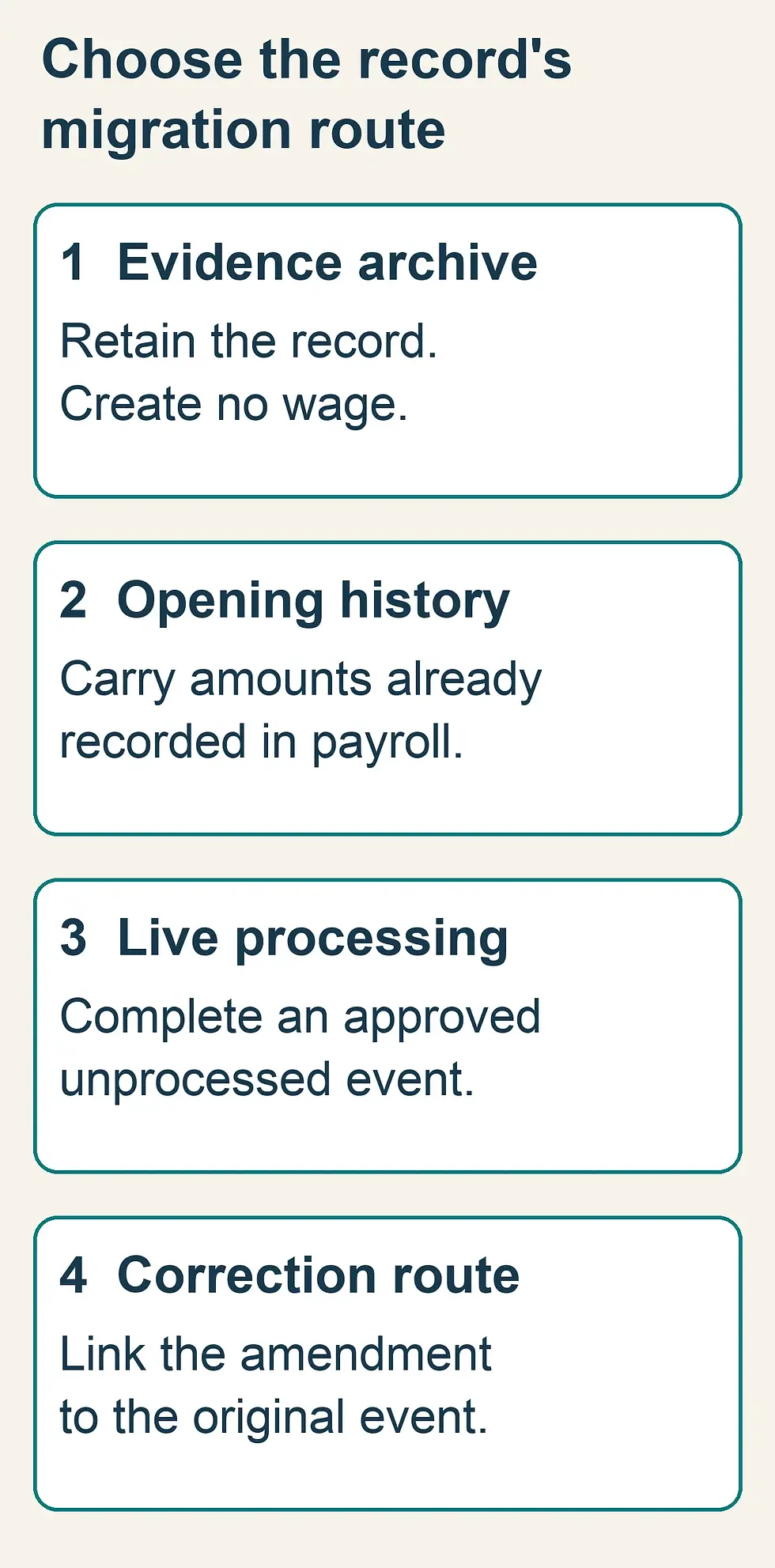
Choose the instruction from the event's approved treatment and recorded status. A file's arrival date does not decide whether it creates new wages.
Before loading a pending event, check whether the old provider posted it after the baseline was extracted. A final delta export and the posted-event register should answer that question. If neither party can establish the status, resolve it before either treats the event as a new earning.
Prevent replays without discarding corrections
Create an event key that survives both payroll systems. It should identify the employer, person and specific stock transaction or tranche event. Keep the stock administrator's original event identifier alongside that key. A grant ID alone is insufficient when the same grant produces several transactions.
Add a version or change sequence, the source-file reference and the processing status. Two records with the same event key and version may be a replay. A later version may instead contain a legitimate amendment. Route each deliberately rather than deleting every repeated key.
For corrections, distinguish a replacement amount from a change amount. If an event previously recorded at $8,400 is corrected to $8,000, the replacement value is $8,000 and the change is negative $400. Applying a replacement file as an additional positive earning would produce $16,400. Applying the negative $400 twice would reduce the event to $7,600.
Preserve the original posting reference, approved amendment, chosen implementation method and resulting balance. The same correction may need coordinated updates in the stock archive, opening payroll history and reporting records. Do not assume that changing one system automatically changes the others.
A receiving system may not support the source event key as a dedicated field. In that case, maintain a controlled cross-reference between the external event key, import batch, receiving transaction ID and final result. Test that a reviewer can retrieve the connection without depending on one operator's inbox.
Include deliberate retry tests in the conversion rehearsal. Submit an already accepted event to the test route and establish how it is blocked or identified. Then submit an approved amendment and verify that it remains distinguishable from a duplicate. Never run an uncontrolled replay against live payroll to discover the behavior.
Reconcile opening wages without creating another payment
Build the opening-balance reconciliation by employee and applicable tax basis. Keep federal income-tax wages, Social Security wages, Medicare wages, relevant state or local wages and the associated withholding separately identifiable. Preserve required cumulative histories for later withholding decisions rather than importing one equity gross amount into every field.
Reconcile ordinary pay and equity pay to the combined payroll totals, while retaining an equity-event schedule that explains the equity portion. Then compare the final approved old-provider balances with the receiving provider's accepted historical balances. Check both employee detail and control totals; equal overstatements and omissions can cancel in a company total.
Consider a fictional employee with $96,000 of ordinary wages and an equity event originally recorded at $8,400. The relevant approved income-tax wage history is initially $104,400. A supported correction reduces that equity event to $8,000, making the corrected history $104,000. These figures illustrate record movement, not a calculation of withholding or every tax base.
If the correction is approved before the opening history is accepted, refresh the baseline and import $104,000 through the supported history route. Keep the earlier $104,400 version marked superseded. The stock archive can retain the $8,000 event detail without posting another $8,000 in new payroll.
If $104,400 was already accepted, use the provider's approved historical-adjustment process to reach $104,000 and connect the negative $400 change to the original event. Have the tax owner determine any related tax, deposit and return corrections. A current-payroll negative earning is not automatically the correct way to fix earlier history.
Now suppose a different approved equity event of $3,600 belongs in subsequent processing under the event's tax instructions. Once posted correctly, the example's income-tax wage history becomes $107,600. An import that instead starts at $104,000 and adds both the archived $8,000 and the new $3,600 produces $115,600, exposing a replay of completed history.
Check the employee's cash-pay effect separately. Historical imports and noncash equity postings can require different supported treatments. Do not use an unexplained deduction to make net pay look reasonable. Verify the earning, offset, withholding, cash payment and employer-tax effects against approved instructions in the rehearsal.
Keep unfinished cash and deposits visible after the switch
Create a separate outstanding-work list for events whose wages were recorded but whose funding or tax-payment work remains open. Identify the amount, responsible party, destination account, required action and due time. Carry that list into the handoff even when the wage event is correctly excluded from new earnings.
For example, an event can be included in the old provider's accepted wage history while money expected from a broker remains unreceived. The receiving provider should not create another wage merely to collect that cash. Finance needs the receivable or funding record, payroll needs the recorded tax liability, and the authorized payer needs instructions and money for the deposit.
Keep share activity, cash movement and tax-payment evidence connected but distinct. Shares withheld or sold do not establish that cash reached the payer. A bank debit does not, by itself, establish the correct tax period, employer account or accepted deposit. Record the evidence needed to follow the actual route.
Confirm who pays any employer tax and who covers a temporary cash gap. Do not delay a required deposit while waiting for a stock sale or provider migration to finish. Under the federal $100,000 next-day rule, accumulating the threshold in a deposit period can require payment by the next business day. Have the tax owner apply the actual schedule, including other payroll liabilities.
The employer generally remains responsible for federal payroll-tax duties when using a payroll service provider. The IRS distinguishes other third-party arrangements, so confirm the actual relationship and authorization rather than treating every vendor as the same kind of agent. Name both the operator performing the work and the employer reviewer confirming the outcome.

A historical wage can be complete while a cash or deposit task remains open. Transfer the unfinished task without recreating the wage.
For each pending item, agree how the departing provider reports a late completion or failure and how the receiving team updates the shared record. Close the task with the actual result. “Sent to new provider” records a handoff, not a completed obligation.
Reconnect the stock feed only after testing its direction
An integration label does not tell you which records move or which system remains responsible. Ask the provider and stock administrator to document the direction, objects, filters, frequency and historical starting point. Determine whether the connection moves employee identities, compensation reference data, taxable events, payroll results or some narrower set.
For example, Gusto's Carta integration documentation describes daily employee and payroll data syncing to support employee updates. That description does not establish that the connection imports all historical stock events into payroll or performs their tax deposits. Obtain specific confirmation for the workflow your migration requires.
Decide how IDs will change when the old connection is disabled and the new one begins. If the stock system stores an old payroll ID, preserve its cross-reference before replacing it. Confirm how former employees, multiple employment records and rejected identities are handled.
Test the first extraction window. A “since last sync” cursor may start differently from a manually supplied historical file. Ask what happens to transactions amended after that cursor, and retain an independent event list for comparing expected and received results. Do not assume a restart knows which historical events payroll already included.
Choose a controlled transition from test to live. Record which feed is authoritative for each population, stop duplicate instructions from the retiring route and reconcile the first live batch against the approved population. Keep an alternative approved processing route for a timely event if the connection fails.
A useful vendor demonstration should show a completed event already in history, an unprocessed event, an amended event and an unmatched former employee. Ask for the resulting payroll references and exception output, not only a screen showing a successful connection.
Before choosing a provider for an equity-heavy payroll, ask how it distinguishes imported history from new events and how it handles a corrected release. A SelectSoftware Reviews advisor can help you consider payroll services to evaluate; confirm the actual event, reporting and support scope with each candidate.
Work from an Equity Cutover Event Ledger
Use the ledger below for one migration batch and repeat the event section for each transaction. Keep sensitive documents in the approved restricted repository and enter access-controlled references in the working copy. Do not put employee tax identifiers or unrestricted bank details into a broadly shared worksheet.
The ledger supplements the payroll system; it does not replace approved tax calculations or the employer's records. A blank field is a question to resolve. Enter “not applicable” only with a reason, so an omitted obligation is distinguishable from a reviewed exclusion.
Migration header
Employer and scope: Legal employer, EIN reference, covered plans, populations and jurisdictions: ______
Boundary and files: Last old-provider posting, stock export time and filters, opening-history version and first receiving run: ______
Identity map: Controlled location of stockholder, old payroll and new payroll cross-references; unresolved people: ______
Owners and urgent route: Equity, old payroll, receiving payroll, tax and treasury contacts; next deadline and escalation contact: ______
Keep this header with every batch version. A changed population or boundary needs a new reconciliation basis.
Event entry, repeated for each transaction
Event identity: Employer/person references, source transaction or tranche ID, award type and grant reference: ______
Version and source: Original or amendment, sequence, source-file reference, approval and superseded event/version: ______
Tax instructions: Approved recognition dates, valuation and separate tax bases; prior inclusions and allocation instruction reference: ______
Already recorded: Old-provider transaction, recorded wages/withholding, tax period and source evidence; or verified unprocessed status: ______
Migration instruction: Archive, opening history, live processing or correction; receiving route and responsible processor: ______
Amount meaning: Replacement amount or change amount, original accepted value, approved result and expected effect: ______
Share and cash work: Relevant share result, cash expected/received, open funding amount and treasury owner: ______
Tax-payment work: Liability period, deposit owner, due time, payment status and confirmation reference: ______
Receiving result: Import batch/transaction, accepted history or live wage effect, cash-pay effect and rejection/retry status: ______
Reporting and closure: Filing owner, reporting fields, outstanding correction, final evidence and reviewer: ______
Retain the event even when the migration instruction is archive only. Record a linked follow-up when the wage is settled but cash, a deposit or a filing correction remains open.
Batch acceptance
Population proof: Expected and received people/events by type and status; unmatched, missing, duplicate and cancelled records explained: ______
Balance proof: Final old history versus accepted opening history, by employee and tax basis; equity detail tied to combined payroll: ______
Replay and amendment proof: Rehearsal evidence showing a replay cannot silently create pay and a correction reaches the approved value once: ______
Open-work proof: Every remaining wage, cash, deposit or reporting action has an owner and due time; urgent actions independently scheduled: ______
Release decision: Approved batch/version, reviewer, unresolved exceptions and their effect on launch or an alternative processing route: ______
Accept the specific batch and remaining obligations. Avoid a general “conversion complete” signoff that hides unfinished events.
Leave the reporting owner a reproducible history
Assign who will prepare, file, correct and furnish the relevant wage statements and payroll returns. For a same-employer provider switch, document how historical and subsequent wages feed that reporting process. Confirm the arrangement with both providers; do not assume the last provider automatically takes responsibility for every earlier adjustment.
Give the reporting owner the event schedule, accepted opening balances, later postings and all supported corrections. Maintain the mapping from equity earning types to tax bases and reporting fields. Check a representative employee from the stock event through payroll history to the draft reporting output.
Retain the original tax periods for unresolved issues. The timing and treatment of a prior-year correction can differ from a current-year adjustment. An import problem does not authorize moving the correction into whichever year the receiving system finds convenient. Obtain the appropriate correction instructions and retain proof that the responsible filer acted.
Make employee communications specific to the actual change. Explain where statements will be available, who answers questions about an equity wage and how an employee reports a missing or duplicated event. Do not describe a provider-generated statement as a new stock award or imply that moving payroll changes the employee's equity terms.
Preserve accessible records before ending the old service. Publication 15 generally requires employment-tax records to be kept for at least four years; some records or circumstances require longer retention. Keep the award/event support, approved tax instructions, historical payroll detail, filed returns and payment confirmations needed to reconstruct the handoff under the employer's retention policy.
A final export is useful only if the receiving team can open it, interpret the fields and retrieve the underlying evidence. Test that access with someone who did not prepare the migration. Document any vendor access that ends at termination and the owner of future corrections.
Accept the handoff through difficult events
Approve the conversion when the event population, accepted history, first live processing and remaining obligations can be explained together. A clean first ordinary payroll does not establish that an equity stream transferred correctly. Review the first equity activity and the first relevant reporting output as separate milestones.
Select difficult examples deliberately: an already recorded event that appears in a new feed, an approved event awaiting processing, a corrected transaction, a former employee and an event with unfinished tax cash. Include an applicable earlier tax inclusion or multi-jurisdiction allocation when those exist in the actual population. Test the exceptions you have rather than inventing an irrelevant test set.
Investigate a missing event without immediately importing the entire source file again. Establish which transactions were accepted, which failed and which remain unknown. Preserve the accepted result while sending only the approved recovery instruction. A full replay can turn a partial failure into duplicate wages.
Keep unresolved tax facts and unsupported system behavior visible in the launch decision. Where a required event cannot be processed correctly or on time, use the authorized contingency and responsible specialist's instructions. Do not accept an unexplained balance difference because the overall conversion is almost finished.
The practical endpoint is a history another reviewer can reproduce: each event has a durable identity, a justified migration instruction and evidence of the work completed or still due. Retain heightened equity review until the first live events, pending cash and reporting handoffs have demonstrated that those connections survived the switch.
Bring the unresolved work in your Equity Cutover Event Ledger to a SelectSoftware Reviews advisor discussion if you need help comparing payroll options. Evaluate the proposed service against the records, deadlines and responsibilities your team must preserve.
Explore payroll decisions and provider support:

About the author
Ben Scott writes and maintains payroll decision guides for founders and operators. His work focuses on execution realities and how decisions hold up under growth, complexity, and controls and documentation pressure. He works hands-on in HR and leave-management roles that intersect with payroll-adjacent workflows such as benefits coordination, cutovers, and compliance-driven process controls.


