
Payroll in Multiple Currencies: Reconcile Rate, Wage and Settlement Amounts


The payroll register shows EUR 3,000 due to an employee. Treasury sends dollars, the payment service converts them, and the bank receipt shows EUR 2,985. A finance dashboard still reports the run as balanced because its dollar total matches the funding request. The missing EUR 15 belongs in the payment investigation even when the consolidated report adds up.
For payroll in multiple currencies, reconcile each amount in the currency in which it has meaning. Establish the approved pay obligation, calculate the applicable payroll result, fund the specified payment and confirm what reached the recipient. Keep the rates used for these steps separately identifiable. A headquarters conversion is useful for reporting; it does not prove that an employee received the amount due.
This guide helps payroll and finance teams, including U.S. headquarters coordinating foreign operations, build that connection. It covers the operating record and review decisions rather than prescribing one worldwide wage currency, tax rate or accounting treatment. The numerical examples are fictional and deliberately simplified. Confirm the relevant employment terms, country rules, tax instructions and accounting policy with the responsible specialists before using a live arrangement.

If your payroll service cannot explain its currency calculation and payment records, define the missing capability before choosing another. A free SelectSoftware Reviews advisor consultation can help you identify payroll options to investigate. Bring your employing countries, wage currencies and funding routes, then confirm the proposed service's actual coverage and responsibilities directly.
Contents
Start with an amount that someone is entitled to receive
Write the obligation as an amount, currency, earning period and pay basis. “Salary 4,000” is incomplete. USD 4,000 gross per month, EUR 4,000 gross per month and a promise of EUR 4,000 take-home pay create different calculation and funding questions. A spreadsheet display format cannot resolve the difference.
Find the governing agreement and approved changes. Check the employing entity, employee, work location and relevant dates before importing the amount into a payroll system. A person paid by one entity can appear in a consolidated report for another; that reporting association does not authorize the second entity to change or pay the wage.
Separate three arrangements when reviewing instructions. In the first, pay is fixed in the local payroll currency and headquarters buys enough of that currency. In the second, an approved amount in another currency is translated under an agreed and legally permissible method before local payroll is calculated. In the third, a supported split payment sends portions of one payroll result through different currency routes. Each needs its own review of entitlement, calculation and actual delivery.
Do not turn an employee's preference for a foreign bank account into an approved change of wage currency. Establish whether the proposed payment arrangement is permissible and supported, what charges may apply, and whether the employer's payment obligation is satisfied by that route. A provider's list of supported currencies answers a service-capability question, not the legal question for that employee.
Where the amount is a net promise, give payroll the approved scope before obtaining an exchange quote. Taxes, deductions and any necessary gross-up need an authorized calculation. Treasury should fund the reviewed result; it should not silently revise the promise to fit a fixed dollar budget.
Keep a currency map beside the payroll result
For each route, name the wage-basis currency, the currency used for local payroll calculation and reporting, the currency paid to the employee, and the currency the employer supplies. Add the accounting functional and presentation currencies where they differ. Several roles can use the same currency, but record the roles instead of assuming that they always coincide.
An example might read: gross pay established in EUR; payroll calculated in EUR; employee net payment delivered in EUR; employer funds the service in USD; finance consolidates the country output into USD. The dollar funding amount and the dollar consolidated expense can differ without either automatically being wrong. They may represent different amounts, dates, fees and exchange-rate purposes.
Label the transaction population as well. Employee net pay, employer taxes, employee withholding, benefit remittances and provider fees are different obligations. Do not convert a gross-pay total and assume that it is the funding request for all of them. Identify which amounts the payment service handles and which remain with the local employer.
Store currency codes in explicit fields. A dollar symbol can represent more than one currency, while a spreadsheet may display an amount without preserving its code in an export. Verify that the destination receives the amount and its currency together. If the interface fixes a currency at account level, include that account setting in the review evidence.
Use one line per employing entity, currency and payment purpose when preparing totals. Preserve the employee-level detail behind a net-pay total. Combining EUR 20,000 and GBP 10,000 as “30,000 payroll” produces a number without a usable currency basis, even if the software accepts it.
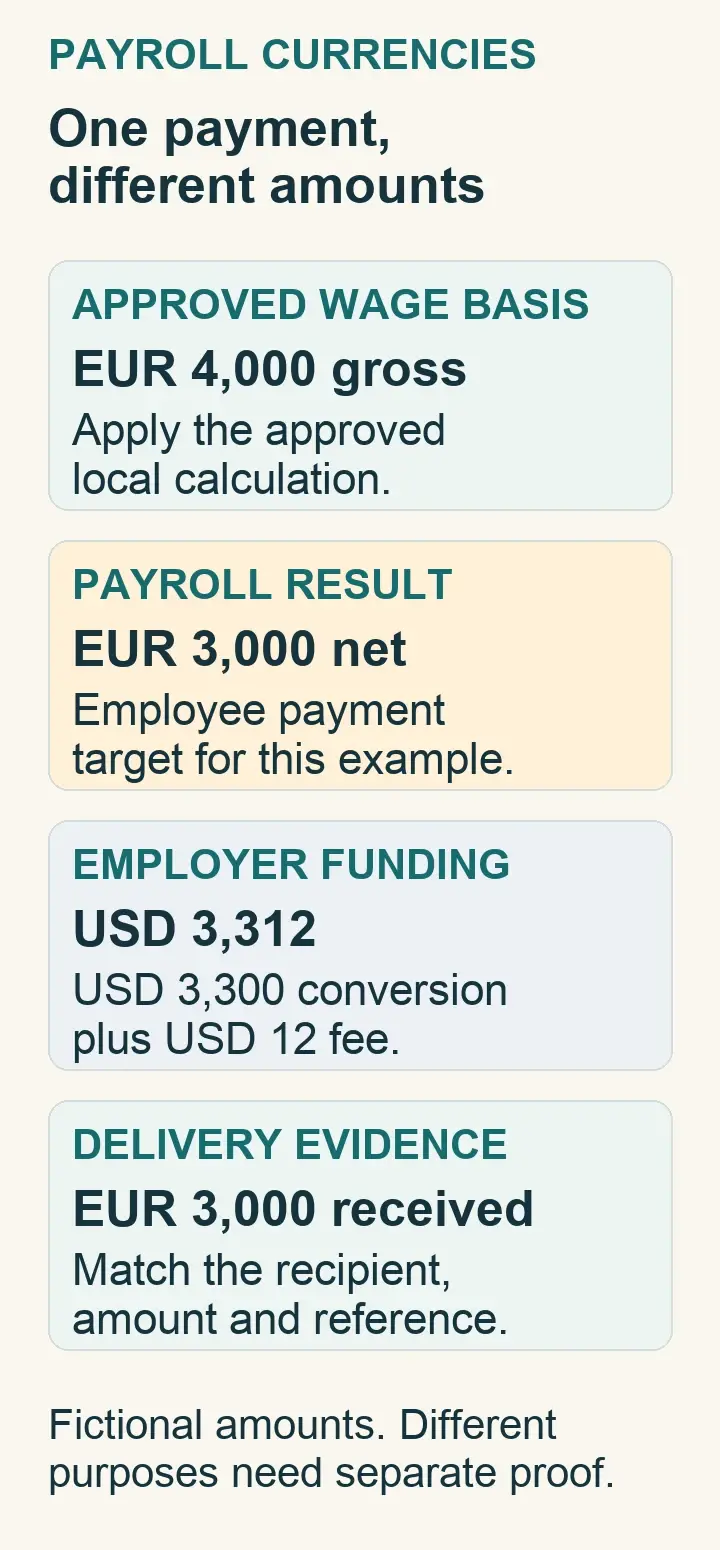
One fictional payment has different wage, net-pay, funding and delivered amounts. Preserve the evidence for each purpose.
Assign a purpose to every exchange rate
A useful rate record states the source amount and currency, destination currency, direction, value, applicable date or time, source evidence and reviewer. Record whether the rate converts the wage basis, supplies a tax reporting value, prices a payment or translates an accounting report. The same number appearing in two systems does not establish that both uses are appropriate.
For a direction such as “USD per EUR,” multiply the EUR amount by the rate to obtain dollars. If the supplied rate is “EUR per USD,” the operation changes. Write the relationship in words and work one simple amount before approving an import. Preserve the original quoted direction rather than converting it repeatedly between screens.
With a fictional rate of USD 1.10 per EUR, EUR 3,000 corresponds to USD 3,300 before any fee. If someone mistakenly treats 1.10 as EUR per USD and divides, the result is about USD 2,727.27. Both calculations can look plausible in a formatted workbook. A reviewer needs the unit relationship, not a check that the cell contains a decimal.
Separate a benchmark from an executable offer. The European Central Bank says its euro reference rates are published for information and discourages using them for transactions. A reference series can support an authorized comparison, but it is not evidence that a payment provider committed to deliver a specific amount at that rate.
Keep the rate as recorded when the decision was made. If a source later updates its page, an uncaptured link may no longer explain the run. Retain the permitted statement, quote identifier or dated extract, along with the approval reference. Apply the employer's access and retention rules to this evidence rather than circulating an unrestricted workbook containing bank details.
For currencies that cannot be exchanged through the intended route, obtain a supported alternative and specialist review. Do not substitute an internet price merely to make the spreadsheet calculate. Treasury must establish how the obligation will actually be funded and paid; finance must establish any separate reporting treatment.
Preserve precision until the approved rounding step
Identify the decimal precision accepted by each payroll, quote and payment interface. Keep the calculation's supported precision until the step where the approved rule requires rounding, then retain both the underlying calculation and the released amount. Ask the provider to identify its actual rule and the scope at which it is applied.
Rounding each employee and rounding a group total can produce different results. For a fictional demonstration using a rule that rounds to cents, two calculated differences of EUR 0.004 round to EUR 0.00 individually, while their combined EUR 0.008 rounds to EUR 0.01. This is an arithmetic illustration, not a required payroll method. The operating check is whether the approved recipient instructions and their total were produced under the same documented method.
Do not distribute a residual penny to an employee merely because it makes a funding summary agree. Establish whether the residual comes from a report translation, a quote, an incorrect rate direction or an actual wage calculation. Keep the correction in the system and approval process responsible for that amount.
Compare like populations and like versions before testing tolerance. A payroll preview prepared before a bonus correction will not reconcile to an updated net-pay schedule, even if both use the same rate. A provider invoice that includes employer taxes cannot be reconciled directly to a net-pay-only bank debit. State the scope beside the total.
Preserve the original amount and its full currency code when moving data between systems. Check decimal separators and thousands separators in the actual saved file, particularly when teams use different regional spreadsheet settings. Review a representative amount after import instead of assuming that a screen's familiar appearance proves the underlying value arrived.
Record a variance in its native currency first. If finance also wants a dollar equivalent for prioritizing investigations, identify that translation separately and preserve the underlying employee amount. A small consolidated dollar variance can contain offsetting recipient errors that still need correction.
Use the local calculation and tax instructions for their own purpose
Determine the applicable calculation and reporting rules before deciding which conversion enters the payroll record. The governing date can differ from the date treasury purchases currency. A monthly budget rate or a payment-service quote does not become a tax conversion method just because it is convenient.
HMRC's EIM40033 provides a scoped example. For the general earnings described there that are taxable when received, it calls for a sterling value tied to entitlement to payment or an earlier payment date. For those earnings, HMRC allows no deduction for currency-conversion costs or exchange losses. That is a UK earnings rule for the stated circumstances, not a universal rule for every country, payment or reporting process.
Likewise, the IRS's foreign-currency guidance explains that U.S. tax-return amounts must be expressed in dollars and that the conversion depends on functional currency and the relevant event. It separately distinguishes payment of U.S. taxes. Use that distinction to frame the questions for the tax owner; do not treat the page as permission to apply one average rate across every employer payroll form.
Have the country payroll owner identify the actual rule and supported system method for the employee's circumstances. Record which components are affected: ordinary salary, a foreign-currency bonus, taxable benefits, reimbursement, deductions or another item. An exchange rule for one component need not govern all the others.
After the calculation is approved, reconcile the original instruction to the payroll result. Identify any employee-level difference caused by the conversion method, rounding or a revised pay component. A change that affects taxable pay, deductions or net pay returns to payroll review; it is not merely a treasury variance.
Keep the employee explanation consistent with the approved arrangement. Explain the gross or net basis, the currency of the payment and the responsible contact. Avoid describing every change in take-home pay as “the exchange rate” before checking taxes, deductions, fees and the amount actually sent.
Follow one EUR payment through a USD funding request
Suppose a fictional payroll calculation produces EUR 4,000 gross, EUR 1,000 of reviewed employee deductions and EUR 3,000 net due. The example does not model any country's tax rates. The payment service is responsible only for the EUR 3,000 employee transfer; other remittances are funded separately.
Treasury obtains an offer to deliver EUR 3,000 at USD 1.10 per EUR, with a USD 12 fee added separately. The required employer funding is USD 3,312: USD 3,300 for the target amount plus USD 12. Preserve the source and target amounts from the actual offer. Do not infer fee treatment from a rate alone.
Now consider a different instruction that caps the total employer debit at USD 3,300, with the same USD 12 fee deducted before conversion. Only USD 3,288 remains for conversion. At the same fictional rate, that buys about EUR 2,989.09, leaving an employee-payment difference of EUR 10.91 against the EUR 3,000 net obligation.
The funding total in both cases can be entered correctly, yet the second instruction does not deliver the reviewed net amount. Resolve the service instructions, available funds and lawful correction before calling the employee payment complete. Never close the difference just by changing the payroll register's net-pay figure.
A second comparison concerns timing. If the price changes to USD 1.12 per EUR before the first offer is secured, buying EUR 3,000 now requires USD 3,360, plus any applicable fee. That additional USD 60 is a funding question while the approved EUR 3,000 target remains unchanged. Determine whether the earlier quote was actually locked, had expired or had conditions the employer failed to meet.
Wise's quote documentation illustrates the distinction: it separately identifies sending and receiving currencies and amounts, and includes fixed or floating rate information and an expiration field. Those documented fields are an example of the evidence to request. They do not establish that any particular account, route or proposed payroll arrangement guarantees an amount.
Record the actual final quote, approved funding, transaction reference and recipient outcome. If a bank fee reduces what the employee receives, identify the charge and the applicable payment obligation. Do not assume that a “sent” status establishes the amount received or that the employee is automatically responsible for the difference.
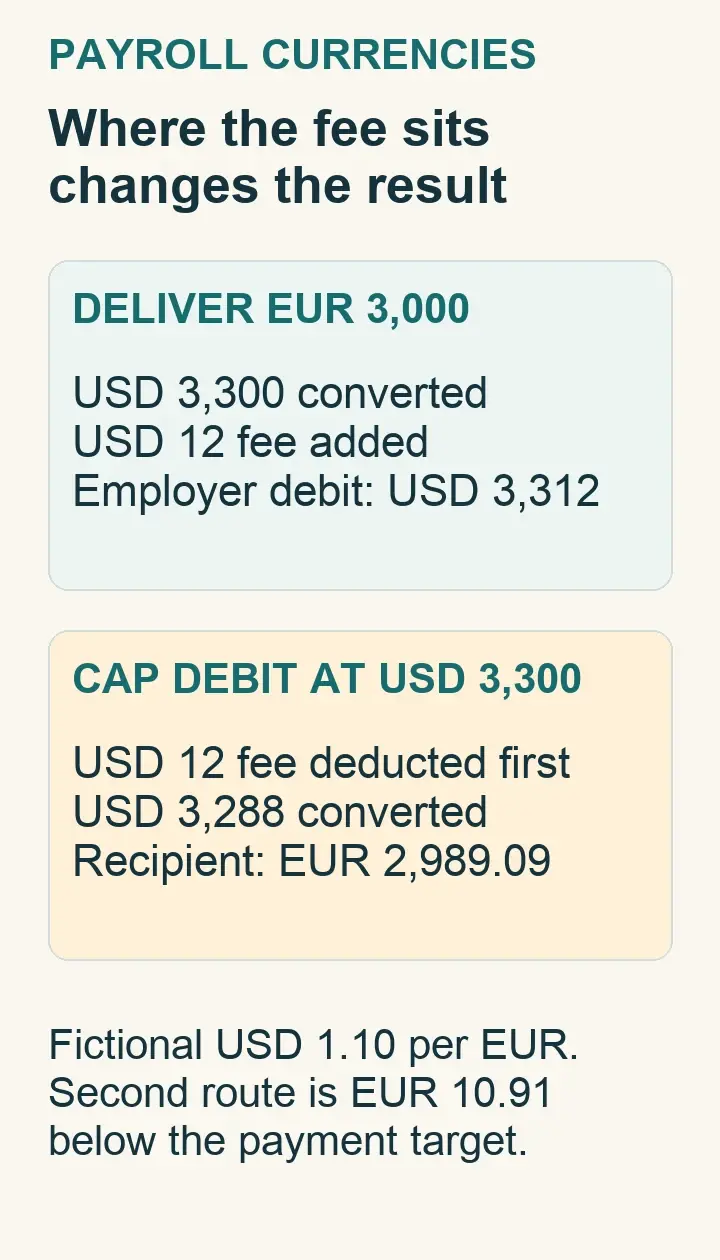
Fee allocation changes the recipient amount even when the quoted exchange rate is identical. The worked calculation above remains selectable.
Back the timetable out from the required payment result
Start with when the employee must be paid under the applicable arrangement and rules. Then identify the latest supported time for the service to receive usable funds, any conversion or quote acceptance step, payroll approval and the earlier source-data deadline. Record the time zone for each event.
Check the calendars that apply to the actual route. The employer's bank, conversion service, intermediary and recipient bank may have different working days or processing conditions. Obtain the route's current instructions rather than applying one generic number of days to every currency.
Ask what creates a firm commitment. A prepared payment file, an approved treasury request, a successful upload and funds available to the payment service are separate events. Record the evidence required at each step and the owner who must respond if it is missing.
Keep the release authority clear when payroll and treasury are separate teams. Payroll approves the calculated obligation and recipient schedule. Treasury approves the funding and conversion within its authority. The payment release follows the employer's actual authorization model. One combined role in a small business still needs to distinguish these decisions in the record.
A late wage change can invalidate a quote or create an additional transfer. Recalculate affected payroll components, update the recipient schedule and obtain the required review of the changed funding instruction. Preserve the earlier version so a second payment is not mistaken for a replacement of the first.
If a deadline is at risk, escalate the affected employees and amounts with the payment owner. Evaluate an authorized alternative based on its actual availability and consequences. Buying currency early is not a reason to postpone an amount that is due, and an internal cutoff is not authority to ignore an applicable wage-payment deadline.
Ask a provider to explain one complete currency route
Use the reviewed pay basis, quote conditions and payment evidence as requirements for a payroll-service comparison. An optional SelectSoftware Reviews conversation can help you identify services to investigate; verify country scope, supported currencies and payment ownership with each provider.
Match received amounts before explaining the finance difference
Reconcile the employee schedule by recipient and currency to the payment instructions and known results. Separate delivered payments from pending, rejected, returned and uncertain cases. A completed batch total should not conceal one employee whose instruction failed while another was duplicated.
For a split arrangement, retain the approved allocation and both delivery results. Two portions cannot be added without an agreed comparison basis if they are in different currencies. Verify the target of each leg and then reconcile their combined relationship to the reviewed payroll obligation.
Investigate an apparent short payment in sequence. Confirm the approved net amount and currency, the payment instruction, the executed conversion, any identified charges and the recipient evidence. Determine who is responsible for the next action under the actual service terms and legal arrangement. Do not decide the correction from a screenshot of one intermediate status.
Keep uncertainty visible before reissuing. A missing recipient confirmation can coexist with an instruction still moving through the service. Establish the status and use the provider's supported investigation or cancellation process before authorizing a replacement that could pay twice. Retain the original reference and the connection to the new instruction.
Once payment outcomes are explained, reconcile the employer's cash outflow and the finance posting. Identify conversion costs, separately billed fees, reversals, refunds and any unresolved amount. Keep foreign-currency balances and the accounting policy's translations visible. A rounded headquarters total alone cannot show which part of the difference belongs to which transaction.
The IFRS Foundation describes IAS 21 as addressing foreign-currency transactions and financial-statement translation, including functional and presentation currencies. That accounting scope illustrates why finance needs its own approved policy. It does not decide the contractual wage or replace country payroll calculation. Have the accounting owner determine the actual entries, applicable framework and treatment of differences.
Copy the Currency Basis and Settlement Bridge
Use one bridge for an employee payment route or a group with identical approved terms and processing. Keep employee-level schedules as controlled attachments, and split the bridge when the employing entity, currency basis, conversion rule or payment route changes. Copy the fields into a secure working record; attach references rather than full bank credentials.
A. Pay basis
1. Employing entity and route identifier: ______.
2. Employee schedule and approved version: ______.
3. Earning period and required payment date: ______.
4. Governing pay amount, currency and gross or net basis: ______.
5. Local payroll calculation currency: ______.
6. Country-rule reviewer and evidence reference: ______.
Settle the obligation and applicable method before pricing the transfer. A currency preference is not by itself an approved pay change.
B. Conversion instructions
7. Wage-basis conversion rule and governing event: ______.
8. Wage conversion source, value and explicit direction: ______.
9. Calculation precision and rounding rule: ______.
10. Tax or statutory reporting conversion instructions: ______.
11. Approved payroll result and net payment currency: ______.
12. Payroll calculation reviewer and exact version: ______.
13. Finance translation policy reference: ______.
Mark a conversion not required when the two relevant currencies coincide. Do not invent another rate simply to fill a field.
C. Funding and delivery
14. Approved recipient amounts by currency: ______.
15. Employer funding currency and authorized source account: ______.
16. Quote identifier and fixed or floating conditions: ______.
17. Quote source amount, target amount and rate direction: ______.
18. Fees, charge allocation and any recipient deduction: ______.
19. Quote expiry and latest usable-funds time, with zones: ______.
20. Funding and payment-release approval references: ______.
21. Actual transfer references and payment outcomes: ______.
The amount funded and the amount received answer different questions. Keep uncertain cases open until the payment owner establishes their status.
D. Reconciliation and follow-through
22. Recipient differences and affected employees: ______.
23. Failure investigation or replacement instruction reference: ______.
24. Actual funding debit, fees and any refund: ______.
25. Finance posting and currency-difference explanation: ______.
26. Outstanding tax or third-party remittance references: ______.
27. Open-case owner, next action and review time: ______.
28. Evidence location, access owner and closure decision: ______.
Confirm each recipient's final amount and currency against the approved schedule. Keep fee deductions, recharges, refunds and any open short payment linked to the original transfer before marking the route reconciled.
Review a route change with evidence from both versions
A new provider, bank account or currency setting can change the result without changing the salary amount. Before releasing the first changed payment, document which parts of the old route are being replaced: calculation, quote, funding, recipient delivery, reporting or some combination.
Use representative fictional cases in a demonstration or controlled test environment. Include a local-currency wage funded from abroad, a foreign-currency pay component, a split payment if needed, an expired quote and a failed recipient instruction. The purpose is to establish support for the proposed configuration; a sales demonstration is not a proven live payroll result.
For each case, ask the service to produce the calculated record, the proposed funding request, the payment instruction and the resulting report. Verify the currency codes, rate directions, precision, fee treatment and references across those outputs. A display that changes currency on screen may not change the actual payout route.
Verify the recipient setup through the employer's established bank-change process. Use approved communication channels and independent checks appropriate to the change. Keep sensitive account evidence in its controlled location, and make the payroll review packet point to it rather than duplicating it broadly.
Plan how the old route will stop. Identify outstanding transfers, scheduled instructions, balances and refunds before disabling or replacing anything. Reconcile an uncertain old payment before issuing a new one. Keep the employee support contact informed of which route is active and which cases remain under investigation.
After the first actual run, complete the bridge with observed outcomes. If a quoted target, a charge or a report differs from the proposed configuration, record the evidence and assign the correction. Do not mark the route accepted solely because the provider can process another run.
Questions that change the next action
Can every step use one exchange rate?
Only if the responsible owners establish that the same rate and timing are appropriate for every affected purpose. A rate used to buy currency does not automatically satisfy payroll reporting or finance translation requirements. Document each use, including occasions when no conversion is needed.
Does a constant local wage mean headquarters cost stays constant?
No. A local-currency obligation can stay fixed while the employer's funding-currency cost changes. Fees and the timing or conditions of conversion can also affect the debit. Compare the obligation and the funding evidence before treating the cost change as a payroll error.
Is a locked rate enough to guarantee the employee's payment?
Read the actual commitment and conditions. Establish the target amount, fee allocation, funding deadline and supported recipient route. A rate lock alone does not prove that funding arrived, that the beneficiary details were valid or that the payment completed.
Should a small difference be written off?
First classify it. An employee short payment, a calculation error, a fee and a finance translation difference can have different correction requirements. Apply the employer's reviewed policy and applicable obligations to the actual case; do not use an accounting tolerance to decide what an employee is owed.
Who closes an unresolved transfer?
Name the payment-investigation owner and the payroll contact responsible for the employee case. Closure needs the actual outcome, any authorized correction and the remaining reporting or remittance work. Keep an explicit next review time when the result is still unknown.
Bring the currency bridge to the buying conversation
If the same conversion or payment gaps keep returning, take a completed Currency Basis and Settlement Bridge into your service evaluation. SelectSoftware Reviews can help you explore payroll options against the requirements you provide. Keep the proposed responsibilities and unresolved conditions in writing before choosing.
Continue exploring payroll decisions:

About the author
Ben Scott writes and maintains payroll decision guides for founders and operators. His work focuses on execution realities and how decisions hold up under growth, complexity, and controls and documentation pressure. He works hands-on in HR and leave-management roles that intersect with payroll-adjacent workflows such as benefits coordination, cutovers, and compliance-driven process controls.


