Unreconciled Payroll Items SOP: How to Classify, Age, Escalate, and Clear Open Payroll Differences

Updated: Sep 18
A practical guide to identifying unreconciled payroll items, classifying what kind of difference they represent, aging them in a way that changes behavior, and preventing open payroll balances from quietly becoming part of the company’s normal close routine.


For teams evaluating a payroll provider change, this advisor-led matching option may help.
Most unreconciled payroll items are not really temporary differences
They often get treated that way.
A payroll liability balance does not tie out this month, so the team assumes it will clear next cycle. A payroll journal line looks slightly off, but the difference is small enough that people expect it to wash through next period.
A tax balance, deduction item, or clearing account variance remains open, but because the close moved forward, the item starts to feel tolerable instead of unresolved.
That is usually where the problem begins.
An unreconciled payroll item is rarely just an accounting leftover. It is often evidence that something in the payroll-to-close process is still unresolved:
a payroll result was not interpreted cleanly
a posting or mapping treatment did not behave as expected
a liability moved without enough explanation
an exception, correction, or off-cycle event changed the numbers in a way no one fully closed out
a support gap forced the team to move forward without fully clearing the difference
That is why this topic matters.
A lot of companies do not have a formal SOP for open payroll differences. They have habits:
leave it open and see if it clears next month
ask payroll for more detail when it comes up again
carry it in a spreadsheet tab
post around it and revisit later
treat it as small enough not to escalate yet
Sometimes one of those habits works once.
They become dangerous when they repeat.
The regulatory backdrop is one reason that matters. The IRS says employers must keep employment tax records for at least four years after the fourth quarter for the year is filed, and those records should be available for IRS review. Those records include items such as wages, tips, dates of employment, tax deposits, and copies of returns.
The Department of Labor likewise requires employers to preserve payroll records for at least three years, and records on which wage computations are based, including time cards, work schedules, and records of additions to or deductions from wages, generally for two years. It also requires retention of total wages paid each pay period and the pay period covered.
That does not mean every unreconciled payroll item becomes a compliance failure.
It does mean unresolved payroll differences sit inside a recordkeeping and control environment where “we think it will clear later” is often not a strong enough operating answer.
The real question is not “do we still have an open item”
The stronger question is:
What kind of unreconciled payroll item is this, how long has it been open, what should happen next, and who owns getting it cleared?
That is a much better operating question than many teams use.
A weak model usually treats open payroll differences as temporary clutter:
something is off
it probably has an explanation
the difference may clear next cycle
finance will keep an eye on it
payroll will help if it comes up again
A stronger model treats unreconciled payroll items as controlled objects.
That means the company should be able to answer:
what category of difference this is
whether it is timing, error, explanation gap, or true unresolved exposure
whether it affects posting, liability review, accrual logic, or close interpretation
how long it has been open
what escalation threshold applies
what evidence proves it is actually cleared
That is why this guide is not just another reconciliation article.
Reconciliation tells you whether balances match.
An SOP for unreconciled payroll items tells you what to do when they do not.
A good open-item SOP should make one uncomfortable question easier to answer
Are we dealing with a normal timing difference, or are we normalizing an unresolved payroll problem?
That question is the heart of the guide.
A lot of payroll and finance teams can tell you that an item is still open. Far fewer can tell you:
whether the item is genuinely low-risk
whether the item has aged too long
whether the same category keeps coming back
whether the item belongs to payroll, finance, systems, or provider ownership
whether the company has accepted a workaround instead of a correction
That is where aging discipline becomes operationally useful.
Without aging, unreconciled payroll items feel equally unfinished. With aging, the company can distinguish:
newly opened items that may still clear normally
items that need active follow-up
items that should already have been corrected
items that are now evidence of a recurring control weakness
COSO’s monitoring guidance is useful here at a principle level: effective monitoring is part of internal control, and unresolved issues should not simply disappear into normal operations without being surfaced and evaluated.
That is exactly the risk with unreconciled payroll items.
If the same open-item category keeps rolling from close to close, the problem is no longer just the difference. The problem is that the organization is starting to accept unresolved payroll noise as part of normal business.
The trade-off is not speed versus neatness
It is controlled aging versus silent carryforward.
That distinction matters because teams often talk about open payroll items as if the choice is:
close on time
or refuse to close until everything is perfect
That is not the real decision.
The real decision is whether the company has a disciplined way to:
classify what remained open
record the close impact
assign the right owner
age the item
escalate it when it stops behaving like a short-term difference
Silent carryforward is what creates long-lived payroll clutter.
Silent carryforward sounds like:
“it is still in the spreadsheet”
“that balance has been there a while”
“we think it relates to an old off-cycle”
“it is probably timing”
“we have not resolved it yet, but it has not gotten worse”
That is exactly how open payroll items become normalized.
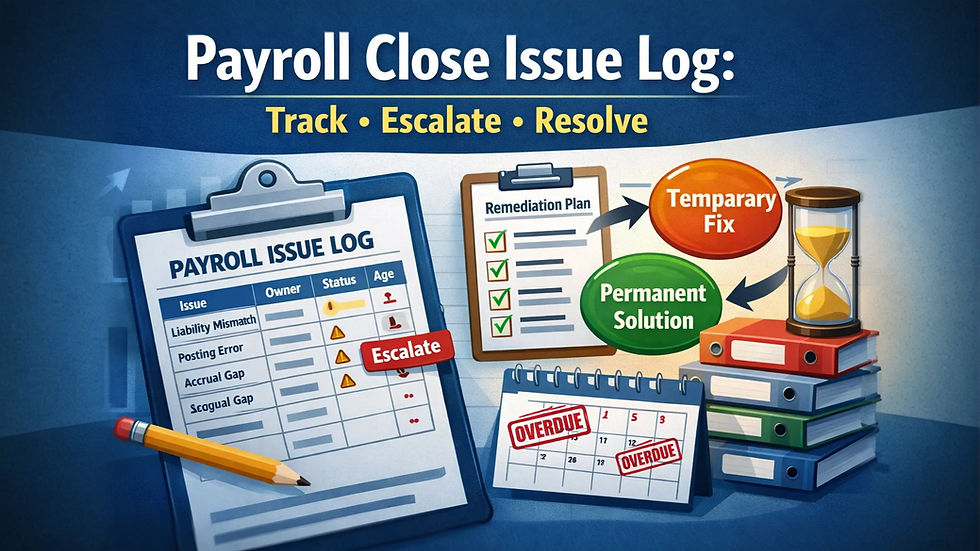
If repeated payroll-close friction is already being captured but not clearly turned into follow-up action, the stronger companion control is often a payroll close issue log so unresolved differences do not live as disconnected notes without category, age, or ownership.
What a strong unreconciled payroll items SOP should usually prove
Before the company decides an item can stay open, the process should support a few specific claims.
1. The item has been classified clearly enough to route correctly
Not just “difference” or “reconciling item.”
A stronger process should identify whether the item is:
a timing difference
a mapping or posting problem
a liability explanation gap
a tax or deduction discrepancy
a support or evidence problem
a true unresolved payroll error
2. The aging logic is visible
The company should know:
when the item opened
how long it has remained unresolved
whether it crossed a follow-up threshold
whether it should now be escalated
3. Ownership extends beyond observation
The item should not sit open because everyone knows about it but nobody owns clearing it.
A stronger model names the function or person responsible for remediation.
4. Clearance means more than disappearance
A good SOP should not let “the number moved” count automatically as “the issue is closed.”
It should require enough evidence that the company can explain why the item is now cleared and why it should not return the same way.
If the deeper problem is that period-to-period differences are still being discovered too late or explained too loosely, the stronger companion control is often the payroll liability reconciliation checklist so open-item follow-up starts from cleaner reconciliation discipline.
Get Your Free Payroll Software Matches
SelectSoftware Reviews Offers 1:1 Help From a Payroll Software Advisor. Get in touch to:
Table of contents
Most unreconciled payroll items are not really temporary differences
A good open-item SOP should make one uncomfortable question easier to answer
What a strong unreconciled payroll items SOP should usually prove
An unreconciled item only becomes governable when the company decides what kind of item it is
How to use the table without overcomplicating open-item review
What should still block an item from being carried quietly into the next close
Diagnosis library: what recurring unreconciled payroll items usually mean
The model is working when open payroll items stop fading into the background
The operating decision at the center of this guide
The core decision is not whether an unreconciled payroll item can remain open for another close.
It is how the company should classify, age, escalate, and clear open payroll differences so temporary items do not quietly become tolerated control failures.
An unreconciled item only becomes governable when the company decides what kind of item it is
That is where many open-item processes fail.
The difference gets noted. Someone agrees it still needs follow-up. The amount is carried forward. But the team never decides what kind of item it actually is.
That sounds small, but it changes everything.
A timing difference should not be aged or escalated the same way as:
a payroll error
a posting or mapping issue
a liability explanation gap
an unresolved deduction problem
an item that remains open only because the supporting evidence is weak
That is why the main artifact in this guide is an aging and escalation table rather than a general reconciliation checklist.
A general checklist can tell the team to review open items.
A stronger aging table tells the team:
what category the item belongs to
how long it can remain open
when follow-up becomes escalation
what evidence is required before the item can be considered cleared
Aging and escalation table for unreconciled payroll items
Item type | What it usually means | Aging and escalation rule | What counts as cleared |
Short-term timing difference | A known item is expected to resolve in the next normal cycle, such as a payment timing lag, deposit timing difference, or ordinary period crossover | Log immediately, review next cycle, and escalate if still open beyond the expected clearing point or if the explanation starts weakening | The item clears in the expected cycle and the team can show why the movement resolved as expected |
Explanation gap or support gap | The amount may be right, but the company cannot explain it cleanly enough or does not yet have support strong enough to defend it | Escalate quickly if the explanation is still incomplete by the next close step it affects; do not let weak support age quietly | The supporting evidence and explanation are complete enough that the item can be interpreted without reconstruction |
Posting, mapping, or classification issue | The payroll result, journal treatment, or ledger classification appears wrong or inconsistent | Escalate immediately if the issue affects posting integrity, liability logic, or repeated close treatment; do not treat it as ordinary timing | The mapping or classification is corrected and the company can explain both the cause and the corrected treatment |
True unresolved payroll difference | The amount remains open because the company has not yet determined the cause, the correct owner, or the right correction path | Highest escalation priority; age visibly, review every close, and require named remediation owner until resolved | The root cause is identified, the correction is complete, and the item is not merely offset or buried by later movement |
How to use the table without overcomplicating open-item review
The point is not to create four labels and stop there.
The point is to help the team ask a much better question when an item stays open:
What behavior should this item trigger now?
That is the real value of classification.
Short-term timing differences
This is the category that gets overused the most.
Sometimes an item really is timing:
a payroll payment cleared after period-end
a tax deposit crossed the close boundary
a liability movement is waiting for the next ordinary cycle to settle
a payroll event posted in a way the team fully expects to clear next period
That category is real.
But it is only useful when the company can say:
why it is timing
when it should clear
what future event should clear it
what should happen if it does not
The danger is not that timing items exist.
The danger is calling something “timing” when the team really means “we have not figured it out yet.”
Explanation gaps or support gaps
This category is more common than many teams realize.
The number may not actually be wrong. The real weakness may be that:
the support package is too thin
the explanation still lives in email or memory
finance cannot tie the item to a payroll event cleanly enough
payroll understands the movement, but the retained support does not
This matters because explanation gaps often age badly. A number that is explainable during close becomes much harder to defend later if the support is never made durable.
If the deeper weakness is that retained payroll evidence is still too thin for later follow-up, the stronger companion control is often a tighter payroll support package for controllers so open items are not left waiting on support that should already exist.
Posting, mapping, or classification issues
These are the items teams most often misclassify as small accounting cleanup.
That is risky.
A posting or mapping issue may look modest in one period, but if the treatment logic is wrong, the item can:
recur
distort later balances
create repeated journal-review friction
weaken liability interpretation
complicate future close work in a way that is much larger than the original number
That is why these items usually deserve faster escalation than ordinary timing differences.
If the underlying weakness is really at the posting-review layer, the stronger companion control is often payroll journal entry review checklist so more of these items are caught before they become aging open balances.
True unresolved payroll differences
This is the category the company should fear normalizing.
A true unresolved item is not just open.
It is open because the company still lacks one or more of the following:
a root cause
a named owner
a correction path
enough support to know what should happen next
These items are the reason an SOP matters.
Without one, they drift:
from spreadsheet to spreadsheet
from close to close
from “we are watching it” to “it has kind of always been there”
That is exactly the point where unresolved payroll differences stop being temporary and start becoming tolerated control weaknesses.
What should still block an item from being carried quietly into the next close
This is where the SOP becomes real.
An unreconciled payroll item should not simply roll forward because:
the amount is not huge
the close has to move on
someone thinks it will probably clear
the item has existed before
the team is tired of reopening it
A stronger model should still stop quiet carryforward when one or more of these is true:
the item has no clear classification
the expected clearing event is vague
the owner is unclear
the explanation is still too weak
the item has aged beyond the agreed threshold
the same category keeps recurring
the “clearance” would depend only on offsetting later activity rather than actual resolution
If those conditions exist, the company is not managing an open item.
It is tolerating one.
Get Your Free Payroll Software Matches
SelectSoftware Reviews Offers 1:1 Help From a Payroll Software Advisor. Get in touch to:
The open-item process usually breaks down in familiar ways
Unreconciled payroll item failures rarely show up as “we need a better aging table.”
They usually show up as symptoms:
the same difference rolls forward month after month
a timing item stays open long after the expected clearing event passed
the amount may be small, but the explanation keeps getting weaker
finance and payroll both know the item exists, but neither side clearly owns clearing it
a later payroll movement makes the balance look quieter, and the team treats that as closure
close moves forward, but the underlying item never becomes easier to explain
That pattern matters because it means open-item discipline can be improved.
The company does not need to wait until the unreconciled balance becomes material or embarrassing. It needs a better rule for what counts as timing, what counts as a true unresolved item, who owns follow-up, and what evidence is required before the item can stop aging.
A practical runbook for unreconciled payroll items
The aging and escalation table defines how items should be classified.
The runbook defines how payroll, finance, and controllers should handle those items from first discovery through closure.
1. Log the item when the difference is first identified
This is the first control step.
Do not wait until after close to recreate what happened.
A stronger process captures the item while the team still knows:
what balance or difference was affected
what payroll event or close step surfaced it
whether the issue affected posting, liability review, accrual review, or close interpretation
what initial explanation existed at that moment
whether the team used a workaround to move forward
That early capture matters because unreconciled items become much harder to classify once the immediate close pressure passes and the context starts fading.
2. Classify the item before deciding how serious it is
A lot of weak processes reverse this order.
The team decides an amount is small or large first, then treats the classification as secondary.
A stronger process starts with type:
short-term timing difference
explanation gap or support gap
posting, mapping, or classification issue
true unresolved payroll difference
That matters because a small posting issue may deserve faster escalation than a larger but well-understood timing item.
Classification should drive behavior more than raw size alone.
3. Define the expected clearing event immediately
This is one of the strongest ways to keep timing items from becoming permanent clutter.
If the item is truly temporary, the team should be able to say what is expected to clear it:
the next payroll cycle
the next tax deposit
the next journal correction
the next liability payment
a specific mapped correction
a specific support package update
If that expected clearing event cannot be named clearly, the item is probably not a simple timing difference.
It may still be manageable, but it should not be treated casually.
4. Separate observation from ownership
This is where many open-item processes drift.
A lot of people may know the item exists.
That is not the same thing as assigning remediation ownership.
A stronger log should name:
who owns explanation
who owns correction
who owns follow-up review
who confirms closure
Those roles may sit with one person in a small team, or across payroll, finance, and systems in a larger one.
They still need to be explicit.
If the recurring weakness is that open items keep surfacing because the same late changes, overrides, or exceptions enter payroll without enough discipline, the stronger companion control is often payroll cutoff exception log so upstream disruption is managed before it becomes a rolling reconciliation item.
5. Review aging every close, not only when an item becomes uncomfortable
A good aging process changes behavior before the item becomes old enough to be embarrassing.
That means every close review should ask:
what opened this period
what was expected to clear and did not
what changed classification
what is now aging beyond the original expectation
what should be escalated because it is no longer behaving like a short-term difference
That review is where the SOP becomes managerial instead of descriptive.
Without it, aging is just a number in a spreadsheet.
6. Require evidence of closure, not just disappearance
This is one of the most important rules in the whole guide.
A balance moving is not the same thing as an item clearing correctly.
A stronger closure standard should answer:
what caused the item to close
what entry, payment, correction, or support update resolved it
whether the item closed for the right reason
why it should not recur the same way next period
That prevents false closure, which is one of the biggest reasons open-item populations never really improve.
If the recurring issue is that explanation stays weak even when the balance moves, the stronger companion control is often payroll support package for controllers so item closure is supported by clearer retained evidence rather than memory and informal notes.
7. Trend by category, not just by outstanding amount
A stronger open-item process does not only ask how many dollars remain unresolved.
It also asks:
which categories recur most often
which categories age the longest
which ones repeatedly rely on workaround instead of correction
which ones should now trigger process redesign rather than another month of monitoring
That is how the company moves from cleanup behavior to control improvement.
Diagnosis library: what recurring unreconciled payroll items usually mean
The item is always described as timing, but it never clears when expected
This usually means the team is using “timing” as a holding label for something it has not really diagnosed yet.
A real timing item should have:
a known cause
a known clearing event
a reasonable clearing window
Without those, the label is probably too generous.
The amount is small, but the explanation is deteriorating
This usually means the company is overvaluing materiality and undervaluing control quality.
A small item with weak explanation can still be a useful signal that:
support is weak
ownership is vague
classification is wrong
the same problem may later recur at a larger size
The balance moved, but no one can say why it is now considered closed
This usually means closure standards are too weak.
The company is treating movement as resolution instead of requiring a real closure explanation.
Payroll thinks finance owns the item, and finance thinks payroll owns it
This usually means the item was logged, but remediation ownership was never separated from observation.
That is an ownership problem, not a reconciliation problem.
The open-item list changes every month, but the issue families do not
This is one of the clearest signs that the company is looking at incidents instead of patterns.
The specific amounts move.
The underlying failure types stay the same.
That is exactly what the aging-and-escalation model should make easier to see.
What stronger teams do differently
They do not just keep a list of open balances.
They govern what those balances mean.
They classify early
They do not let an item sit in the log for weeks before deciding whether it is timing, support-related, mapping-related, or truly unresolved.
They name the expected clearing event
They do not allow “it should clear later” to stand in for a real follow-up expectation.
They separate workaround from closure
That keeps the same item from being treated as solved just because close moved on.
They use aging to trigger action
They do not let older items simply become familiar.
Switching triggers
An unreconciled payroll items SOP should be tightened before open balances start feeling normal instead of temporary.
That usually becomes visible in a few familiar ways.
Timing items stop clearing on time
This is one of the clearest triggers.
If multiple items are still being labeled as timing even after the expected clearing event passed, the classification model is too loose or the follow-up discipline is too weak.
The same categories keep reappearing across closes
This is another strong trigger.
If the open-item list changes, but the recurring categories still look like:
liability explanation gaps
posting or mapping issues
deduction differences
off-cycle distortion
support weaknesses
then the company is not dealing with random noise. It is dealing with repeated control patterns.
Small unresolved items are accumulating into tolerated clutter
That is a major warning sign.
The issue is not only financial size. It is that the company is starting to accept unresolved payroll differences as part of normal close behavior.
Closure standards are too casual
If an item can be marked closed because:
the balance moved
a new period changed the number
someone believes the issue is no longer important
nobody has asked about it again
then the SOP is too weak at the clearance stage.
Failure modes
Weak open-item processes usually fail in recognizable patterns.
The “timing until proven otherwise” failure
This is one of the most common.
The company assumes an item is timing because that is the easiest short-term explanation.
That can delay the harder work of finding the real cause.
The “spreadsheet graveyard” failure
This happens when open items live in a tracker, but the tracker does not meaningfully drive:
aging review
ownership
escalation
closure quality
process change
At that point, the list exists, but the process does not.
The “small enough to ignore” failure
This is especially risky because it sounds practical.
A small unresolved item may not justify a large immediate response, but it still needs clear classification, aging, and ownership. Otherwise, the company teaches itself that unresolved payroll noise is acceptable.
The “movement equals closure” failure
A later balance movement may reduce or offset the amount, but that is not enough by itself.
A stronger process still asks whether the original item:
was explained
was corrected
cleared for the right reason
is unlikely to recur the same way
The “everyone knows about it” failure
This is the quietest one.
The item is widely known, but no one owns the actual fix.
That often creates the illusion of control without the reality of remediation.
Migration considerations
An unreconciled payroll items SOP should be revisited whenever the company changes payroll providers, payroll-to-GL mapping, reconciliation workflow, close ownership, or document-retention structure.
A new environment may change how items appear.
It does not automatically improve how they are governed.
Do not migrate vague item categories into a new environment unchanged
If the old process relied on labels like:
payroll difference
liability issue
reconciling item
tax variance
support gap
Moving those same labels into a new workflow will not improve open-item control. The categories need to be tight enough to drive aging and escalation decisions.
Build the escalation logic before the tracker grows
The better order is:
define item categories
define expected clearing events
define aging thresholds
define owner rules
define what counts as closure
then build the sheet, workflow, or close routine around that model
Not the reverse.
Use early cycles to test whether the SOP changes behavior
The right questions are practical:
are items being classified earlier
are “timing” labels being used more carefully
are old items becoming more visible
are owners clearer
are closure decisions better supported
are repeated item families starting to decline
If those answers remain weak, the company may be tracking open payroll differences without truly governing them.
The model is working when open payroll items stop fading into the background
That is one of the clearest practical tests.
A stronger unreconciled payroll items SOP does not eliminate every open balance immediately.
It makes open items:
easier to classify
easier to prioritize
easier to age
easier to escalate
harder to quietly tolerate
The company should be able to answer:
what kind of item this is
why it is still open
what event should clear it
who owns clearing it
how long it has been open
what evidence proves it is actually closed
If those answers are becoming easier to give, the SOP is improving.
Final recommendation summary
An SOP for unreconciled payroll items should be treated as an open-item governance process, not just a reconciliation afterthought.
The strongest model usually does four things well:
classifies the item type clearly
makes aging visible
escalates items when they stop behaving like short-term differences
requires real evidence of closure
For most companies, the next improvement is not a bigger tracker.
It is sharper rules.
That usually means defining:
what each open-item category means
what clearing event is expected
when aging becomes escalation
who owns remediation
what closure actually requires
That is what turns unreconciled payroll items from tolerated close residue into something the company can actually reduce.
Where to tighten the process first
Start where open payroll items currently feel most normal.
That is usually one of these:
timing items that never quite clear
deduction or liability items with weak explanation
posting or mapping issues that keep resurfacing
small balances that have aged too long
items everyone knows about but nobody owns fully
closures that rely on later movement instead of real evidence
Then ask a better question than “Is the amount still open?”
Ask:
what category is this really
what was supposed to clear it
why is it still here
who owns the next step
what would count as real closure
That usually makes the first correction obvious.
Get Your Free Payroll Software Matches
SelectSoftware Reviews Offers 1:1 Help From a Payroll Software Advisor. Get in touch to:
Q&A: unreconciled payroll items
Q1) What is an unreconciled payroll item?
An unreconciled payroll item is an open difference, balance, or discrepancy that payroll and finance have not fully explained, corrected, or cleared. It may relate to a liability balance, deduction item, payroll journal treatment, tax amount, clearing account, or another payroll-related figure that does not yet tie out cleanly.
Q2) Why is an unreconciled payroll item different from a normal timing difference?
A normal timing difference should have a known cause and a known clearing event, such as the next payroll, deposit, payment, or journal cycle. An unreconciled payroll item becomes riskier when the explanation is weak, the expected clearing event is vague, or the item stays open longer than it should.
Q3) What is the biggest mistake companies make with open payroll differences?
One of the biggest mistakes is labeling too many items as timing differences without defining what should clear them and when. That often allows real payroll, mapping, liability, or support problems to stay open longer than they should.
Q4) What kinds of unreconciled payroll items should be classified separately?
Most companies should separate short-term timing differences, explanation or support gaps, posting or mapping issues, and true unresolved payroll differences. Those categories do not age the same way and should not be escalated under the same rules.
Q5) Why does aging matter so much for unreconciled payroll items?
Aging helps the company distinguish between a new item that may clear normally and an old item that is becoming tolerated close clutter. Without aging discipline, open payroll items often stay visible but never become urgent enough to drive action.
Q6) What should usually trigger escalation of an unreconciled payroll item?
Escalation should usually happen when the expected clearing event passes without resolution, the explanation remains weak, the owner is unclear, the same category keeps recurring, or the item affects posting integrity, liability interpretation, or close confidence.
Q7) What counts as real closure for an unreconciled payroll item?
Real closure means the company can explain why the item is no longer open, what corrected or cleared it, and why it should not return the same way next period. A balance moving by itself is not always enough to count as closure.
Q8) Who should own an unreconciled payroll item?
The owner should be the person or function responsible for clearing the item, not just the person who noticed it. Depending on the issue, that may be payroll, finance, payroll systems, a provider, or shared ownership across functions.
Q9) What are signs that an open payroll item process is too weak?
Common signs include items being called timing differences indefinitely, balances rolling from month to month without a clear owner, small unresolved items becoming normal, and closure decisions being based on later movement instead of real evidence.
Q10) What should a company tighten first if open payroll items keep coming back?
Start with the part of the process that is weakest today. In many companies, that means vague item classification, missing expected clearing events, weak aging review, unclear ownership, or closure standards that are too casual.
Get new payroll decision guides and operational checklists
Subscribe and receive the Payroll Provider Data Migration Field Map (editable spreadsheet)

Continue with related payroll guides and templates:

About the author
Ben Scott writes and maintains payroll decision guides for founders and operators. His work focuses on execution realities and how decisions hold up under growth, complexity, and controls and documentation pressure. He works hands-on in HR and leave-management roles that intersect with payroll-adjacent workflows such as benefits coordination, cutovers, and compliance-driven process controls.