S Corporation Payroll Services: Choose Support for Owner Pay

Updated: 22 hours ago

Before buying payroll for an S corporation, write down the decisions you expect the service to make about your own pay. Will its team assess compensation, enter instructions from your tax adviser, handle an owner health benefit or prepare a return? Put those answers alongside the price. Salary entry, benefit reporting and individual tax advice each need a defined service commitment.
Choose S corporation payroll services by the owner-pay work you need someone to undertake. Establish the facts and tax decisions with a qualified adviser, ask each provider to demonstrate how it will implement those instructions, and put the remaining responsibilities into the engagement. The Owner-Pay Service Brief below helps you compare an actual service proposal with that work.
This guide is for U.S. business owners selecting payroll support for an entity taxed as an S corporation. It does not determine whether to elect S status or calculate a defensible salary. Its purpose is to help you buy a service that can carry out the right instructions and produce evidence your tax advisers can use.
Contents
Separate compensation advice from payroll processing
Start with the distinction between owning a company and working for it. The IRS explains that corporate officers who perform services and receive, or are entitled to receive, compensation are generally employees for federal employment-tax purposes. An officer performing no services or only minor services, with no entitlement to compensation, can fall outside that rule. Shareholder status alone does not settle the answer.
For a shareholder-employee providing services, the IRS requires reasonable compensation before nonwage distributions. Its discussion considers duties, time, experience, comparable pay and other facts. That is a factual assessment, not a universal salary-to-distribution percentage. Ask who will perform and document that assessment for your business; a pay-rate field is not evidence that the payroll company has done so.
Convert the assessment into an instruction the payroll operator can use: approved cash compensation, payment frequency, effective date, reviewer and the event that requires another review. Keep the analysis itself with the adviser and authorized company records. A provider may need the resulting instruction rather than the full confidential compensation file.
Then separate payroll from the other owner transactions. Ask how distributions, reimbursements and other transfers will be recorded and reconciled, including work performed outside the payroll service. Do not let an owner's bank transfer become an earnings instruction merely because the same person receives both. The bookkeeper and tax adviser should resolve the classification before an operator chooses a payroll code.
Name the service you are buying precisely. “Process the compensation approved by our tax adviser” is a workable obligation. “Handle everything for our S corporation” leaves the compensation analysis, benefits review, corporate return and personal return undefined. If the provider offers those additional services, identify their deliverables and fees in the agreement.
Choose the arrangement your owner can sustain
There are several reasonable ways to organize this work. The practical difference is who translates the advice into payroll, checks the result and deals with a question when the owner is busy. Compare the proposed arrangement with your available time and knowledge before comparing subscription prices.
Owner-operated software with an outside tax adviser. This can fit an owner who will maintain the inputs, review each run and obtain advice before unusual entries. The adviser supplies the tax decisions; the owner implements or arranges the implementation. Confirm that the adviser will review the intended reports, not merely receive a W-2 after everything is final. Also identify who answers a setup question between tax appointments.
Accountant- or bookkeeper-operated payroll. This can reduce the owner's recurring administration when a firm actually agrees to perform it. Determine whether the same firm provides tax advice, whether an outside adviser remains involved and which person authorizes payments. Someone preparing the payroll is not automatically engaged to determine reasonable compensation or prepare the individual return. Ask for a backup operator and a review path that does not rely on sharing the owner's login.
Payroll service with specified specialist support. A provider may offer an implementation team or a defined correction service. Ask what that team receives, what it decides and which requests require a separate engagement. A named contact is useful only if the contract covers the work you expect that person to do. Confirm the actual plan, service tier and response route rather than relying on a broad “full service” description.
For any arrangement, rehearse an ordinary month and an awkward month. In the ordinary month, identify who supplies the compensation instruction, confirms funding and reviews the output. In the awkward month, the owner is unavailable, a premium amount changes or the adviser revises an instruction. Decide who notices, who can act and what must be resolved before the next run.
An inexpensive software package can be a good choice when the retained work has a capable owner. A more expensive managed service can be a poor fit when its exclusions leave the same work unassigned. The comparison is the complete arrangement, including professional advice and your own recurring effort.
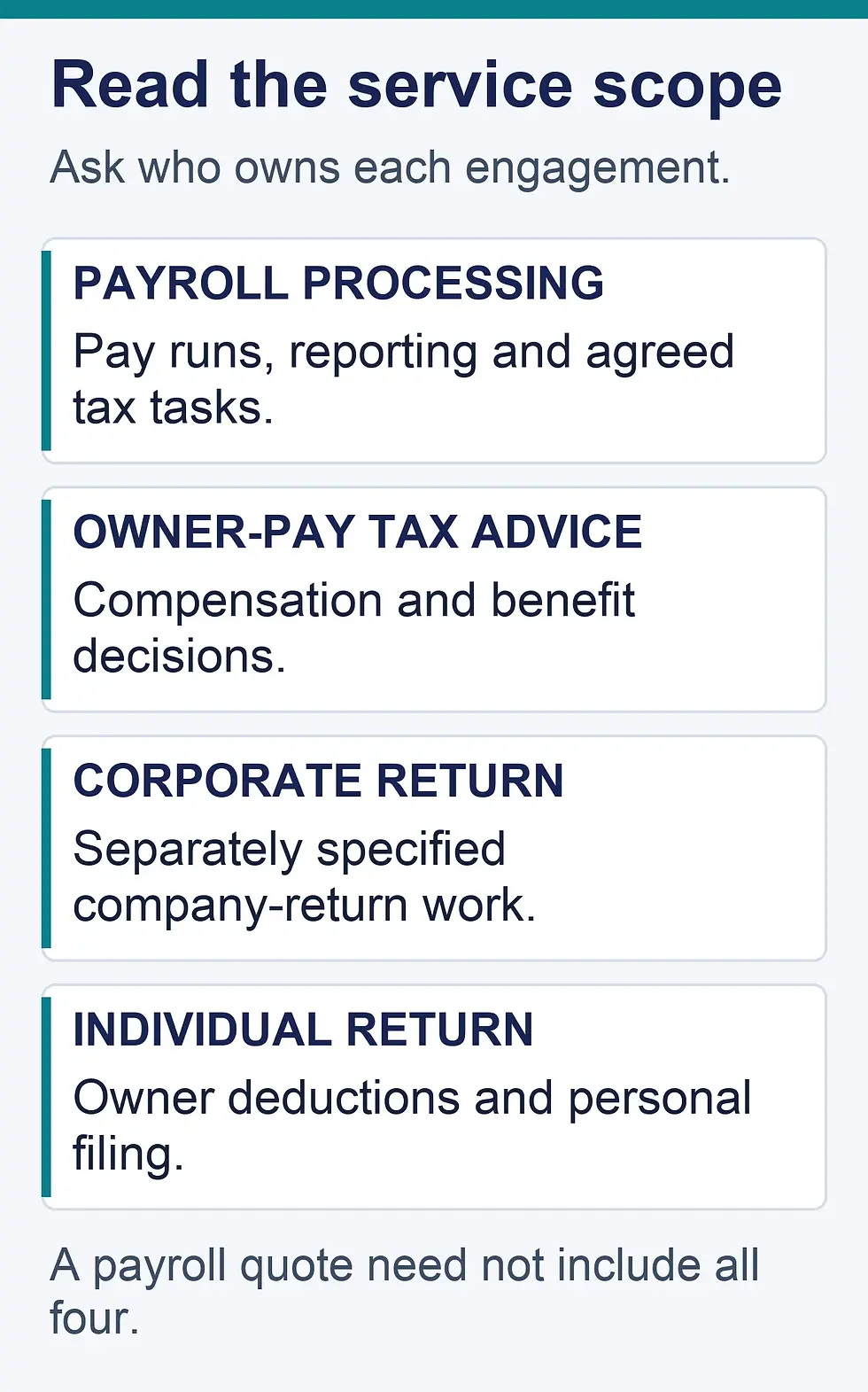
Read each quote as a set of services. A payroll subscription does not establish which of the other engagements is included.
Establish shareholder and benefit facts before setup
Ask the tax reviewer to confirm the entity's tax status and the ownership facts relevant to each benefit. IRS Publication 15-B defines its special shareholder category using ownership of more than 2% of stock or voting power, directly or indirectly, on any day during the tax year. For cafeteria-plan purposes, those shareholders are not treated as employees eligible for the usual exclusion. This special treatment does not mean the person stops being an employee for every payroll purpose.
Supply the reviewer with ownership changes and relevant family relationships rather than selecting a benefit checkbox from the percentage shown on one current ownership report. Have the reviewer explain the resulting payroll instruction and which period it covers. Publication 15-B itself uses “2% shareholder” as shorthand for the more-than-2% category. Confirm that the provider's setting implements the reviewed facts and the same threshold, rather than treating ownership of exactly 2% as enough.
Inventory the benefits you actually need processed. For health coverage, identify the policy, who paid the premiums, whether the corporation reimbursed the owner, the covered periods and any amounts already entered in payroll. Keep proof of payments and the adviser-approved treatment available through a controlled reference. The service brief should describe the required result without exposing medical details to a salesperson.
Insurance reporting and an individual deduction are connected but separate questions. IRS Notice 2008-1 describes corporate payment or substantiated reimbursement and W-2 inclusion as part of establishing the arrangement for the shareholder deduction. Other eligibility conditions still apply. Have the adviser review the arrangement before treating a payroll entry as proof that a deduction is available.
Avoid extending the medical-insurance answer to every owner benefit. Give the reviewer a separate list of retirement contributions, HSA activity, life insurance or other benefits you use, and obtain the necessary instructions for each. A provider demonstration of one health-premium item establishes only that demonstrated workflow, not support for the entire list.
If the owner is your only worker today, ask what would change when the business hires someone else. This is a scope question for the adviser and provider: which benefit arrangements require another review, which settings need revisiting and who initiates that review? It prevents an early setup from becoming an undocumented default as the company grows.
Request proof of the owner-health workflow
The IRS describes health premiums paid for a greater-than-2% shareholder-employee as wages subject to income-tax withholding. When the stated plan-or-system conditions are met, those additional wages are excluded from Social Security, Medicare and FUTA taxes and appear in W-2 Box 1 rather than Boxes 3 and 5. The applicable conditions matter; do not tell a provider to apply that result to an unreviewed arrangement.
Give a prospective operator your adviser's approved fact pattern and expected treatment. Ask the operator to show the earning or benefit item, whether it creates a new cash payment, the affected wage bases and the year-end report preview. Have your adviser verify that the demonstrated result matches the instruction. An entry appearing on a pay statement is only part of the evidence.
Current vendor documentation illustrates why a general assurance is insufficient. Gusto's shareholder-status guidance distinguishes ownership setup and prior benefit activity. It directs employers to contact support when correcting a midyear or year-end classification after pretax benefit deductions. Ask whether your history needs that support route and what records the team requires; do not assume changing the profile alone completes the correction.
Check the exact product in Intuit's S-corp medical guidance: its instructions separate payroll products and supported insurance-plan situations. Recurring entries also follow different steps from fringe-benefit-only or zero-net workflows. Ask for a demonstration in your named package and reviewed arrangement, with any limitation explained in writing.
These are documentation examples, not results from our own software testing or endorsements of one provider. Use the same proof request for every candidate. If a sales representative cannot demonstrate the item, ask for a documented specialist response before treating it as supported. Record an unanswered question as an open condition, not as a passed capability.
Also ask what happens when a noncash addition creates withholding that the available cash pay cannot cover. The operator should explain the supported handling and obtain any required adviser instruction. Do not improvise a gross-up, an extra payment or an offset simply to make a preview reach zero.
Follow a premium from payment to reporting
Mara owns a fictional consulting S corporation and is its working shareholder. Her tax adviser has reviewed her ownership and health arrangement and supplied the applicable payroll treatment. The corporation has already paid twelve monthly premiums of $1,200, totaling $14,400. This example isolates the reporting workflow; it does not prescribe Mara's salary, decide her deduction or establish that another owner's arrangement qualifies.
Mara gives a prospective operator the premium ledger and the instruction. The operator must distinguish the $14,400 already paid to the insurer from any new cash due to Mara. Recording that same benefit for wage reporting should not, by itself, send her a second $14,400 payment. The demonstration should make the cash effect visible before anyone authorizes a live run.
The adviser then reviews the benefit's effect on each relevant wage base and the W-2 preview against the instruction. Mara's bookkeeper checks that the payroll-related accounting will not book a second insurance expense for a premium already recorded. If the software creates a liability, offset or clearing entry, the bookkeeper needs its meaning and the reconciliation method, not a mysterious balancing line.
The reporting record should also show how much was entered earlier in the year. If $9,600 has already been included, only the remaining $4,800 is the unrecorded portion of the $14,400 total. Before an adjustment, the operator verifies the earlier entry's type and tax treatment; subtracting totals does not prove that the earlier amount was mapped correctly. The demonstrated result should explain both the remaining amount and the full annual reporting.
Finally, Mara's individual-return preparer reviews the separate deduction question. The IRS describes Form 7206 and its instructions as a way to determine the self-employed health-insurance deduction that may be claimed on Schedule 1. Payroll reporting alone does not establish the amount she can claim. Agree who will provide the relevant records to that preparer and who will answer a question after payroll year-end support has closed.
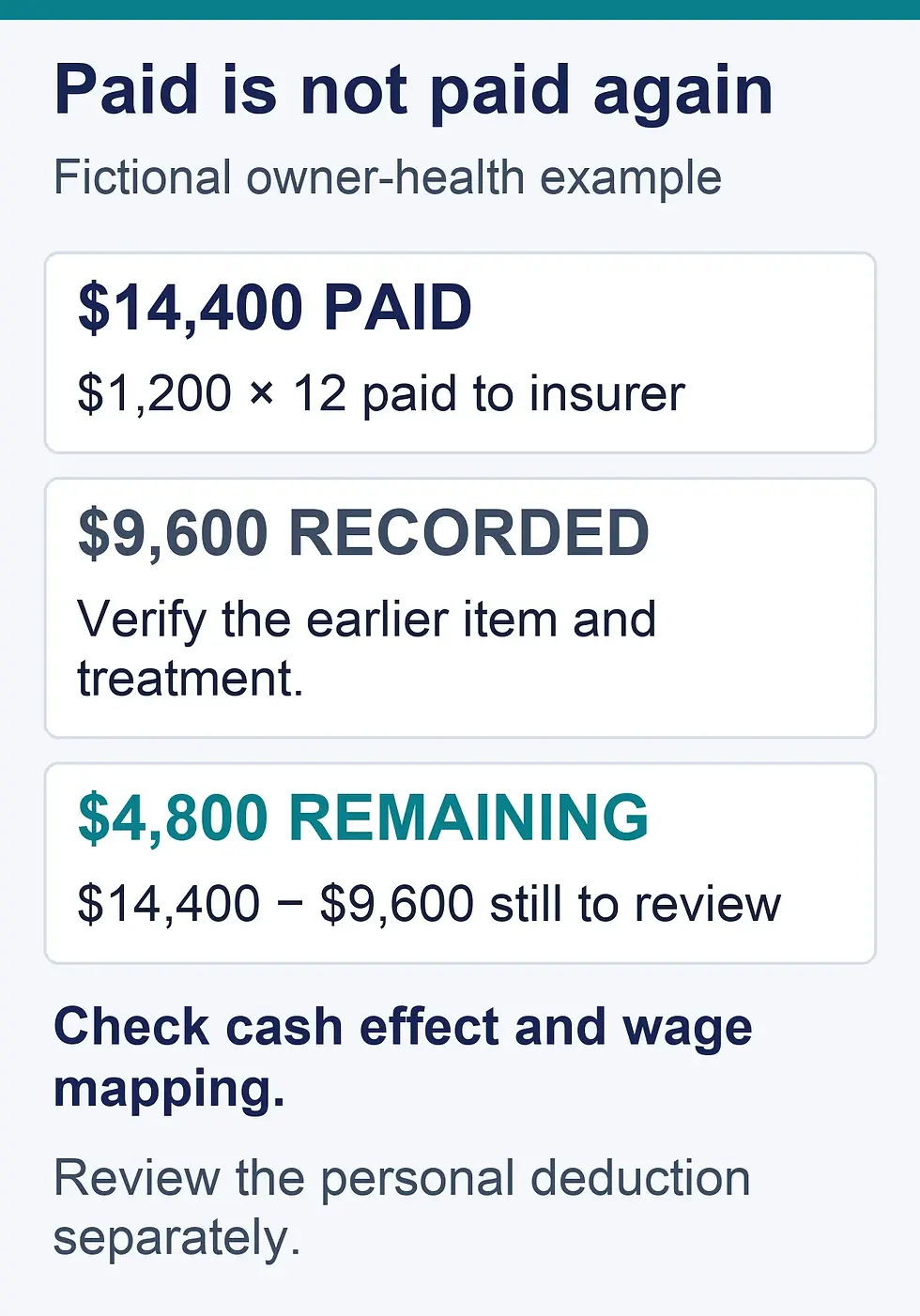
Example relationships: $1,200 × 12 = $14,400 paid; $14,400 − $9,600 already recorded = $4,800 still to review for entry. Cash effect, wage mapping and deduction eligibility require their own checks.
Price the first year separately from steady service
A routine monthly payroll quote may not describe the work required to get an existing owner onto the service. List what has already happened in the current year: compensation paid, benefits recorded, taxes deposited, returns filed and any corrections still open. Ask the new operator to state which history it will load, verify or leave with another party.
For a new S election or a changed tax classification, obtain professional advice on the effective period before scheduling entries. Do not use the date you bought payroll software as the tax-status effective date. Ask the adviser to identify any earlier activity requiring review, then quote that cleanup separately from prospective processing. This guide does not supply an election or retroactive-pay remedy.
Request separate quote lines for initial setup, prior-payroll entry, benefit corrections, additional or off-cycle runs, year-end forms and amended reporting. These are questions to ask, not claims that every provider charges for each item. For every included service, identify its limits and what triggers additional work. A vague promise of “year-end support” needs a description of the reports, review and correction responsibilities it covers.
Compare the cost of the same completed service. One proposal may leave benefit entry and report review with the owner; another may include operator entry but still require outside tax advice. Estimate the retained hours and professional fees using your own quote and availability. Do not convert missing services into assumed zero-cost work simply to produce a cheaper annual total.
Ask how you will approve additional work. Specify who can authorize a correction, whether the provider supplies an estimate and how an urgent issue reaches the person with authority. If an amendment concerns a period before the service began, name the party handling that period rather than assuming the current operator has accepted it.
Agree how the service handles changes and evidence
Put a review event into the engagement for changes in owner duties, ownership, benefit arrangements or compensation instructions. The business should know whom to notify and what evidence to provide. The operator should know when it needs an updated tax instruction rather than independently reinterpreting a change. Record the effective period and the point at which a revised instruction enters payroll.
Require a correction route for mistakes discovered after a run or a filing. Ask who diagnoses the issue, obtains professional input, calculates the correction, submits any necessary reporting and confirms completion. A support ticket number is useful for tracking, but closure should refer to the actual result and any remaining company action. Specify access to help after cancellation for work the provider has already undertaken.
For ordinary payroll-service outsourcing, the IRS warns that sending tax funds to a provider does not remove the employer's federal payment responsibility. Ask how the company will independently monitor deposits, receive agency notices and verify completed filings. If the proposed arrangement is a different third-party payer model, have an appropriate adviser explain its responsibilities rather than assuming the ordinary-service rules answer every question.
Keep the owner and accountant able to retrieve the agreed evidence: payroll registers, benefit detail, filed forms, deposit confirmations and correction records. Determine which reports are available, how they can be exported and who retains them. A screenshot of the dashboard cannot substitute for records another preparer needs to reconcile the year.
Arrange access for an absent owner without turning every adviser into a payment approver. Give each participant the access needed for the agreed task and establish a backup route for essential work. If an accountant only needs reports, verify that the proposed access supports review without giving broader bank-change or release authority by default.
The last step in an engagement should be as clear as the first. Ask what happens when the company changes providers, changes accountants or stops running payroll. Separate access removal, record retrieval, remaining filings and open corrections. A service ending on a certain date does not tell you who owns each unfinished task.
Complete the Owner-Pay Service Brief
Use this brief before a provider meeting, then complete a separate copy for each serious proposal. Refer to controlled records rather than pasting Social Security numbers, bank details, medical information or the full tax analysis into it. The brief is a buying and acceptance tool; the adviser's actual instruction remains the authority for tax treatment.
Owner facts and approved instructions
Complete these rows with the business and tax reviewer. An unresolved fact should carry a reviewer and a date for resolution before the affected setup is accepted.
Entity and period: Taxed-as-S-corporation confirmation and applicable year or effective-period reference: ______
Work and ownership review: Owner's duties, reviewed shareholder classification and review-record reference: ______
Compensation instruction: Approved cash-pay instruction, effective date and next review event: ______
Benefit facts: Required owner benefits, payment evidence and treatment-instruction references: ______
Earlier activity: Prior payroll, benefit entries and open corrections the proposal must address: ______
Tax reviewer: Named adviser, questions still open and decision due date: ______
Keep the ownership assessment and medical evidence in their proper files. This section records where the authorized decisions can be found.
Work included in this proposal
Write a named operator or retained company responsibility for each row. “Included” is incomplete without a result and the limits of the service.
Recurring pay: Input preparation, review, release and backup responsibilities: ______
Employment-tax work: Agreed filings, deposits, monitoring, notice handling and excluded periods: ______
Owner-benefit processing: Entry, wage/report validation and year-end review responsibilities: ______
Correction service: Who handles diagnosis, adviser input, amendments, fees and completion evidence: ______
Separate tax engagements: Who provides compensation advice, corporate-return work and individual-return review: ______
Price initial history or cleanup separately where necessary. Record which work the owner still performs even if the proposed subscription is described as full service.
Demonstration and buying decision
Complete these rows from observed outputs or an identified written specialist response. A proposed demonstration is not evidence that it has occurred.
Named configuration: Product, plan, operator and reviewed owner fact pattern used: ______
Reporting proof: Benefit item, affected wage bases, W-2 preview and adviser's response: ______
Cash and accounting proof: New-cash effect, earlier recorded amounts and bookkeeper's reconciliation: ______
Open condition: Unresolved capability or tax decision, responsible person and required evidence date: ______
Selection record: Choose, choose only after stated conditions, or decline; reason and exact proposal version: ______
Carry each unresolved item into the proposal acceptance record. Do not convert “specialist will confirm” into a supported feature while comparing quotes. Repeat the demonstration for a changed fact pattern that affects the required result.
Decide which proposal is ready to accept
A proposal is ready when your required tax decisions have appropriate owners, the operator has demonstrated the necessary implementation and the agreement covers the remaining work. Some outputs, such as a future annual filing, cannot exist yet. In that case, accept the documented service commitment and the available demonstration for what they establish, then schedule verification of the actual future result.
Choose conditionally when a specific, resolvable gap remains. For example, the provider may need a specialist to confirm a supported method for an existing benefit entry. Record the answer required, its owner and the date it must arrive. Keep the affected setup out of accepted status until that evidence is reviewed. A condition is useful only when it changes what the team is allowed to proceed with.
Decline a proposal when a required service is outside the provider's scope and nobody can reliably perform it. This can include a missing compensation adviser, unsupported benefit configuration or unassigned prior-year correction. The point is to obtain a complete arrangement, not to make one payroll brand responsible for every professional service.
After signing, use the brief in the first actual review. Compare the approved instruction with payroll output, confirm the cash and accounting result and retain the evidence promised in the engagement. A change in ownership, benefit arrangements or the owner's duties should trigger another scope review with the appropriate adviser. Update the brief and the engagement when that review changes the operator's instructions or responsibilities.
Explore the Decision Guides library.
See the Payroll Software Comparisons hub.

About the author
Ben Scott writes and maintains payroll decision guides for founders and operators. His work focuses on execution realities and how decisions hold up under growth, complexity, and controls and documentation pressure. He works hands-on in HR and leave-management roles that intersect with payroll-adjacent workflows such as benefits coordination, cutovers, and compliance-driven process controls.