Payroll API vs File Integration: Buy the Supported Exchange


Ask a payroll finalist to put a rejected change on screen. Who sees it, who repairs it and which part of the purchased service covers that repair? The answer often reveals more about the proposed integration than a slide labeled API or SFTP.
Choose the exchange that supports your required records, timing and recovery work under a clear agreement. An API can be the right route for frequent changes and a maintained application connection. An automated file feed can be the right route for a scheduled, reviewable batch. A manual export can also be workable when its operating effort is affordable and its controls fit the deadline. None earns the purchase merely by being available.
This guide helps U.S. employers compare payroll connections with retained time, HR, benefits or accounting systems. It separates the integration service you are buying from the payroll decisions your organization still owns. The Exchange Offer Record and all numerical examples are original buying tools, not results from hands-on vendor testing or promises about a particular product.

Bring both system names and your required exchange to the provider conversation.
SelectSoftware Reviews offers free payroll software matching help. Use it to explore providers that may support your integration needs, then confirm the exact connection, included work and price with each finalist.
Contents
Separate the route from the service
API, SFTP and CSV answer different questions. An application programming interface exposes defined operations through which software can request or change information. SFTP is a method of transferring files over SSH. CSV is a file format. A scheduled CSV file delivered by SFTP is one possible arrangement; an API can also move data in batches. These labels do not, by themselves, establish the frequency, level of automation or responsibility for a rejected record.
Compare four offers that may sit behind the same integration logo:
A maintained application connector. A provider or partner supplies the connection and maintains its supported behavior. Ask which company operates it and whether its maintenance covers changes at both ends.
Custom development using an API. Access to endpoints is a building block. Someone still has to design, build, authorize, test, host and support the actual exchange.
A managed file exchange. A scheduled job creates, transfers and imports an agreed file. Its scope may cover the complete route or stop at a server folder.
A manual export and import. Staff select, download, review and upload the file. The recurring labor and absence coverage belong in the comparison.
ADP's integration materials distinguish marketplace applications, custom API access and file-based routes. Its technical whitepaper also assigns different parts of a file exchange to ADP, the client and third parties. Treat that as a reason to obtain the responsibility map for your exact ADP product and offer, not as evidence that every route is included in every subscription.
Ask the seller to mark every handoff on one page: source application, connector or transformation service, delivery point, destination import and business review. A marketplace listing identifies an offering; obtain the order form and applicable service description to establish what your employer will receive.
A two-way connection needs two descriptions. Employee changes flowing into payroll and payroll results flowing back to HR can use different fields, timing and technologies. A hybrid arrangement is acceptable when its parts are explicit. Calling the connection two-way does not establish conflict resolution or support for every change in either direction.

The channel, the information it can carry and the service that keeps it operating need separate evidence in the offer.
Make availability the first buying gate
Before comparing features, confirm that your employer can actually use the proposed route. Record the precise payroll product, account type, destination application, country and integration owner. Then ask whether production access requires a particular plan, add-on, partner, customer approval or separately purchased service.
Gusto's customer guidance currently distinguishes partner-built app integrations and Embedded Payroll, and says direct API access is not supported for customers connecting their own company systems to their Gusto account. That does not mean an employer cannot use a supported Gusto app. It means a proposal to build a private connection needs a supported access route rather than an assumption based on public documentation.
Gusto's developer introduction also points customers toward separate CLI and MCP options. Confirm whether one fits the proposed supported service rather than treating it as partner API entitlement.
Development access and production authorization also differ. Gusto's App Integrations introduction describes a review before production keys and application scopes assigned to the integration's use case. A successful sandbox demonstration does not establish that the same operations are authorized for your purchased production arrangement.
Apply the same question to a file proposal. Can the destination import the required record type through the proposed service? Who enables it? Does the fee cover one employer, several employers, one layout or later layout changes? If the seller offers only a download, do not silently budget as if it includes a scheduled receiving process.
Use three availability outcomes: confirmed for the specified offer, unresolved pending evidence, or unavailable for the requirement. An unresolved essential item stays outside the accepted scope until it is resolved. Avoid accepting a future roadmap feature as the only way the first live payroll will work.
Write the exchange in business terms
Start with one event the connection must handle, such as approved hours for a defined period or an employee's authorized department change. Specify what must reach which employer record, by when, and what result the payroll reviewer needs to inspect.
For each essential event, require an example with:
The source and destination identifiers, including how multiple employers or rehires remain distinguishable.
The exact fields, units and supported values, including any required code translation.
The direction of movement and whether the operation creates, adds to, updates or replaces data.
The event date, effective date, pay period and submission cutoff where those affect treatment.
The destination state that counts as success and the evidence available to the employer.
A field named department may refer to a home department, a labor allocation on a time record or an accounting dimension. A connection that transfers one of them does not necessarily transfer the others. Have the seller demonstrate the actual requirement before treating a matching field name as coverage.
Include changes that arrive out of sequence. Ask how a future-dated instruction is stored, how a correction replaces an earlier instruction and what happens when an employee is terminated and rehired. If the destination lacks a required concept, record the supported alternative and its operating cost. A custom field is useful only if the relevant calculation or downstream process can use it.
Keep the purchase decision distinct from assigning field authority. HR may approve an employment change while payroll determines how an authorized instruction enters the run. The integration can carry that instruction without acquiring authority to resolve an underlying compensation or benefit dispute.
For accounting routes, identify the actual transaction and its level of detail. A summarized journal, a set of bills and employee-level detail are different results. For QuickBooks, identify the company file and the transaction the connector creates. For Xero, identify the organization and whether the route produces a journal or a bill. The transport choice alone does not establish posting quality.
Price the time until a usable result
Ask for the elapsed time from an approved source event to a verified destination result. Break it into source availability, extraction or event detection, transfer, processing and business review. If a rejection occurs, the recovery interval must also fit the payroll deadline.
An API may be polled on a schedule. A webhook may notify another application that something changed, after which that application retrieves or processes the record. A file feed may run several times daily. Buy the timing your payroll needs rather than equating API with instantaneous or file with overnight.
A fictional time feed illustrates the issue. Approved hours become available at 2:00 p.m. A proposal allows up to 15 minutes before detection, 10 minutes for processing and 30 minutes for the agreed recovery exercise. That consumes 55 minutes before a 3:00 p.m. acceptance deadline, leaving five minutes. A second retry or missing approval could exhaust the interval. These are illustrative planning allowances, not a recommended universal buffer or a vendor service level.
Have the provider demonstrate the ordinary path and a missed cycle at the expected volume. Include the destination's processing window, business hours, weekends and relevant time zone. A fast transfer into a queue that is not processed until tomorrow does not meet a same-day requirement.
Paylocity's current rate-limit documentation says endpoints have designated limits and that Weblink limits differ from its other API documentation. Ask which limits apply to the actual connection and how the operator handles throttling. A general limit copied from another API family is not a defensible capacity assumption.
Specify how the employer learns that nothing arrived. A failure notification can report a rejected attempt, but a job that never started may generate no such attempt. Request a missing-delivery check tied to the expected schedule, together with a named escalation route.
Require a recovery demonstration before signing
Ask the integration operator to show one interrupted delivery in a safe demonstration environment. Stop the explanation at the point where the sender cannot tell whether the destination accepted the work. Then ask what the operator checks before sending it again.
The buying requirement is a documented way to avoid duplicating or overwriting valid work while recovering the missing result. Request the supported retry behavior, identifier, scope and time limit for the exact operation. AWS's engineering discussion of idempotent APIs explains how caller-provided request identifiers can support safe retries. It does not establish that a particular payroll endpoint has that feature.
For files, ask whether the import accepts or rejects the whole batch, processes individual rows, or leaves work in a staging state. Have the provider show the row-level result and the permitted correction method. Renaming and resending a file can create a second import unless the actual receiving service prevents it.
For APIs, distinguish an accepted request from a completed business operation. Ask how the employer finds the final state, what an error response means and how an uncertain result is investigated. Do not assume a success code authorizes payroll release.
Webhook delivery adds another responsibility. Gusto's App Integrations best practices describe possible duplicate events and delivery that is not guaranteed to arrive in order. Ask a proposed connector operator how it recognizes repeats, handles older events and confirms the final record. Those are product-specific facts supporting the question, not a claim that every vendor uses the same event model.
Use a fictional three-record demonstration. Two approved changes reach the destination and the third is rejected for an invalid code. The acceptable explanation identifies the two accepted changes, corrects only the unsupported instruction through the approved route and verifies the final three records. A response that merely shows three later successes leaves the earlier accepted work unexplained.
Agree who can authorize a replacement, rollback or manual fallback. A technical operator can restore a connection while a payroll reviewer still needs to reconcile the affected run. The purchase should provide the evidence and assistance needed for that decision without transferring wage approval to a connector vendor.
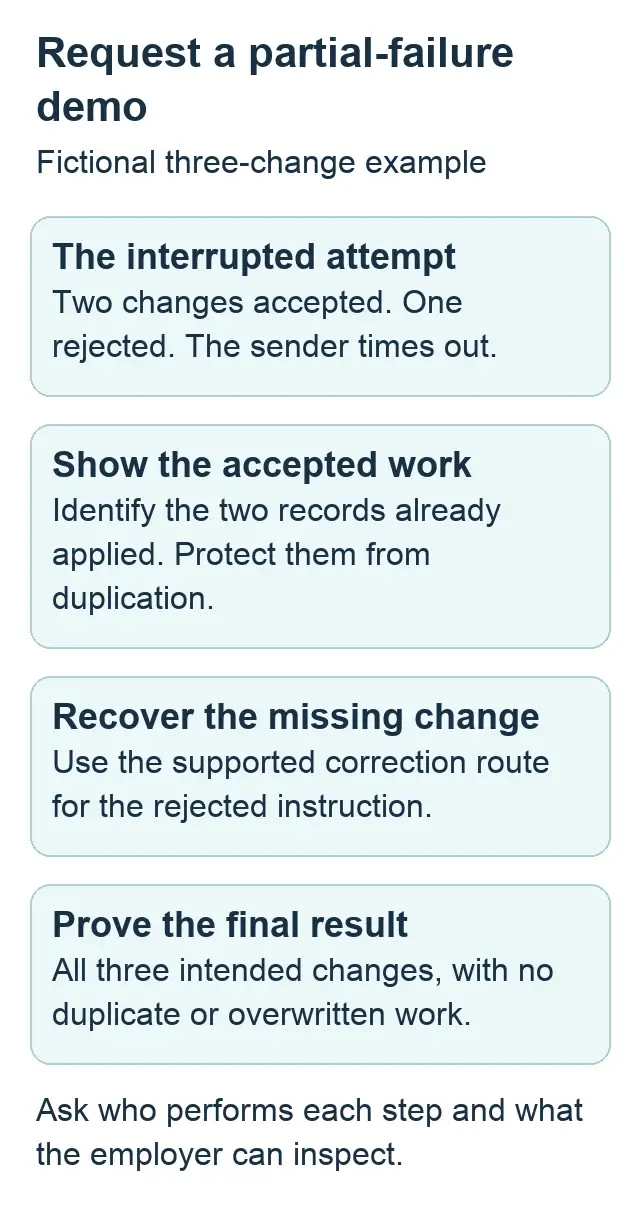
Request a demonstration of the uncertain outcome and its recovery, with an owner and inspectable evidence for each step.
Put maintenance and support on the order form
Ask who operates each part after the implementation team leaves. Name the provider support route, the integration operator and the employer's payroll contact. Specify who opens a cross-vendor case and remains responsible when each supplier says its own system is working.
Separate receiving a ticket, restoring the connection and verifying the payroll result. A response-time commitment does not establish how soon a rejected batch will be repaired. Request the applicable coverage hours, escalation channel, severity definition and exclusions for the service you are buying.
Include routine change work: a new earning code, an added employer, a changed destination field, a credential rotation and a supplier API or layout update. For each, ask whether the operator monitors the change, tests it, implements it and charges for it. Identify who maintains the test examples and who approves the business mapping.
Gusto's published App Integrations versioning policy describes dated versions and eventual retirement. The practical buying question is who watches deprecation notices, schedules the upgrade and retests your supported use cases. Do not assume an integration remains unchanged because the payroll subscription continues.
For a file connection, request the corresponding layout and version-change process. Ask how a new column, changed code set or revised filename is communicated. Both routes need a supported change process; they may differ in how often particular changes occur.
Have security review the actual access and storage arrangement. Confirm the service identity, permitted data, credential owner, server or application verification, intermediate storage and log access. Keep passwords, private keys and actual employee identifiers out of buying worksheets. Neither the word secure nor an encrypted transport establishes appropriate permissions after delivery.
Microsoft's SFTP connector guidance illustrates another boundary: its connector supplies file-management operations inside workflows that someone creates. A usable connector component is not, by itself, a maintained payroll integration service. Ask which organization supplies and supports the complete workflow in your proposal.
Price the complete supported connection alongside the payroll service.
A free SelectSoftware Reviews advisor conversation can help you discuss payroll options when the proposed integration leaves work uncovered. Ask the provider and integration operator to verify their own scope and recovery responsibilities.
Compare full costs over the same period
Request a quote that separates setup, recurring access, connector operation, usage charges, supported changes, testing and support. Add the employer's expected review and exception-handling time. Treat unpriced essential work as unresolved rather than zero.
Use the same assumptions for every offer: employers, active connections, direction of movement, expected records or transactions, payroll calendar, implementation period and comparison horizon. An included outbound feed may still leave a separately priced inbound route. Confirm what happens if usage, headcount or the number of employers increases.
Consider two fictional offers that both pass the essential requirements:
Offer A, managed API: $6,000 setup, $4,800 annual service, 24 internal hours annually at an assumed $60 per hour, and a $600 annual change allowance.
Offer B, managed SFTP: $2,500 setup, $2,400 annual service, 48 internal hours annually at the same $60 rate, and the same $600 annual change allowance.
Offer A's illustrated annual operating amount is $4,800 + $1,440 + $600 = $6,840. Offer B's is $2,400 + $2,880 + $600 = $5,880. Over three years, including setup once, the totals are $26,520 and $20,140. Offer A costs $6,380 more on these assumptions despite requiring fewer internal hours.
That arithmetic does not decide the purchase. If only A can meet an essential acceptance deadline, B is not a lower-cost solution to that requirement. If both meet it, examine whether A's additional capability is worth the difference. If B's extra labor cannot be staffed during absences, its cost estimate describes capacity you do not actually have.
The allowances are planning assumptions, not named-provider prices or predictions of error savings. Record the quote date, minimum term, renewal basis, taxes and cancellation charges separately. Avoid turning a speculative reduction in payroll errors into guaranteed financial savings.
Complete an Exchange Offer Record
Copy one record for each proposed route. Keep the evidence in an approved workspace and use references here rather than employee data or access secrets. Mark each essential requirement as supported, unresolved or unavailable; do not average an unavailable essential requirement into an otherwise attractive score.
A. Offer and eligibility
Offer reference: Vendor, integration operator, product/account configuration and quote date: ____________________.
Exchange boundary: Source, destination, legal employers and each direction being purchased: ____________________.
Production eligibility: Required plan, approval, access entitlement and party confirming availability: ____________________.
Included service: Maintained connector, custom build, managed file service or manual work; exact start and end points: ____________________.
Evidence reference: Applicable service description, field specification and demonstration record: ____________________.
B. Required behavior
Business event: The approved instruction or result this route must move: ____________________.
Field meaning: Identifiers, code translation, units and any unsupported essential field: ____________________.
Change behavior: Create, add, update or replace; future dates, corrections and rehire treatment: ____________________.
Accepted result: Destination state, record count or item comparison and evidence the employer can inspect: ____________________.
Timing requirement: Source availability, required acceptance time, volume and recovery allowance: ____________________.
C. Recovery and ongoing ownership
Uncertain outcome: Supported investigation and retry method, identifier and any time limit: ____________________.
Partial rejection: How accepted items are protected and rejected items are corrected: ____________________.
Missing delivery: Expected-cycle monitor, notification recipient and escalation deadline: ____________________.
Maintenance owner: Who monitors API/layout changes and pays for testing and implementation: ____________________.
Security handoff: Approved service identity, access/storage owner and credential-rotation responsibility: ____________________.
Support coverage: Case owner, coverage hours, cross-vendor escalation and applicable exclusions: ____________________.
D. Cost and purchase decision
Setup amount: One-time provider, partner and employer implementation costs: ____________________.
Recurring amount: Access, operation, usage and support under the same annual assumptions: ____________________.
Employer capacity: Review/exception hours, valuation assumption and absence coverage: ____________________.
Change and exit work: Included allowance, billable changes, export assistance and termination costs: ____________________.
Comparable total: Chosen horizon, setup once, recurring amounts and explicitly unresolved costs: ____________________.
Decision and conditions: Supported essential requirements, unresolved evidence, chosen route and approving owner: ____________________.
Review trigger: First live verification, material volume/scope change or support/contract review date: ____________________.
Keep section labels, each field and explanatory notes separate when copying the record. The field list is a buying record, not an authorization to send payroll or a substitute for the employer's payroll release controls.
For the fictional cost comparison, the comparable-total field reads A $26,520 and B $20,140 over three years, with the stated internal-hour and change assumptions. If both meet timing, the decision field can prefer B subject to confirmed staffing and support. If B misses an essential deadline, mark that requirement unavailable and return to the offer; do not write approved beside the cheaper total.
Choose a route the team can sustain
Favor a maintained API connection when the required operations and production entitlement are confirmed, the expected timing matters and a named operator maintains the complete route. A custom build can also fit when the business needs justify it and the employer has funded ownership beyond the initial project.
Favor an automated file exchange when scheduled batches satisfy the business requirement, the layout carries the necessary information and the service provides usable acceptance and recovery evidence. A file route can be automated and well supported. Its suitability depends on the actual schedule, importer and responsibilities.
Keep a manual route only when staff can perform and independently review its recurring work at the required frequency, including absences. Budget it as an operating process. A temporary manual bridge needs a defined end condition and a viable fallback if the automated route is delayed.
Use more than one route when the record types genuinely need different services. For example, a maintained employee-change API and a scheduled accounting export can be evaluated separately. Name each owner and reconcile their shared identifiers; do not let a hybrid proposal hide work that neither agreement covers.
Before signing, obtain the supported scope, demonstration results, price assumptions and unresolved conditions in writing. Before the first live run, verify the chosen exchange in the purchased configuration, retain the result and hand ongoing checks to named people. The commercial selection ends with a service the team can operate; payroll release still requires its own review.
Questions to settle with the seller
Is an API automatically faster or safer than a file feed?
No. Timing depends on detection, scheduling, processing, review and recovery. Security depends on the actual authorization, configuration and storage controls. Ask for the required behavior in the proposed service rather than treating the technology label as the result.
Does two-way integration mean every field moves both ways?
No. Require separate field lists, supported actions and timing for each direction. A return status or results file can make an arrangement bidirectional without letting HR update every payroll field.
Can we accept the integration if one essential field needs a manual workaround?
Only after the responsible owners accept a supported workaround that meets the requirement. Record who performs it, its cost, its review and what happens during absence or failure. If the workaround cannot preserve the required result, the proposal does not meet that requirement.
What should we do when the demo works but production access is pending?
Keep production eligibility unresolved and make approval a purchase or launch condition. Confirm the supplier's process and the allowed test environment. Do not place real payroll data into an unauthorized environment or invent a production workaround to meet an implementation date.
Use your completed Exchange Offer Record to discuss the payroll purchase.
SelectSoftware Reviews provides free payroll software matching help. Bring the unresolved fields, timing and service responsibilities to the conversation, and verify the recommended provider's actual offer before committing.
Continue comparing payroll services:

About the author
Ben Scott writes and maintains payroll decision guides for founders and operators. His work focuses on execution realities and how decisions hold up under growth, complexity, and controls and documentation pressure. He works hands-on in HR and leave-management roles that intersect with payroll-adjacent workflows such as benefits coordination, cutovers, and compliance-driven process controls.