Payroll Implementation Contracts: Define What the Fee Buys


The proposal has one line for implementation. Your payroll lead expects a reconciled opening position, configured pay rules and two trial runs. The provider expects a completed template, one import and an online training session. The fee can be perfectly clear while the work remains unresolved.
Before approving payroll implementation fees, translate the proposal into specific work, inputs, evidence and commercial decisions. Identify what the supplier will deliver, what your team must prepare, how completion will be judged and what can change the price. Then compare proposals against the same required outcome.
This guide is for a U.S. employer reviewing an implementation offer with its payroll, finance, procurement and legal owners. It provides a practical buying method and a copyable Scope-to-Fee Worksheet. It does not determine your contract rights or supply contract language for every provider. The worked quotes are fictional, and an operational recommendation here does not override the agreement your authorized reviewers approve.
Contents
Give the implementation line a defined boundary
Start with the decision the employer needs to make: can this offer produce the required payroll setup with people, money and time the organization can actually supply? A single implementation amount cannot answer that question when the parties have different populations, histories or integrations in mind.
Write the baseline before asking whether the price is competitive. Identify the employing entities, payroll accounts, pay groups, jurisdictions, worker populations, intended first pay date and systems involved. State the date at which that baseline was agreed. Adding an employer after the quote can affect more than the number of records in an import.
Describe the service boundary in ordinary verbs. Will the supplier extract, interpret, cleanse, map, configure, load, reconcile, test, train or support? Those are separate tasks. A promise to load a customer template does not, without more, establish who will resolve inconsistent source records or prove that the loaded history is right.
Keep the operational result next to each verb. For example: the provider loads the agreed current-year wage and tax categories, produces receiving-system reports, supports an employee-level comparison and resolves differences assigned to its import work. The employer supplies reconciled source reports and reviews the result. That is more usable than a line saying conversion assistance, even though the actual agreement may use different terminology.
Separate mandatory outcomes from optional improvements. A needed opening tax balance, supported payment route or required pay rule must have a workable delivery path before the purchase is approved. An additional dashboard can be separately priced or deferred. Removing an essential output from the comparison does not make a smaller quote meet the same need.
Where a provider offers a standardized self-service setup rather than a negotiated project, use the same questions to assess the published service and the employer work it leaves. You may not be able to negotiate individual acceptance terms. You can still decide whether the available assistance and your own capacity form a feasible implementation.
Read the documents as one proposed arrangement
Collect the actual order, implementation statement of work, service description, applicable terms, pricing schedule and written clarifications. Record their versions and which company supplies each part of the work. A slide shown during a demo is useful context, but ask the authorized commercial reviewer how that promise enters the arrangement being approved.
Have the contract reviewer identify the governing terms, order of precedence, change process and any acceptance or objection deadlines. Do not invent a universal rule that a statement of work always controls the master terms, or that an email always changes the signed order. The operational team needs the reviewer's conclusion and the resulting instructions.
For a concrete example of layered terms, Gusto's employer terms incorporate applicable additional service terms and state that those additional terms control conflicts on their subject matter. The same employer terms address customer-data responsibilities and possible additional fees for setup, exceptions and special services. That example is a reason to inspect the actual documents, not evidence that every Gusto customer will pay a particular implementation fee.
Ask what happens if the documents describe the work differently. A fixed fee in the order, an estimated effort allowance in the service description and an exclusion in an appendix may require clarification together. Preserve the answer with the reviewed version. A spreadsheet created internally can explain your comparison; it cannot by itself amend the provider's commitment.
Keep unresolved commercial questions visible. Identify the person obtaining the answer, the required decision date and whether the uncertainty prevents approval. A blank price or an unconfirmed responsibility should not quietly become an assumed inclusion when someone totals the quotes.
Specify the delivered result, not just a data upload
Divide the work into deliverables that can be reviewed. Employer and worker setup, historical balances, pay-rule configuration, interfaces, testing, training and the handoff may need different owners and evidence. A service can support some of these without delivering all of them.
For historical data, specify the records and periods being transferred, the balance definitions and the intended use. An opening year-to-date amount, a prior-year reporting archive and a document repository are different deliverables. State what will be loaded into the new system, what will remain retrievable elsewhere and who accepts each route. Do not buy a general promise of history without knowing which history survives.
For mapping and cleanup, identify who decides what the source values mean and who changes them. Fixing a format, resolving duplicate worker identities and deciding the correct benefit balance require different evidence. If your organization must supply a clean template, price and staff that work on your side. If the supplier undertakes it, define the input condition, expected output and exceptions it will return for a decision.
For configuration, name the rules and affected populations. A demonstration that one hourly employee can be paid does not establish that the purchased setup handles an overnight premium, a continuing deduction, a separate employing entity or another required condition. The payroll owner supplies the approved business instruction; identify who configures it and what evidence confirms the result.
For an integration, describe the exchange that must work: source and destination, direction, data, timing, supported volume, error handling and ongoing support. Separate access to an application interface from the development and operation of a connection. Identify any partner agreement, customer subscription or authorization that must exist before the provider can complete its part.
For training and documentation, identify the audience and the task the person must be able to perform. Attendance at a webinar is different from a trained backup who can review a run and route a correction. Ask what materials remain available after the project and which continuing service handles questions that arise later.
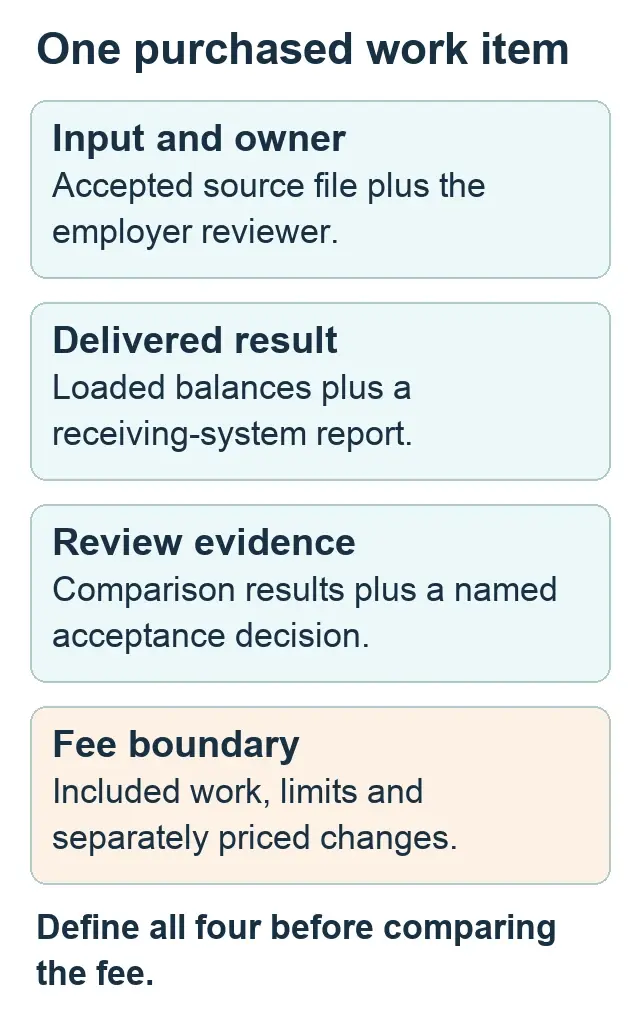
An uploaded file is one event. The purchased result also needs an agreed review and a commercial boundary.
Count the employer work before accepting the timetable
A proposal can include substantial assistance while leaving consequential work with the employer. List the source exports, data decisions, registrations, approvals, bank steps, access and staff availability that must be ready. Assign each item to a named role with an expected effort and due date.
Current Gusto account-setup instructions, for example, require employer and worker information and include separate setup steps for company taxes, prior payroll and the bank account. The presence of an onboarding process does not establish that a supplier will reconstruct missing records or obtain every employer decision. Confirm the actual purchased assistance and the facts required from your organization.
Read dependency dates in both directions. When must the employer provide an accepted source file, and when must the supplier provide the specification that makes that file possible? Who reviews a rejection, how quickly can the issue be resolved and which later milestone depends on it? A deadline to supply a template is weak planning when the required columns are still under discussion.
Price the employer's effort separately from supplier invoices. Payroll specialists, finance reviewers, project coordination and an outside accountant may need time during an ordinary payroll cycle. An internal estimate is not an additional provider charge, but it can determine whether the cheaper offer is deliverable with available staff.
Ask what a delay does to resources, dates and fees. Does the supplier reserve the team, rebook work, charge for additional sessions or require a new plan? Which circumstances count as customer delay? Record the terms and have the appropriate reviewers resolve ambiguity before treating a target date as committed.
For illustration, Simployer's published implementation statement of work separates supplier and customer activities, excludes certain data-cleanup and custom-development work, and describes consequences for specified customer-related delays. It concerns Simployer One HR implementation, not a universal U.S. payroll contract. Its practical lesson is to inspect the allocation of work rather than infer it from an implementation label.
Decide which test rounds and repairs the fee covers
Specify the testing bought with the implementation. Identify the population and required behaviors, the source and configuration versions, the outputs to be compared and the reviewer. A demonstration, a sample calculation, a parallel run and a final live-payroll release review serve different purposes.
Ask how many planned rounds are included and what a round means. Does a supplier count one file submission, one complete comparison or one session with a consultant? What happens when the agreed test cannot be completed because the environment or a required input was unavailable? Record the commercial treatment instead of discovering it when an invoice lists additional testing.
Separate correction of an agreed deliverable from a request to expand it. If the supplier loaded the agreed file incorrectly, that is a different question from the employer adding another entity or requesting an unpriced interface. The actual obligations, remedies and fees depend on the agreement and its review. Do not assume that every retest is free, or accept a new fee without establishing what changed and why.
For each issue, retain the baseline requirement, observed result, evidence, proposed correction and affected test scope. A mismatch can arise from a source error, interpretation, configuration or a provider defect. Labeling everything a change order obscures responsibility; labeling everything a defect can do the same.
Have the reviewer identify the evidence required after a correction. A repaired field may affect a wider population or a later output. Buying one extra trial does not establish that one extra trial is sufficient. If a necessary result remains unproven, retain the unresolved condition and its decision owner rather than approving the project solely because the purchased sessions have been used.
Preserve the agreed testing package with the quote comparison. A price that covers more relevant verification may be useful. A larger count of vaguely defined sessions may add little. Compare the evidence the team will receive and its ability to act on the results.
Keep acceptance, invoicing and the first payroll distinct
Identify the events that can trigger completion, acceptance, an invoice, the end of implementation support or the start of a subscription. Ask whether time passing, production use or another action can have a commercial effect. Have the contract reviewer explain what the actual terms require the employer to do, including any notice route and deadline for objections.
The Simployer SOW cited above, for example, connects completion to delivery of its stated deliverables and confirmation of go-live or written customer acceptance, whichever occurs first. That is an example of a document-specific trigger, not a recommended clause for your purchase. Read your own trigger before relying on an internal signoff form as the only relevant event.
An operational acceptance record should identify the deliverable, reviewed version, evidence, remaining conditions and person accepting the result. A payroll reviewer can assess calculation evidence; a finance reviewer can assess the agreed accounting output. Someone with commercial authority must decide what the result means for the purchase and any disputed fee.
Keep that review separate from authorizing the first real payroll. A commercially completed setup can still require current employee inputs, bank confirmation, a funding decision and final approval of the actual run. Conversely, making a necessary employee payment does not by itself settle an unresolved invoice dispute or establish what the parties' contract says about acceptance.
Arrange the approval timetable so the people who need to review evidence can do so. Identify holidays, ordinary payroll deadlines and absences that reduce capacity. If an acceptance period begins before a reviewer receives usable evidence, raise that mismatch with the commercial owner before approving the arrangement.
Avoid promising that withholding a signature preserves every right or stops every charge. Record objections and unresolved work through the agreed route, with the appropriate legal or procurement advice. The worksheet supports that review; it does not determine the enforceability of a term.
Normalize two quotes against the same required work
Consider a fictional employer, Alder Design, comparing implementation offers for two employing entities, 90 employees and three states. Its required package includes the agreed current-year opening balances, identified data cleanup, configuration of a supported existing time feed, two planned parallel comparisons, specified correction support, training and handoff. Both suppliers must confirm that they can deliver this package before the financial comparison is meaningful.
Offer A quotes a fixed $5,000 for that defined package. Offer B initially quotes $3,500 for a narrower package. During clarification, B separately prices $1,200 for the required cleanup, $600 for the second planned parallel comparison and $450 for the required project coordination. With those written additions, B's comparable supplier fee is $5,750: $3,500 + $1,200 + $600 + $450.
The initial $1,500 apparent saving becomes a $750 higher supplier fee for B on the normalized scope. These invented amounts illustrate the method; they are not vendor prices, market averages or an estimate for your implementation. Verify that both offers cover the same result, rather than treating a sum of fees as proof of comparable service.
Now compare employer effort separately. Suppose the employer's accepted planning estimates are 30 hours for A and 45 hours for B. At an illustrative internal costing rate of $50 an hour, the labor estimates are $1,500 and $2,250. The combined planning views are therefore $6,500 for A and $8,000 for B. The supplier invoices remain $5,000 and $5,750; internal labor is not money owed to the provider.
This arithmetic does not automatically select A. Review timing, the evidence each team can produce, staff capacity, necessary service capabilities and unresolved terms. If A cannot meet an essential requirement, its smaller total does not cure that failure. If B supplies a needed capability absent from A, the scope comparison must show that difference before anyone treats the totals as equivalent.
Keep unresolved required work out of an apparently final total. Mark its price or delivery route as unresolved, with an owner and decision date. Do not enter zero because a provider has not priced it. Where hourly work is proposed, record the rate, estimated units, approval threshold and any agreed cap, including what happens when the allowance is exhausted.

Normalize the required work first. Keep supplier fees, employer effort and unresolved conditions distinguishable.
Give new work a price and an authorized decision
Preserve the baseline that was accepted. When a request arrives, identify the affected deliverable and explain the difference from that baseline. A change request should describe an observable addition or alteration, rather than a generic instruction to do whatever is needed to reach the original outcome.
Use the issue evidence to decide whether the request concerns corrective work under the existing scope, new scope, a changed customer input, a delay or a disputed responsibility. Route disagreement to the responsible commercial and technical owners. The payroll operator should not be expected to decide a contested contract merely because a pay date is approaching.
Ask for the fee and timing effect before authorizing new work. Specify the unit being purchased, rate or fixed amount, assumptions, revised output, affected milestone and required retest. Identify who may approve it for the employer and supplier. A project contact who can answer a configuration question may not have authority to commit additional budget.
For example, suppose Alder later adds a third employing entity. The parties review the new population, setup and history work, dependencies and testing. A proposed $1,900 addition to B's accepted $5,750 supplier package would make $7,650 if authorized as stated. Do not merely multiply the original per-employee assumption and assume that it captures all of the work for the new employing entity.
Record what happens while a decision is pending. Can unaffected work continue? Must a dependent test wait? Is a safe revised launch date available? Commercial approval cannot remove an employee-payment or tax deadline. Escalate any conflict to the people responsible for that obligation and the actual processing route.
Update the scope, budget and acceptance evidence together after approval. Keep the prior version and the change reference so the team can explain why the final deliverable or invoice differs from the original proposal. An approved extra fee should have an identifiable purchased result, not disappear into an untraceable implementation total.
Use the Scope-to-Fee Worksheet
Complete one deliverable record for each material work item, then repeat the change section whenever the agreed baseline changes. Keep restricted employee data in the approved source systems and reference it here. The fields are purchasing and review prompts, not a replacement for the supplier's contract or the employer's approval rules.
Describe one purchased result
Work item and baseline: Deliverable reference, employing entities, population, period and reviewed proposal version: ______.
Supplier output: Specific work and the receiving report, configuration, file or other result to be delivered: ______.
Employer contribution: Source evidence, cleanup or decision to be supplied, responsible person and due date: ______.
Dependencies and limits: Other parties, access, assumptions, exclusions and unresolved essential requirements: ______.
Acceptance evidence: Required observed result, tested version, reviewer, review window and treatment of an unresolved item: ______.
Record the money and timing
Supplier fee basis: Fixed amount or rate and units; included rounds, allowance, cap and separately priced work: ______.
Employer effort: Named roles, accepted hour estimates and internal costing basis, kept separate from supplier charges: ______.
Commercial triggers: Relevant invoice, acceptance, production-use, subscription and support-ending events, with the contract review reference: ______.
Implementation dates: Input readiness, delivery, review and planned go-live; affected payroll obligations and owners: ______.
Comparable total: Required supplier package ______; separately estimated employer effort ______; unresolved price or delivery conditions ______.
Authorize a specific change
Change and cause: Difference from baseline; correction, new work, changed input, delay or disputed classification, with evidence: ______.
Effect and price: Revised output, fee or units, timing, dependent work and required retest: ______.
Decision authority: Employer and supplier approvers, decision reference, date and instructions while pending: ______.
Revised baseline: Accepted scope and budget version, retained prior record, acceptance owner and invoice-check reference: ______.
Add priced required items to obtain the comparable supplier package. Add employer effort only in a separately labeled planning view. An unresolved essential item is a condition to settle, not a zero-cost entry. Preserve the assumptions behind every calculation so a later reviewer can reproduce it.
Close the project without losing the remaining obligations
Before the implementation team hands over, collect the accepted configurations, mappings, test results, known limitations, unresolved work and ongoing contacts. Identify what evidence the employer may retain and how it can retrieve needed records after temporary project access ends. Test retrieval with someone who will use the record later.
Confirm the tax-service boundary explicitly. The IRS's explanation of payroll service providers and reporting agents states that these arrangements do not relieve employers of their employment-tax obligations. Other payer structures require their own review. A successful implementation or a contract line saying taxes included is not sufficient evidence that a particular deposit or return was completed.
Assign outstanding history, filing, registration, interface and benefit questions to the responsible continuing service or employer owner. Specify the evidence needed to close each item. A project can end while separately assigned work remains, but the handoff should not leave an essential payroll activity without an operating route.
Compare the final supplier invoice with the original accepted work and authorized changes. Distinguish fees from wages, tax funding, benefits money and internal labor estimates. Route disputed commercial items through the agreed process while the relevant owners protect ongoing payroll and record access. Do not let an invoice reconciliation substitute for verifying employee payments.
The result of this review should be a purchase the employer can explain: the required work has a delivery path, the price has a defined basis, customer effort is staffed and changes need an identifiable decision. Retain that record with the actual agreement and implementation evidence. It will be useful when a project contact changes or a later invoice raises a question nobody remembers deciding.
Questions about a quoted implementation fee
Does no implementation fee mean the employer has no setup work?
No. Establish the available onboarding assistance and the inputs, decisions, configuration and review that remain with the employer. A zero supplier fee can be a suitable offer when your team can complete that work; it does not prove that all required setup is done for you.
Should every implementation use a fixed fee?
Not necessarily. Compare the actual work and uncertainty. A bounded package can make fixed pricing useful, while uncertain cleanup or custom work may be offered by agreed units or hours. In either case, specify what is included, how additional work is approved and what happens when an allowance or cap is reached. The label alone does not settle the risk.
Can payroll approve a change because it protects the first payday?
Not on that basis alone. Payroll should explain the dependency, payment risk and latest useful decision time. The person with commercial authority must approve the purchase under the employer's rules, while the responsible payroll and legal owners determine the lawful payment response. An urgent date does not silently give every project participant budget authority.
Explore the next payroll decision:

About the author
Ben Scott writes and maintains payroll decision guides for founders and operators. His work focuses on execution realities and how decisions hold up under growth, complexity, and controls and documentation pressure. He works hands-on in HR and leave-management roles that intersect with payroll-adjacent workflows such as benefits coordination, cutovers, and compliance-driven process controls.