Payroll SOC Reports: Turn Assurance Evidence Into Buying Requirements

Updated: 16 hours ago

A payroll SOC review should end with supported conclusions, named gaps and decisions someone can approve. A report may support the provider's calculation service while leaving a tax-remittance partner outside its examination. Your purchasing record needs to show that boundary before the sales conversation turns into an implementation commitment.
SOC means System and Organization Controls. The reports come from examinations of a service organization's controls. For an employer buying payroll, the useful question is which parts of the proposed service the actual report addresses, over what dates and with what responsibilities still assigned to the employer.
Use the Payroll Assurance Review Record below to connect the report to your purchase. It is an original operating aid for U.S. payroll, finance, security and procurement teams. Your financial-statement auditor decides whether evidence meets the needs of its audit. This guide does not issue an audit opinion, certify a provider or assess a confidential report it has not seen. All report packets and organizations in the worked example are fictional.
Contents
Choose the assurance question each report can answer
Start by identifying who needs an answer and what they are trying to establish. Finance may need evidence about controls affecting financial reporting. Security may need information about the systems handling employee data. The payroll operator may need to know which approvals, reviews and corrections remain local responsibilities. Those needs can coexist.
The AICPA's SOC 1 overview concerns controls relevant to a customer organization's internal control over financial reporting. That purpose can matter when payroll calculations, transaction processing or accounting outputs affect the books. It does not establish that every tax, banking, benefits or integration service sold under the provider's name is included.
SOC 2 addresses controls against applicable trust services criteria involving security, availability, processing integrity, confidentiality or privacy. Read the report to identify the categories, system and commitments actually examined. A reference to SOC 2 does not establish that every category or every product was included, and it does not answer a separate financial-reporting question automatically.
The AICPA describes SOC 3 as a general-use report with less detail than SOC 2. A public SOC 3 report can help an initial screen. If the purchase requires analysis of detailed tests, exceptions or employer responsibilities, request the appropriate detailed evidence through the provider's authorized process.
Type 1 and Type 2 describe another distinction. A Type 1 report addresses the system and design of controls at a specified date. A Type 2 report adds evidence about operating effectiveness over its stated period, including tests and results. Oracle's public report guide explains these differences for its customers. Read the actual opinion and dates rather than treating the word Type 2 as a blanket approval.
A Type 1 report may still be relevant to a newly introduced service or a design question. It cannot supply a period of operating-effectiveness testing that it does not contain. If that period is essential to your decision, keep the requirement open and ask the responsible reviewer what other evidence is needed.
Translate each need into a request: “Finance needs evidence about the payroll processing controls that affect our ledger,” or “Security needs the report covering the hosted application and the relevant information-handling commitments.” This makes a missing report a specific follow-up instead of a vague disagreement over whether the vendor is compliant.
Get the authorized report and identify its boundaries
Request the complete report that the provider is authorized to share, together with any current supplemental material needed for your review. A badge, certificate-style graphic or excerpt of an opinion page can omit the system description, tests and customer-control assumptions that change the purchasing decision.
Ask which legal entity, product, service configuration and geographic operations the report covers. The seller on an order form, the organization named in a report and a subcontractor moving funds may be different entities. Record how they connect. A report about one business unit is not evidence about another merely because both use the same brand.
Controlled distribution is common. For example, Gusto's published SOC-report request instructions describe access for prospects, customers and past customers through its Security Trust Center after a nondisclosure agreement. Its public security page says it maintains SOC 1 and SOC 2 reports. Those statements establish an access route and the reports the company says it maintains. They do not disclose a particular report's opinion, scope, exceptions or current period.
Have an authorized person review any confidentiality terms. Give reviewers a controlled copy or approved access and record the version they used. Do not paste restricted reports into a public worksheet, an unrestricted chat or a broadly shared supplier folder. A buying record can cite a report section and summarize the decision without reproducing confidential details.
Identify the report title, service organization, independent firm, issue date, report type, covered period or point in time, and any restriction on use. Keep management's description, the service auditor's opinion, test results and supplementary information distinguishable. They are different parts of the evidence packet, even when delivered as one PDF.
If access is delayed, record the request owner, promised date and effect on the decision. The appropriate response may be a conditional shortlist, a delayed approval or a request for an acceptable alternative. It is not necessary to invent a positive conclusion to keep a buying process moving.
Follow one payroll instruction through the described system
Read the system description with a concrete payroll event in mind. For example, trace an approved hourly-pay change through entry, calculation, review, release, payment, tax handling and accounting output. Identify which of those steps the proposed provider will actually perform and which are described in the report.
The event is a reading aid. It does not turn a report review into a test of the provider's production system. Its purpose is to expose boundaries: a report can cover the calculation engine while the purchased package also includes an employer-operated time feed, an outside payment service or a partner's filing work.
For each important handoff, record the service, responsible entity and relevant report reference. If the provider points to an assurance report for its hosting company, ask how that report relates to the payroll application and the provider's own controls. Infrastructure evidence alone does not demonstrate that every application approval or payroll output has been examined.
Check the actual configuration in the offer. A provider's standard report may describe its core system while a custom interface, optional module, acquired product or managed service follows a different route. Ask for a written explanation when the connection is unclear. Keep “covered by this report” separate from “available in this package.”
This service-to-report match also helps the team avoid asking the wrong document to prove a product capability. A report about access controls does not demonstrate whether a supervisor can approve a correction in your chosen plan. Keep the relevant product demonstration and contractual service description in the buying file alongside the assurance review.
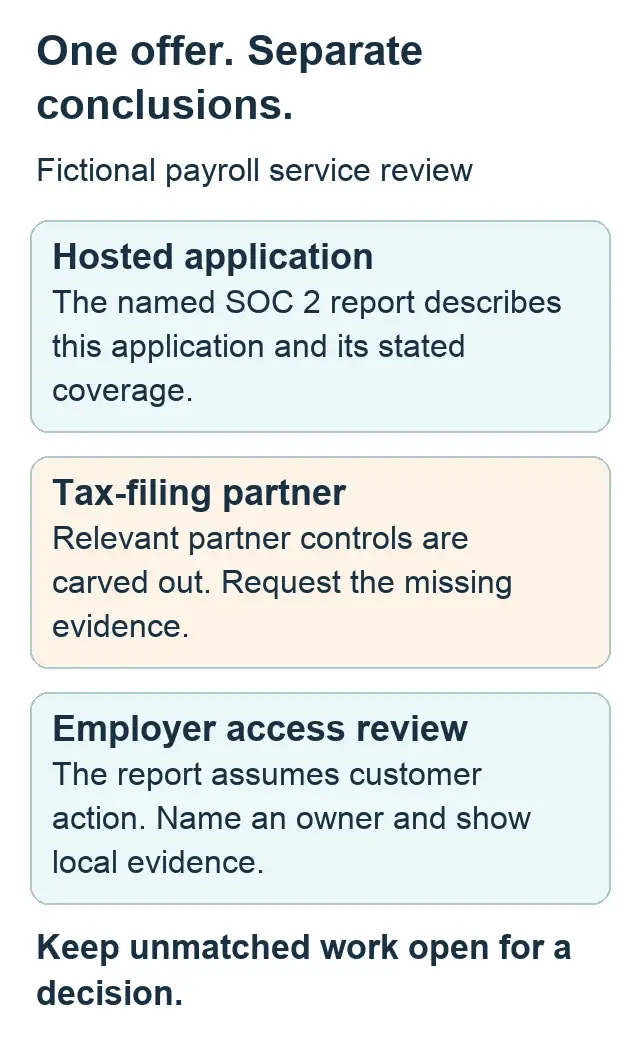
Connect the work being purchased, the report that addresses it and the employer controls needed to use it.
Put the report period on your purchase calendar
There are several dates to record, and the most recent date on the PDF is not always the end of the examination period. A report can be issued in November about controls operating through September. The issue date does not add October's activity to the tested period.
Write down the period start and end for a Type 2 report, or the specified date for a Type 1 report. Add your intended launch date, any financial-reporting period relevant to the review and the expected availability of the next report. Show the interval that remains unsupported by that particular examination.
Request information about changes after the reported period: a product migration, new payment partner, changed processing location, acquisition, important incident or revised control process. Ask the provider to identify which changes matter to the service you are buying and what evidence is available about them.
A bridge letter, sometimes called a gap letter, may provide management's information about a later interval. Read who issued it, which report it references, the dates it addresses and any changes or exceptions it discloses. Oracle's public guidance describes its bridge letters as statements of the vendor's belief about continuing controls. That is different evidence from the independent firm's examination of a defined period.
Do not extend the auditor's opinion in your worksheet because management supplied a more recent letter. Also do not assume that a bridge letter proves a newly added service was included in the older examination. Ask the reviewer responsible for the relevant risk whether the available evidence supports the proposed decision.
There is no universal report-age or bridge-letter cutoff imposed by this guide. Your organization, contract, audit needs and the significance of the change determine what follow-up is appropriate. Record the reason for accepting an interval, the supporting evidence and the person approving that conclusion.
In a fictional 2026 packet, a Type 2 period ends September 30, a report is issued November 5, a bridge letter addresses changes through November 12 and payroll is scheduled to launch December 4. Neither November date changes the September 30 period end. The team must consider the intervening activity and the service it will use at launch.
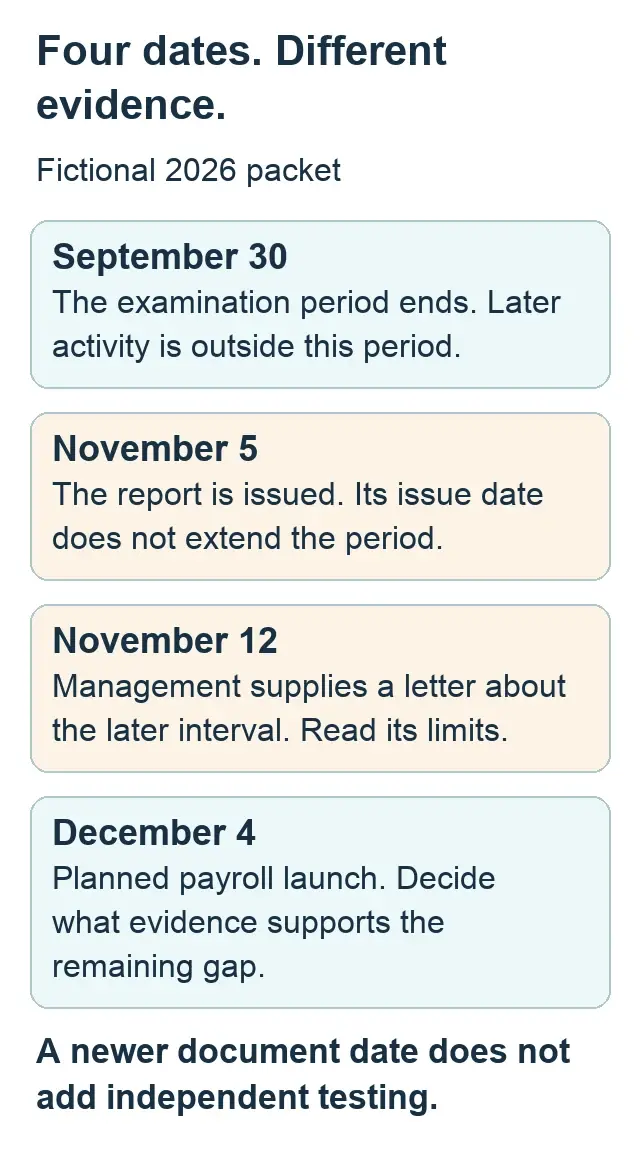
Keep the examination period, issue date, management update and planned launch separate.
Read the opinion and the tests as separate evidence
Locate the independent firm's opinion first. Record what the opinion addresses and any qualification or limitation, using the report's own language and section references. A sales summary saying “passed” does not explain an opinion's scope.
Then read the relevant test descriptions and results. An opinion without a qualification does not necessarily mean that every tested instance had no exception. Conversely, an exception needs context before it becomes a conclusion that the whole service is unusable. Ask the qualified reviewer to connect the observation to the controls, transactions and objectives relevant to your organization.
For each relevant exception, capture what failed, the population or sample described, the dates affected, the service involved and the response. “Management has a remediation plan” and “the correction has been implemented and independently retested” describe different evidence. Keep the status and any retest source explicit.
Consider the employer's exposure. A delayed access removal in a population of former administrators may be important to a payroll team that relies on provider support privileges. A missed report review may affect the evidence finance expects at close. The significance depends on the actual control, report and service, not just the number of exceptions on a summary page.
The PCAOB's AS 2601 discusses the need for a user auditor to assess whether a service auditor's tests and results are relevant to the audit's assertions, considering their nature, timing and extent. That is auditor guidance in its own context, not a procurement checklist that grants an employer audit authority. The practical buying lesson is to give your controller, security reviewer or auditor the relevant details rather than substituting a badge for their judgment.
If a test does not cover the service you need, identify the missing evidence. More favorable results elsewhere in the report do not fill that specific gap. A team may request clarification, additional evidence, an appropriate contract condition or a different service arrangement.
Assign the controls the report leaves with your organization
Look for complementary user entity controls, often abbreviated CUECs, and distinguish them from other customer responsibilities. A CUEC identifies a customer control the service organization assumes will operate alongside its own controls to achieve the relevant objectives or criteria. Other responsibilities may have a different basis. Depending on the actual report, the assumed customer work could include authorizing input, reviewing output, maintaining authorized users or reconciling activity.
Write the relevant requirement in operational terms. “Review user access” needs a population, an owner, an appropriate schedule, a way to record decisions and confirmation that approved changes took effect. “Authorize payroll input” needs an identified instruction, a person with authority and evidence that the approved version reached the run.
Those are examples of how to implement a responsibility, not a claim that every SOC report contains those exact controls. Use the actual report's wording and references. An employer may have additional controls that the report does not list, and a responsibility can require action by finance, IT, HR or a benefits administrator rather than payroll alone.
The existence of a provider report does not establish that the employer performed its part. The public AS 2601 material explicitly addresses the interaction between service-organization and customer controls and notes that the service auditor has not evaluated individual customers' controls. Keep your local implementation evidence beside the report review.
Ask whether the proposed product and service make the assigned control practical. Can the employer obtain a usable access roster? Can finance export the reports needed for reconciliation? Will the provider identify a rejected instruction promptly enough for payroll to respond? A control that your team cannot operate is an unresolved purchase condition.
Name a primary owner and a backup, define the evidence to retain and decide who verifies initial readiness. A signed responsibility list is a starting point. Before launch, the owner should be able to show the actual process, available permissions and records it will use.
Investigate the services that sit outside the examination
A service organization can use other organizations to deliver part of its service. Read how the report addresses those subservice organizations. In an inclusive approach, relevant subservice controls are included in the described examination. In a carve-out approach, relevant controls at that subservice organization are outside the examination's scope.
A carve-out is a boundary to investigate. It does not establish a control failure by itself, and the inclusion of a subservice organization does not mean every service that organization sells is covered. Identify the specific activity, the applicable report and the controls involved.
For a payroll purchase, the dependency could be hosting, payment processing, tax filing, document delivery or another service. The report may also describe controls by the payroll provider to monitor a subservice organization. Keep those monitoring controls separate from the excluded organization's own controls.
Ask which additional evidence can be made available and who will review it. Where another report is relevant, check its own entity, service, period, opinion, exceptions and customer-control assumptions. Where the provider's report lists controls it expects the excluded organization to perform, check those against the partner's own report. Do not treat a chain of report titles as proof that there are no gaps between the services.
Keep assurance questions separate from other essential obligations. A SOC report does not, by its title, establish a contractual promise to reimburse an employer, insurance coverage, the legal ownership of prefunded money or that a particular payroll tax payment reached an agency. Request the records and terms that answer those separate questions.
If the team cannot obtain or assess evidence for an essential dependency, record the limitation and its decision impact. The owner responsible for that risk must decide whether an alternative control or service is acceptable. An undocumented assumption should not become a permanent part of the operating model.
Work a fictional packet from receipt to purchase conditions
Consider Cedar Workshop, a fictional 120-person employer comparing a payroll service for a December 4 launch. Its planned purchase includes payroll calculation, payment-file preparation, tax filing and a journal feed to the accounting system.
The seller provides a SOC 2 Type 2 report, a public security page and a statement that it also maintains a SOC 1 report. Procurement initially marks the assurance request complete because documents have arrived. The controller asks for a service-to-report map before approving that conclusion.
The security reviewer finds that the SOC 2 description covers the hosted application and the stated security and availability commitments. That is useful evidence for the system described. It does not settle the controller's separate question about financial-reporting controls or establish what the tax-filing partner's examination includes.
The team obtains authorized access to the SOC 1 report. In this fictional example, the report was issued November 5 and covers calculation and payment-file preparation for the period April 1 through September 30, 2026. Tax filing is performed by a named partner whose relevant controls are carved out. The custom journal interface Cedar plans to buy is not described clearly.
The review produces three specific requests. First, finance asks for the relevant tax-partner evidence and clarification of how the payroll provider monitors that partner. Second, the integration owner asks which report, service description and acceptance test address the custom journal interface. Third, the controller asks how the provider will address relevant changes between September 30 and launch.
A November 12 bridge letter reports no identified material changes within its stated scope. The team records that statement and its limits. It does not relabel the report period as ending November 12 or describe the letter as independent testing of the gap.
There is also a local readiness issue. The fictional report expects the customer to review authorized users, but Cedar has no owner for provider-support access. IT and payroll agree on who requests the relevant information, who reviews it and what happens when a privilege cannot be confirmed. They test that process before calling the responsibility implemented.
Cedar may keep the supplier on its shortlist while those questions are open. It should not mark all essential requirements satisfied. Its purchase conditions identify the missing evidence, responsible provider contact, internal reviewer, due date and consequence if the evidence does not support the planned service.
Nothing in this example establishes that a real provider has these report boundaries, exceptions or controls. It shows how one packet can produce several different conclusions: useful evidence for a described application, unresolved evidence for a partner, an interface question requiring another kind of proof, and employer work that must be made operational.
Complete the Payroll Assurance Review Record
Use one record for a defined purchase or renewal. Keep detailed report references in an access-controlled location and put only the information permitted by the report's use restrictions into a shared buying summary.
For each field, enter a reference, an owner or a concrete decision. “Unknown” is useful when paired with the next evidence request. Do not replace missing scope information with a numerical score. The record is intended to preserve the reviewer’s reasoning and the actions needed before approval.
A. Purchase and report identity
Decision owner: Internal coordinator and the specialists responsible for financial reporting, security and payroll operations: ____________________.
Purchased service: Legal provider, product, package, countries or entities, and the work being bought: ____________________.
Report identity: Title, SOC family, Type 1 or Type 2, service organization, issuing firm and controlled-copy reference: ____________________.
Report dates: Specified date or examination start and end, issue date and any subsequent bridge-letter date: ____________________.
Decision calendar: Planned purchase, launch or renewal date, relevant audit-period need and evidence deadline: ____________________.
B. Match the service to the evidence
Processing path: Important payroll steps, interfaces and delivery parties, with their service-description references: ____________________.
Relevant coverage: Control objectives or criteria and the report sections that address the purchased work: ____________________.
Scope exclusions: Products, activities, locations, custom work or partner controls not covered or not yet confirmed: ____________________.
Period gap: Interval between examined activity and the decision's required dates, with the reviewer’s follow-up request: ____________________.
C. Read the limitations and dependencies
Opinion: What the independent firm's opinion addresses, including any qualification, limitation and exact reference: ____________________.
Test result: Relevant control, procedure, population or sample, exception and period affected: ____________________.
Response evidence: Management response, implemented correction, retest reference and unresolved verification: ____________________.
Subservice treatment: Named dependency, inclusive or carve-out treatment, monitoring controls and additional report needed: ____________________.
Later changes: Changes or incidents reported after the examination period, letter scope and evidence still required: ____________________.
D. Make the employer responsibilities operable
Customer-control reference: Exact report responsibility and the local process it depends on: ____________________.
Control owner: Primary owner, backup and reviewer for the employer's part: ____________________.
Operating evidence: Required inputs, permissions, records, review timing and retention location: ____________________.
Readiness check: How implementation was demonstrated, what failed and what remains open before launch: ____________________.
E. Reach a dated purchase decision
Open request: Missing evidence, supplier contact, internal reviewer and due date: ____________________.
Purchase condition: Contract or implementation condition, acceptance evidence and consequence if unresolved: ____________________.
Disposition: Proceed, proceed subject to named conditions, defer or decline, with reasons tied to the essential requirements: ____________________.
Approval: Decision-maker, date, permitted service scope and any expiry or follow-up requirement: ____________________.
Review trigger: Next report, renewal, relevant incident, service change, provider acquisition or local-control change that calls for another review: ____________________.
Keep the section labels, individual fields and explanatory notes visibly separated when copying the record. It supports a buying decision; it is not a substitute for the underlying report or the judgment of the responsible auditor and risk owners.
Write conditions that survive the sales handoff
Turn an unresolved finding into a requirement another person can act on. “Provide a better SOC report” is difficult to enforce because it does not say which missing service, period or control the new evidence must address.
A useful condition identifies the purchased activity, missing evidence, responsible provider contact, internal reviewer and approval boundary. For example: “Before we approve the tax-filing service, provide the named partner's applicable report and an explanation of the monitoring controls; the controller will review coverage and unresolved limitations.” Have the appropriate contract owner turn that operational requirement into agreed terms.
Use conditions proportionately. A missing document may delay a particular service or approval rather than every aspect of a project. Conversely, a critical control gap cannot be canceled out by a favorable price or a strong report for an unrelated service.
If a supplier proposes a workaround, describe the work it transfers to the employer. Record the required access, people, timing, evidence, cost and failure response. Ask the person who will operate it to demonstrate readiness. An employer review cannot be assumed effective merely because it has been described in a purchasing meeting.
Keep a clear status for each essential requirement. “Requested,” “received,” “reviewed,” “accepted with conditions” and “closed” should represent observable events. A report uploaded to a portal has been received. The review is complete only when the responsible person has evaluated it and recorded a decision.
The closing purchase summary should identify the version of the offer and report packet it supports. When the service configuration changes during negotiation, revisit the affected conclusions. A review of an earlier package is not automatic approval of a larger service.
Keep the evidence usable after the first payroll
Transfer the report references, accepted conditions and employer-control responsibilities to the people operating payroll, security and finance. Otherwise, a careful buying review can disappear into a procurement folder while the team running the service never sees its responsibilities.
Track the availability of the next report and any promised remediation evidence. At review, compare the named service, organization, period, relevant criteria or objectives, exceptions, subservice treatment and customer responsibilities with the version previously accepted. Do not assume the next annual packet is identical.
Use service changes as review triggers. Adding a tax service, changing a payment route, replacing an integration, moving processing to another entity or introducing a new employer-control requirement can change the evidence needed. A renewal review should also ask whether the employer still performs the controls it accepted.
When an incident occurs, use the established response process and current facts. A historical favorable report does not resolve a present payroll error, authorize a funds transfer or establish the scope of a data incident. Preserve the records needed for the immediate issue while the relevant owners assess its effect on the buying and risk decisions.
At exit, preserve report references and decisions according to their permitted use and the organization's record rules. Confirm who can continue to access the retained evidence after the provider account closes. Do not assume that a download right remains available forever.
Questions about SOC evidence in a payroll purchase
Should we require both SOC 1 and SOC 2?
Identify the questions your organization needs answered. SOC 1 and SOC 2 have different purposes, and a payroll purchase may involve both financial-reporting and information-system concerns. Have the responsible reviewers specify the evidence needed for the particular service rather than imposing a report count without a reason.
Does a Type 2 report make the provider safer than one with a Type 1 report?
The reports provide different evidence about the stated system and dates. Type 2 includes operating-effectiveness evidence over a period; Type 1 does not provide that period of testing. Compare the relevant scope, results and employer needs before drawing a purchasing conclusion about either provider.
Is a public security page enough if we cannot obtain the report?
It can establish what the provider publicly states, but it cannot supply undisclosed report details. Keep the required review open, ask about authorized access or an acceptable alternative, and record the consequence if essential evidence remains unavailable.
Does a bridge letter extend the audited period?
Do not record it that way. A bridge letter supplies information within its stated scope and dates. Keep that evidence distinguishable from the independent examination and ask the responsible reviewer how it affects the interval relevant to your decision.
Can we accept a report with an exception?
Ask what the exception affects, how it relates to the purchased service, what remediation or retesting exists and what employer controls are relevant. Record the qualified reviewer's conclusion and any purchase conditions. Neither automatic acceptance nor automatic rejection based only on the word exception is a useful decision rule.
What if the report assigns a control we cannot perform?
Treat that as an unresolved operating requirement. Establish whether the product, service agreement, access or staffing can support an effective process. If it cannot, the responsible owner must approve an acceptable alternative or the service does not meet the requirement.
Can an advisor review the SOC report for us?
Clarify the engagement. Payroll software matching helps identify providers to evaluate. It does not by itself provide an independent audit opinion, legal review or assessment of your confidential assurance packet. Assign those tasks to people qualified and authorized for the work.
Continue evaluating payroll providers:

About the author
Ben Scott writes and maintains payroll decision guides for founders and operators. His work focuses on execution realities and how decisions hold up under growth, complexity, and controls and documentation pressure. He works hands-on in HR and leave-management roles that intersect with payroll-adjacent workflows such as benefits coordination, cutovers, and compliance-driven process controls.