
PTO Reconciliation: Match Accruals, Time Taken and Pay

Updated: 3 days ago

A pay statement shows 35.2 hours of paid time off. The employee's leave portal shows 29.2. Both numbers can be right if the portal has reserved six hours for a future absence. Changing one balance to match the other could create the error the reconciliation was supposed to find.
PTO reconciliation connects the meaning of a balance to the transactions behind it. Rebuild what the employee earned, received, used or had paid out during a defined interval. Then check whether the leave actually taken produced the correct payroll treatment. A correct balance does not prove correct pay, and a correct paycheck does not prove the leave bank was updated.
Use this process for U.S. employer leave banks with recorded hours, including vacation and combined PTO arrangements. Statutory sick leave, agreements, jurisdictional rules and the employer's approved policy can require different calculations. The PTO Movement and Pay Match Sheet below organizes the evidence; it does not establish eligibility, authorize forfeiture or determine a wage deadline. All worked examples are fictional.
Contents
Read the label beside each balance
Before comparing values, establish which question each screen answers. A posted balance usually reflects completed transactions through that system's processing cutoff. An available balance may also subtract approved future requests. A projected balance may include leave not yet earned. Those are working definitions to confirm with the actual system, not labels to assume every vendor uses consistently.
Ask for the calculation behind the displayed number. Does it include pending requests or only approved ones? Are future accruals added? Does a payroll preview change the balance, or does the change wait until payment? Can an administrator's adjustment appear before a related payroll finishes?
Gusto's reporting documentation provides a useful example of this timing difference. It says manual adjustments appear immediately in its Time off balances report, while requests enter that report after the related payroll is paid, on or after the check date. Its policy documentation also distinguishes current balances from requested hours and explains why approved upcoming leave can make available hours lower. These are documented product behaviors, not a universal model for other systems.
Write the definitions into the reconciliation header. Keep separate columns for posted hours, reserved future hours and any projection. If the system combines them, obtain the transaction detail needed to separate the components. Do not treat an undocumented difference as an approved timing difference merely because its size resembles a familiar accrual.
For a policy that does not maintain a finite bank, a zero-hour reconciliation is the wrong test. Reconcile approved absence events and their payroll treatment, and confirm any separate statutory tracking or notice obligations. In California, for example, the paid-sick-leave FAQ addresses how an unlimited arrangement is identified on the required employee notice. A software label does not remove those obligations.

When time-off totals keep needing manual repair
If your team repeatedly rebuilds balances outside the system, compare how prospective providers record accruals, reservations and paid leave. SelectSoftware Reviews offers free advisor-led payroll software matching. Bring a real type of discrepancy and ask each shortlisted provider to show its transaction history, correction path and employee-facing result.
Freeze one employee-policy interval
Start with one employee, one employing entity, one leave bank and a specific opening and closing boundary. An employee can have a vacation bank, a separate sick bank and different employment assignments. A company total hides a movement posted to the wrong person or policy.
Choose an opening balance that was previously substantiated. If that balance was imported or manually entered, keep its source and as-of date. When no reliable opening exists, label it unverified and reconstruct the necessary earlier history. Treating the latest unexplained number as a clean opening simply moves the discrepancy outside the current period.
Capture the policy version and assignment dates. Confirm the earning method, eligibility start, service tier, applicable earning hours, grant date, rounding method, accrual ceiling and any permitted carryover rule. A policy document establishes an instruction to review; the responsible HR or legal specialist must also confirm the applicable requirements.
Keep these clocks distinct:
Activity date: when the employee worked, took leave or became entitled to an adjustment.
Effective date: when a policy, eligibility or approved correction applies.
Posting date: when the system recorded the movement.
Pay date: when the associated payroll payment is due or made.
A November absence paid in December does not belong to only one of those months for every purpose. Select the clock appropriate to each comparison, and retain the bridge to the other dates. The payroll processing cutoff must not silently redefine the employee's entitlement.
Save both systems' exports with their extraction times, selected dates, employee filters, policy filters and status options. Include inactive employees when their balances or transactions belong in the interval. A report filtered to current staff can omit the very separation payout being investigated.
A repeatable join should use the employer, employee identifier, policy identifier and relevant event or period. Names alone can merge two people or split one employee after a name change. Keep historical policy assignments when a bank is renamed or replaced; a new display name does not establish a new entitlement.
Reconstruct every posted movement
Use a roll-forward that another reviewer can reproduce:
Expected closing posted hours = verified opening hours + earned credits + grants + approved upward adjustments − posted leave taken − payout hours removed − reviewed lawful other downward adjustments.
Enter each addition or subtraction as a positive number of hours in its own category. An export may store usage as a negative value; translate that sign before subtracting it again in this bridge. For a reversal, preserve the original event and its opposite movement without counting the same restoration twice.
Compare that result with the observed closing posted balance for the same population and cutoff. Record the difference as observed minus expected, so its direction remains consistent. Positive means the observed bank is higher than the substantiated result; it does not establish why.
Keep earned credits separate from front-loaded grants. Otherwise an annual allocation can be counted again as periodic accrual. An opening imported balance also must not be treated as a new grant simply because it appears on the first payroll.
For an hourly earning rule, reproduce the eligible-hour calculation. Identify whether the approved basis includes worked time, paid leave, overtime hours, holidays or other categories. A setting called hours paid and a policy saying hours worked can produce different results. For fixed periodic credits, check the earning schedule and eligibility instead of applying an hourly formula.
The current Intuit time-off documentation illustrates why these distinctions belong in the specification: it describes yearly, per-pay-period, hours-worked and manual accrual options, along with separate balance and carryover settings. Select the actual product and policy configuration before relying on an export. A menu option is not legal approval for its use.
Record transactions individually when timing changes the result. If an employee reaches a ceiling before taking leave, earning can differ from a calculation that nets all month's activity first. Obtain the policy's reviewed ordering rule and compare the system's event sequence with it.
A carryover limit, an earning ceiling and a forfeiture are different instructions. California's vacation guidance, for example, distinguishes a permissible reasonable accrual cap from an impermissible loss of earned vacation. The same guidance explains that a combined vacation-and-sick PTO policy can remain subject to vacation rules. Do not insert a year-end write-off just to make the configured balance match a target.
Convert units explicitly. If one record uses days and another hours, identify the applicable hours-per-day definition and effective schedule. A move from an eight-hour schedule to a ten-hour schedule does not, by itself, tell payroll how an existing day-denominated entitlement should convert. Get the approved treatment before recalculating the bank.
Retain the source precision for earned fractions and document the rounding point. Repeatedly rounding intermediate values can differ from rounding a cumulative result. Investigate the employee-level effect under the applicable rule rather than assuming a small residual is acceptable.
A bank can be wrong while the paycheck is right
Assume a verified opening balance of 40 hours, earned credits of 3.2 hours, eight hours of vacation actually taken and due to post by the cutoff and no grants, payouts or other adjustments.
The expected closing posted balance is 40 + 3.2 − 8 = 35.2 hours. Suppose the payroll register confirms that the eight vacation hours were paid at the approved $25 hourly rate, for $200 gross, but the leave bank shows 43.2 hours.
The eight-hour bank difference is consistent with a missing usage debit. Verify the actual event and transaction history before concluding that is the cause. If confirmed, correct the bank through the supported route and verify that the repair does not pay another $200.
Now assume six additional hours are approved for next month and the portal subtracts future reservations. Its available balance is 35.2 − 6 = 29.2 hours. That six-hour difference from the posted balance is explained without a new debit to the posted bank.
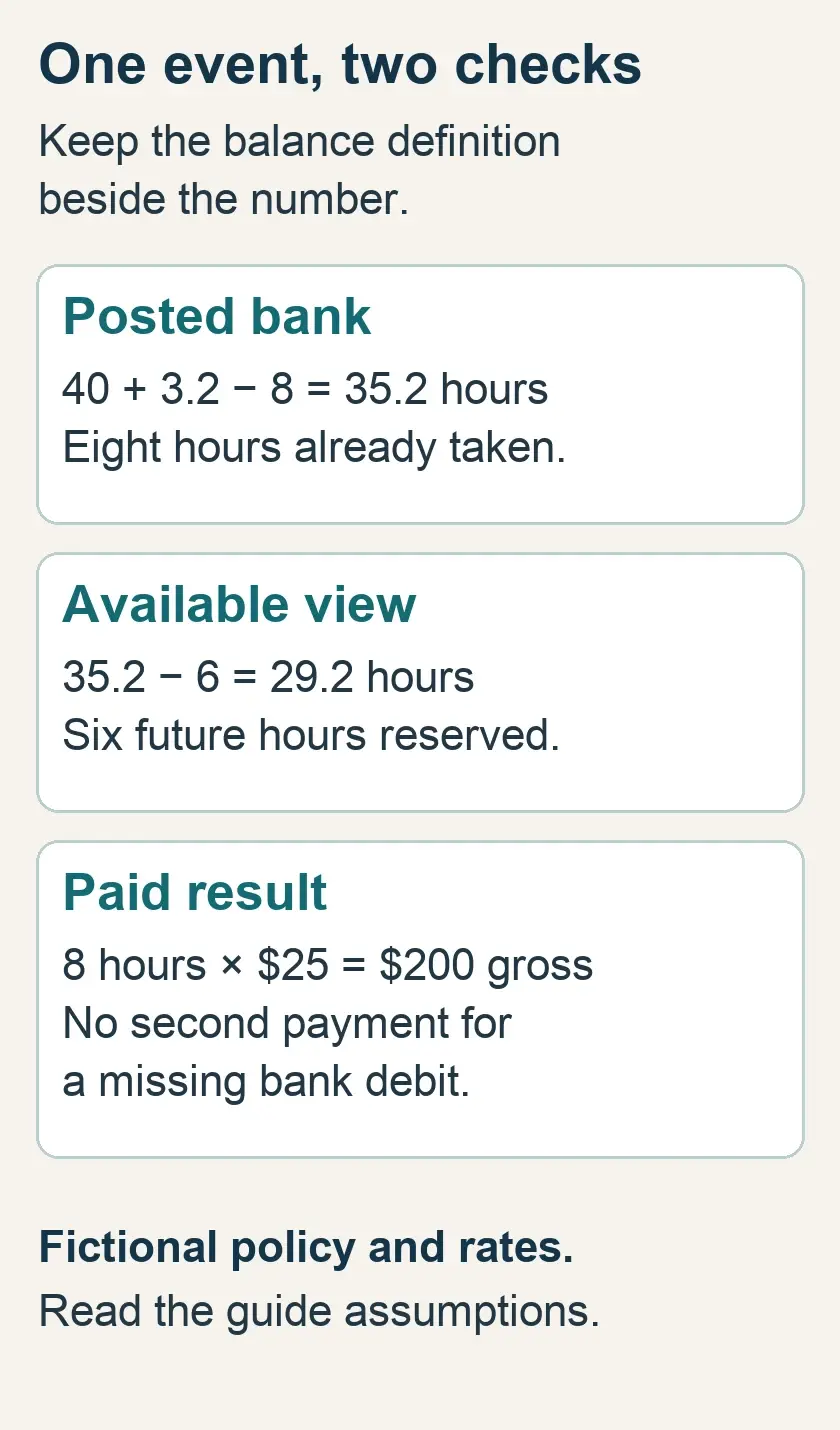
Illustrated definitions only. Confirm the actual reservation model and posting cutoff; the $200 is fictional gross vacation pay, not take-home pay.
Follow taken time into payroll
For each absence that actually occurred, trace the approved dates and hours into the payroll result. Capture the employee, bank, request identifier, final approval or corrected event, earning code, pay period, pay date and result status. A request marked approved is evidence of authorization, not proof of payment.
Separate future approved leave from leave already taken. Separate a cancelled request from a request that was taken and later amended. Those distinctions determine whether a reservation should be released, a posted bank movement reversed, a wage result corrected or more than one record changed.
For an hourly employee, verify the approved leave-pay rate and the associated gross amount. A matching number of hours can still produce incorrect earnings if the wrong rate or code was applied. Do not assume every statutory sick-pay calculation uses the ordinary base rate; obtain the applicable instruction.
For a salaried employee, leave hours may reclassify part of salary rather than create additional compensation. Inspect total salary and the earning-code treatment together. Adding an hourly PTO payment to an unchanged full salary can duplicate compensation when the approved design was a reclassification.
An exhausted bank does not automatically authorize a salary reduction. The Department of Labor's salary-basis guidance generally requires qualifying exempt employees to receive their full salary for a week in which they work, subject to specified exceptions. Partial-day deductions have particular restrictions. Have the responsible reviewer establish the actual pay treatment, including any applicable FMLA or state-law instruction.
Keep paid nonwork time separate from actual hours worked. Under the ordinary FLSA framework, the Labor Department explains that paid vacation, holiday and sick time are not hours worked for federal overtime purposes. A more generous employer commitment or another applicable rule can change the payment obligation. Do not turn all displayed paid hours into worked hours, or erase actual work because the employee also had approved leave.
Use final payroll evidence. A preview can demonstrate the proposed calculation; it cannot establish that the released run used that version or that payment completed. Where the pay result is wrong, address the wage obligation through its proper correction route instead of waiting for the next scheduled balance review.
Separate an earning-rule error from a reporting-date gap
A difference that can be explained is not necessarily a difference that should remain. Identify whether the rule is wrong, the transaction is missing, or the compared records cover different stages.
Consider a fictional policy that earns 0.04 PTO hour per eligible worked hour. The reviewed instruction excludes paid leave from this earning basis. An employee has 72 eligible worked hours and eight paid vacation hours.
Expected earned credit is 72 × 0.04 = 2.88 hours. If the system accrues on all 80 paid hours, it credits 3.20 hours, creating an excess of 0.32 hour. Matching the payroll's 80 paid hours does not validate that earning basis.
Reproduce the configuration and employee assignment that caused the result. Correct the applicable earning instruction and investigate affected periods and employees. Do not change every policy to a worked-hours basis; this example's rule is an assumption, not a national requirement.
A second employee might be short 0.32 hour for a different reason. The two errors net to zero at company level while both employee records remain wrong. Review differences by employee and policy, with separate positive and negative totals where a summary helps.
A timing gap needs different evidence. Suppose an approved absence has not reached the balance report because the associated payroll has not paid. Record the event, expected posting trigger and expected check time. Recheck after that trigger. If it does not post as documented, the explanation is no longer sufficient.
Use a dated exception for a known timing item, with an owner and next check. Do not manufacture a manual debit to make today's reports equal if the automatic debit will arrive tomorrow. If an immediate manual repair is necessary, establish how the later automated transaction will be prevented or reversed.

The 0.04 rule is fictional and excludes paid leave by assumption. Recalculate using the employee's applicable policy and legal requirements.
Ask for the history behind the balance
When comparing payroll systems, ask a demonstrator to show one leave request through reservation, payroll, payment and correction. SelectSoftware Reviews can help you identify providers to investigate. Confirm that the proposed package exposes the reports and permissions your reviewers need; a clean balance screen alone cannot answer the test.
Resolve cancellations, payouts and changed employment
A cancellation before leave is taken may require only releasing a reservation. A cancellation after a posted debit or payroll calculation requires reviewing what actually happened. Preserve the old request and the corrected instruction instead of deleting the evidence needed to distinguish the two.
If an employee worked a day originally coded as vacation, obtain the actual work record. Review the bank restoration and the wage calculation, including any overtime effect. Equal base-rate dollars do not establish that replacing vacation with work has no other pay consequence.
For a payroll void or reissue, determine which balance transactions the product reverses and when. A voided wage result and a leave-bank reversal may be separate events. Verify the replacement calculation and final posted bank; do not assume the word void proves both were repaired.
A payout needs linked hours and money. Establish the permitted or required payout, earning cutoff, hours, rate, payment reference and bank reduction. Distinguish a requested payout from one actually processed. Removing hours before the related cash result is verified can make an unpaid obligation disappear from the next review.
At separation, obtain the applicable final-pay instruction. California's vacation guidance generally requires earned unused vacation to be paid at the final rate when employment ends, subject to its stated collective-bargaining qualification. That is a California example, not a rule for every state or every leave bank.
A negative bank is also not an automatic employee debt that payroll may recover. The same California guidance prohibits deducting advanced, unearned vacation from final wages. Identify the actual jurisdiction and reviewed recovery route before attempting a deduction.
When an employee changes employer, work location, service tier or policy, reconcile the old assignment through the transition date and identify exactly what opens in the new assignment. A transfer should not both retain the full old balance and create the same hours as a new credit unless the approved arrangement requires that result.
For rehires, preserve history and obtain the applicable restoration instruction. California's sick-leave FAQ describes restoring accrued sick leave when the same employer rehires an employee within 12 months, provided it was not paid out under a PTO policy at separation. Do not reset every bank to zero because an employee received a new system record.
An accounting liability report answers another question. Its dollar valuation can depend on the applicable accounting treatment, compensation rates and payout assumptions. Use the reconciled hours as supporting evidence, but have finance determine the recognition and valuation method. Do not force the leave bank to match a general-ledger amount by changing hours.
Use the PTO Movement and Pay Match Sheet
Copy this sheet into an employer-controlled workpaper. Use one scope header and movement bridge per employee-policy interval, then repeat the pay-match rows for each absence or payout event. The numbers below are field labels, not transaction sequence numbers.
Comparison scope
Identify the employee and bank before entering hours. Save the exact report versions so another reviewer can repeat the comparison.
1. Employee identifier and employing entity: ____________________
2. Leave bank, policy version and assignment dates: ____________________
3. Opening/closing boundaries, balance definitions and report versions: ____________________
Posted movements in hours
Use the same cutoff for all movements. Enter fields 8 through 10 as positive hours removed, not signed negative values. Keep source references beside each amount; a blank amount is unresolved, not an assumed zero.
4. Substantiated opening posted hours and source: ____________________
5. Earned credit, eligible basis and reproduced calculation: ____________________
6. Front-loaded or other distinct grant and authority: ____________________
7. Approved upward adjustments and references: ____________________
8. Posted leave-taken debit and event references: ____________________
9. Payout hours removed and payment references: ____________________
10. Reviewed lawful other downward adjustments and authority: ____________________
Balance bridge
Add fields 4 through 7, then subtract fields 8 through 10. The pay-match evidence below remains a separate check.
11. Expected closing posted hours: ____________________
12. Observed closing posted hours and extraction time: ____________________
13. Observed minus expected difference and explanation: ____________________
14. Future reservations and available-balance calculation: ____________________
Absence or payout to pay
Repeat these rows for each materially different event. Confirm the appropriate gross-pay or salary-reclassification instruction, not only the hours.
15. Event identifier, actual dates, hours and final status: ____________________
16. Approved earning treatment, rate and expected gross result: ____________________
17. Actual payroll version, pay date, status and gross result: ____________________
18. Event-to-result match, earlier payments and remaining pay issue: ____________________
Correction and verification
Keep the bank correction and any pay correction identifiable. Record a timing item with a specific trigger and follow-up owner.
19. Required change to bank, pay, policy or report comparison: ____________________
20. Supporting authority, reviewer and approved correction version: ____________________
21. Responsible operator, payment obligation and next check: ____________________
22. Original/reversal/replacement transaction references: ____________________
23. Verified posted balance, pay result and employee explanation: ____________________
24. Remaining exception or next recurrence to inspect: ____________________
Correct the affected record without hiding the original
Choose the repair from the evidence. A wrong display comparison calls for correcting the report or explanation. A missing usage debit calls for the bank's supported correction. An incorrect paid amount calls for a payroll correction and verification of the employee's payment. A policy assignment error may require recalculating a series of movements rather than one balance change.
Retain the before state, the proposed correction and the approval. For each adjustment, identify the employee, bank, effective date, posting date, amount, reason, original event and operator. A note saying reconciliation adjustment does not show which entitlement or transaction justified the change.
Avoid an unexplained opening-balance reset. If a supported repair must set an absolute balance rather than post a delta, preserve the substantiated movement bridge that produces that value. Check for requests or scheduled credits that might subsequently apply and duplicate the correction.
For an earning-rule defect, determine the affected population from the rule and effective period. Test employees with relevant service tiers, schedule changes, caps or leave usage. A convenient sample can reveal the problem, but it cannot establish that everyone else is unaffected.
Separate the supported correction from a disputed amount. Escalate unresolved policy or legal questions to the accountable reviewer with the payment date and employee impact. An internal approval problem does not, by itself, create permission to delay wages that are due.
After processing, obtain new source records. Verify the corrected bank, the actual pay result where affected, the employee-visible balance and the next automated transaction. A saved setting or accepted support ticket does not prove the completed correction.
If the pay correction changes earlier hours or earnings, review the affected workweek and related reporting instead of pricing every adjustment at a single base rate. Preserve earlier paid amounts so the employee is not paid twice or charged for a balance-only repair.
Give employees a number you can explain
Answer a balance question with the bank, date and calculation. For example: the posted balance is 35.2 hours after eight hours taken; six approved future hours are reserved, leaving 29.2 available under this portal's model. Include the relevant dates and tell the employee where to report a missing or cancelled event.
Do not give employees another unlabelled total from a different report. Where processing has not completed, explain which event is waiting, when it is expected to appear and who will verify it. Avoid promising an updated figure before the actual posting trigger has occurred.
Check the required statement or notice separately. California's paid-sick-leave guidance requires available sick time on a pay stub or a document issued the same day, and records of earned and used sick leave for three years. That illustrates why an internal spreadsheet or generic portal access should not automatically be assumed to satisfy every jurisdiction's requirement.
Keep medical detail out of the balance workpaper when it is unnecessary to the calculation. Use approved identifiers and references to controlled leave records. Give each reviewer the information needed for the assigned decision rather than circulating an unrestricted file containing every request note.
Employee communication belongs in closure when the displayed result changed. Confirm the employee can see the corrected bank or updated statement and understands whether a pay correction was also made. If one question remains open, identify that question and its next response date rather than describing the entire matter as resolved.
Make recurring checks follow the events that change the bank
Check the current period's earned credits and paid leave events during each payroll review. Schedule a complete employee-policy roll-forward at a documented cadence: a complex hourly accrual process may need it each payroll, while a simpler bank can use a regular close review plus event-driven checks. Confirm that the timetable also meets applicable statement and record requirements. Add event-driven checks around annual grants, resets, policy changes, acquisitions, migrations, employee transfers and separation payouts. The goal is to find incorrect entitlement or pay while the evidence and correction options remain available.
Use a small set of deliberate demonstration cases before expanding automation: a future reservation, a partial-period hire, an employee at a cap, a cancellation after payroll approval and a payroll reversal. Reconcile expected movements and earnings with actual configured results. These are suggested checks for your environment, not claims that a vendor has passed them.
Make the recurring output useful to its next owner. HR confirms policy and eligibility; payroll confirms earnings and payment; the system owner investigates missing or duplicated transactions; finance receives substantiated balances for its separate accounting decision. Assign the next action to the specific record that failed.
Keep both directions of evidence. An approved taken event should have its appropriate bank movement and pay treatment; an unexplained bank debit or payroll leave result should lead back to authority. This also helps identify an employee or policy omitted from one report rather than merely comparing the visible rows.
End the review with the supported closing balance, the actual pay match and the remaining exceptions, each with a responsible owner. On the next run, begin from that substantiated result and verify that the same defect has not returned.
Choose a system your reviewers can follow
If leave reconciliation is part of a payroll replacement decision, bring the completed movement bridge and one corrected event to the comparison. SelectSoftware Reviews provides an optional, free advisor-led route to providers worth investigating. Ask candidates to demonstrate the employee view and the reviewer evidence as well as the payroll calculation.
More payroll guides and practical tools:

About the author
Ben Scott writes and maintains payroll decision guides for founders and operators. His work focuses on execution realities and how decisions hold up under growth, complexity, and controls and documentation pressure. He works hands-on in HR and leave-management roles that intersect with payroll-adjacent workflows such as benefits coordination, cutovers, and compliance-driven process controls.


