Global Payroll Providers: Separate Country Coverage From Service Ownership

Updated: Nov 4

A provider's country list tells you where to ask the next question. It does not tell you who will calculate a particular entity's payroll, approve a correction, submit a return or release money. Two proposals can cover the same countries while leaving very different work with your local teams.
Compare global payroll providers one country and employing entity at a time. Establish the local calculation and service arrangement, the parties responsible for filings and payments, and the records your team can obtain. Then decide whether one managed relationship, a mix of country services or a coordination layer around existing providers is the better purchase.
The buying method assumes a U.S.-based team coordinating payroll for its own employer entities across countries. Decisions about creating an entity, using an employer of record, classifying a contractor or changing a worker's employer come first. The commercial examples are fictional, and the country map is a buying method, not a substitute for local employment, tax, treasury or privacy advice.

SelectSoftware Reviews offers 1:1 help from a payroll software advisor. Bring your country list and confirm which providers can support the employing entities and services you need.
Contents
The country row is the unit of purchase
Begin with a list of employing entities, not a total headcount. For each entity, record its country, registered identity, payroll population, pay frequency, existing processor and the date you want a different service to begin. Separate countries where you already employ staff from countries still being considered for expansion. A future market should not quietly become an accepted implementation commitment.
Keep materially different populations visible within a country. An ordinary salaried group, an hourly operation, expatriate arrangements and a workforce governed by a particular agreement may require different evidence. This does not mean every population needs a separate provider. It means the proposed country service has to explain the actual work rather than demonstrate a convenient generic employee.
Use the current payroll to describe what must survive the purchase: recurring earnings, variable pay, deductions, employer contributions, statutory reporting, payslips, payment methods and the finance export. Mark which instructions come from HR, local management, benefits, time systems or outside advisers. A worldwide interface cannot repair an undefined source instruction.
Then divide requirements into essential country conditions and preferences that can be traded. A required reporting route or an unsupported pay population can make a country arrangement unusable. A less convenient dashboard may be manageable if the underlying service is sound. Do not average an essential country failure into a reassuring overall score.
Country coverage should therefore have a recorded meaning. Does the provider offer calculation for your entity now, through which delivery party, with which included tasks? Is the named service operational, dependent on a new partner, or only on a roadmap? Ask for the answer in the proposal and the country service schedule. Obtain a country service commitment from the operating supplier before recording that country as accepted.
Three delivery models can coexist under one login
One approach buys local calculation and service from the same provider group that supplies the global platform. This can reduce the number of organizational handoffs, but the buyer still needs to establish which country engine, operating team and contracted entity will serve the account. Common ownership alone does not establish response hours, special-pay support or the correction process.
A second approach buys a managed network. A lead supplier coordinates local processing parties and presents a common relationship to the customer. That can be useful when headquarters wants one service escalation and a consistent reporting process across a varied footprint. Its value depends on what the lead supplier actually undertakes when a country partner is late, changes personnel or cannot process an unusual instruction.
Ask whether the lead supplier can direct the local processor, who approves a workaround and whether your team can communicate with the country specialist. Obtain the route for a replacement partner and the conditions for changing one. A single contract can reduce commercial administration while still depending on several operating organizations.
A third approach retains selected local providers and adds consolidation or coordination. This may suit a business whose local services work well but whose headquarters cannot obtain consistent data or see progress. It can also avoid replacing a capable country operation merely to obtain one reporting interface. The tradeoff is that somebody must own mismatches between the local service, the data connection and the consolidating platform.
In that arrangement, list the contracts you retain and the tasks added by the new supplier. Determine who resolves a late local file, who pays for adapting its format and who maintains the connection after either system changes. Ask the consolidator to specify its review of the underlying local calculation and the evidence it accepts.
These are ways of examining delivery, not rigid labels for an entire brand. A multinational portfolio can use one arrangement in a large country and another in a small country. Ask providers to describe the proposed mix explicitly. A hybrid can be sensible when each boundary is understood; it becomes difficult when the buyer assumes every country receives the same service.
What four providers' published descriptions actually establish
These examples show questions to bring to a shortlist. They are based on the providers' public materials, not hands-on product tests or a ranking. Country availability, included work and contractual remedies must be confirmed for your own entities.
ADP: distinguish the global view from the country configuration
ADP's Global Payroll page describes a global platform with local expertise and integrated reporting. Its customer example describes adding ADP Celergo countries to a dashboard that already shows ADP GlobalView countries. That supports asking about a mixed product portfolio; it does not establish which product or processing party your country would receive. Request a country schedule naming the proposed configuration, transition work and service owner rather than accepting the dashboard as the complete service specification.
Remote: separate own-entity payroll from the other employment offers
Remote's Global Payroll offer addresses employees in countries where the customer owns an entity and describes preparation, review, approval, payment and reporting in a common workflow. Its help center names the customer's legal entity as the hiring entity for Global Payroll and Remote as the hiring entity for EOR. Confirm the purchased product for each population. Then ask which local calculations, filings, payments and specialist support your proposed service includes. Do not infer an employer change from the fact that several products share an account.
Lano: establish which local relationships you will retain
Lano's payroll explanation describes consolidating foreign entities' payroll data either by integrating existing providers or using its in-country network. Those alternatives create different buying questions. If you retain a local provider, identify the continuing contract and responsibility for its delivery. If the proposal uses a network provider, identify the lead supplier's obligations and the escalation route. The useful comparison is the work transferred in your configuration, not simply whether a consolidation feature exists.
CloudPay: read payroll and payments together, then specify their boundaries
CloudPay's managed payroll description says it manages service providers under a single customer contract. Its process describes customer approval followed by post-processing outputs and salary payments through its Payments solution. Request the equivalent country-level sequence in your proposal: who approves, what output is produced, how funding reaches the payment route and what proves completion. A described end-to-end service is a starting point for contractual scope, not proof that every payment or local exception is included.
A service contract does not settle the employment relationship
Write the employing entity separately from the contracting customer, the local payroll processor, the filer and the payer. The same organization may hold several roles, but combining their names into one vendor field makes omissions hard to see. An invoice addressed to headquarters does not by itself identify the employer of each worker.
Jurisdiction matters when assigning legal responsibilities. For UK PAYE, HMRC says the employer remains responsible for completing PAYE tasks even when it pays a provider to do them. The provider may supply additional support, including records, payslips or payments to HMRC, but that service scope needs to be established. Treat this as a UK rule, not a statement of every country's outsourcing law.
For U.S. federal employment taxes, the IRS distinguishes several third-party arrangements, including payroll service providers, reporting agents, section 3504 agents and certified professional employer organizations. Liability can differ with the arrangement and facts. Do not export those U.S. labels to a foreign country or assume an ordinary processing contract changes employer liability.
Have qualified local advisers confirm the entity registrations, filing authority and obligations applicable to each proposed arrangement. Record the answer and its supporting documents in the country map. If a proposal requires changing the worker's employer or entering an employment arrangement you have not approved, pause that country purchase and resolve the separate employment decision.
Require three different proofs for calculation, filing and payment
A global workflow should make its completion states intelligible. Calculated, approved, submitted, accepted, funded, released and settled describe different events. Ask the provider to show which events its status screen represents and where the underlying evidence can be retrieved.
For calculation, inspect a country payroll result with the expected employees, pay components, deductions, employer amounts and net pay. Identify the source version and the person who approves the result. The trial should include an ordinary local complexity from your population, not only an unchanged salary that any demonstration can reproduce.
For filing, name the party authorized to submit and the record that proves what happened. A report generated for review is different from a submission receipt or an authority's acceptance. Establish who investigates a rejection, who informs your local team and how the corrected result is connected to the original payroll.
For payment, start with the funding account, currency, required arrival time and authorized release. Determine whether your team sends a bank file, the payroll supplier initiates payments, or another payment service undertakes the transfer. Include employee pay and any tax, social contribution or third-party payments that are actually in scope. Do not infer all of them from the phrase “salary payments”.
Trace one payment to a named recipient outcome. Ask how the service reports an invalid account, rejected instruction or returned amount, and which party authorizes a replacement. Confirm how the replacement is reconciled to the payroll record so a second release does not create duplicate pay. A successful upload to a bank or platform is not sufficient evidence of receipt.
Keep wage calculation currency, funding currency and headquarters reporting currency distinct. Ask who provides the conversion rate, when it is fixed, which charges apply and who handles a shortfall. This guide does not prescribe an exchange-rate method. The buying requirement is a documented, reviewable relationship between the local obligation, the funding instruction and the eventual settlement.
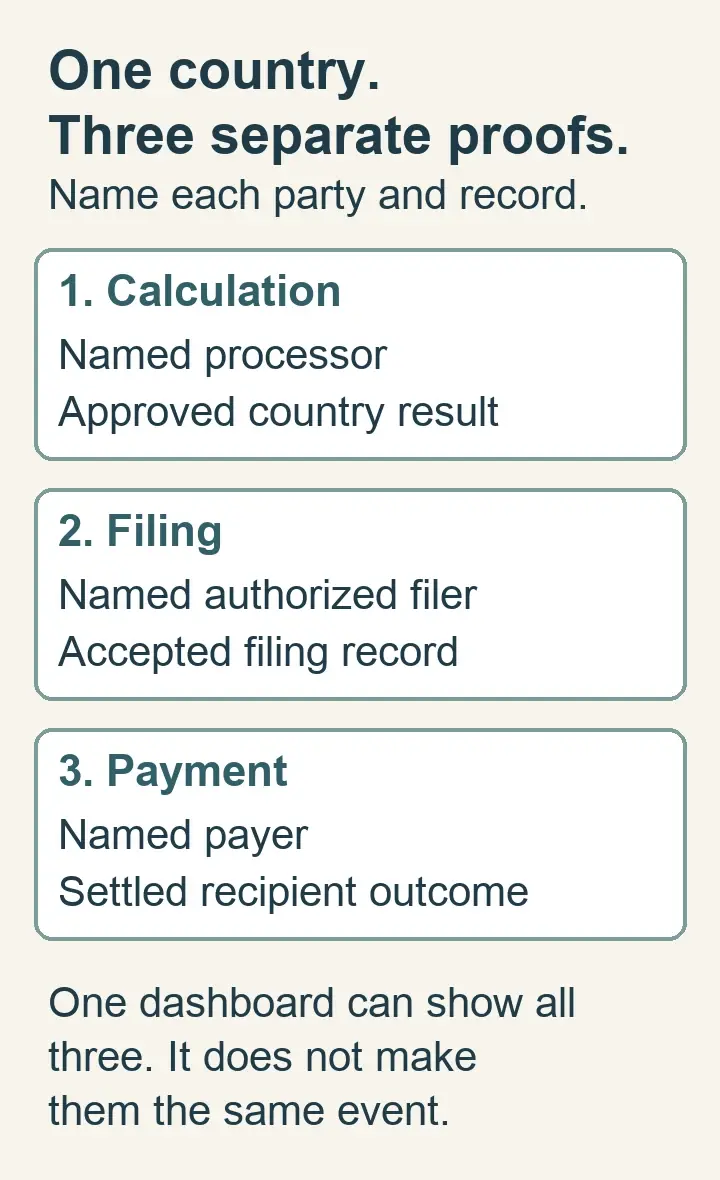
Name the party and the evidence for each outcome. A common dashboard can display all three without making them the same event.
Locate the people and data behind the global interface
Ask where the payroll work and support will be performed, which organizations receive employee data, and how those arrangements can change. A provider's sales office, local legal entity, processing team, data host and support desk need not be the same place. Record the proposed arrangement rather than inferring it from an office address.
Give the privacy and security reviewers the actual processing and support chain. Ask for the relevant processing terms, sub-processor information, access controls, locations and transfer arrangements. The UK ICO's international-transfer guidance illustrates why a processor's onward transfers and sub-processors need separate attention under UK GDPR. It describes obligations for controllers and processors, including appropriate protections and relevant contractual arrangements. Have the reviewers apply the rules that govern your own data flows; a general security badge is not that assessment.
For the operating team, identify who can answer a local calculation question in the needed language and hours. Distinguish the time to acknowledge a ticket from the time to provide a decision that the country payroll can use. Identify the deputy, escalation contact and route when the usual specialist is absent. Ask whether communication with a country partner is direct, mediated or restricted, and what each route costs.
For the data team, request a sample country export and its mapping to the common report. Preserve the local pay-code meaning and effective dates even when headquarters groups several codes into one cost category. A normalized total should be traceable back to the country result. If a code or employee identifier changes, the agreed process should explain how history remains connected.
Send a changed country case through the proposed service
Prepare one fictional or appropriately controlled case from your actual buying requirements and give the same instruction to each shortlisted supplier. Describe the country, entity, worker population, payroll period, relevant pay component and approved result you need. Ask the supplier to explain the route and produce the evidence it expects your team to review.
For example, an approved variable-pay change arrives after the country's ordinary input cutoff but before the intended payday. Ask who determines whether the current run can change, which approvals must be repeated and what other route exists if it cannot. The answer must address local payment obligations; an internal cutoff does not settle whether wages may wait.
Then change the case after the proposed run is approved. Have the supplier identify who can still edit the instruction and what invalidates the earlier approval. Ask where the revised calculation, payment instruction and any reporting correction appear. The purpose is to expose the handoff between the global service desk and the local operating party, rather than to collect a reassuring yes.
Include a failure that crosses the service boundary. Suppose the local processor produces the correct result but the common platform imports an old pay-code mapping. Which party corrects the file or mapping, who validates the revised global report, and does the country payroll need to be recalculated? The map should identify both the local result owner and the consolidation owner so neither can close the issue merely by pointing to the other.
Record what was demonstrated, what remains a proposed configuration and what the supplier has put into the contract. A demonstration may use a sample environment that differs from the purchased country setup. List the remaining conditions, their owners and the proof due before that country goes live. Do not mark the entire portfolio accepted because one representative country worked.
Price the portfolio with the same work in both proposals
Compare a full service year and the transition separately. Ask for country or entity minimums, employee charges, run-frequency assumptions, implementation, historical data, special runs, corrections, annual reporting, support, interfaces, payments, currency charges and exit assistance. Mark an excluded item explicitly. Ask the provider to mark each item included, priced separately or excluded.
The following fictional quotes concern a company retaining its existing U.S. payroll service for 200 employees while changing the arrangement for 35 UK and 12 German employees. All comparison fees are expressed in U.S. dollars solely to compare service costs. They are not wage amounts, tax rates or actual vendor prices. The same retained U.S. provider charge is excluded from both options and must still be included in the company's full budget.
Option A: a managed country network. The illustrative quote charges 47 employees at $18 per month, or $846. Two country service fees at $250 add $500, and bringing the retained U.S. results into the common report adds $150. The monthly comparison total is $1,496. Twelve months cost $17,952; adding $3,600 implementation produces a first-year comparison of $21,552.
Option B: retained local processors plus consolidation. The illustrative UK processing charge is 35 at $11, or $385; Germany is 12 at $14, or $168. Three entity-consolidation charges at $200 add $600, and the quoted payment-service charge adds $80. That totals $1,233 per month, $14,796 for twelve months. With $5,400 implementation, the first-year comparison is $20,196.
The apparent first-year difference is $1,356, smaller than the $3,156 difference in annual recurring charges because Option B has $1,800 more implementation cost. Those figures compare the listed charges only. Before preferring either option, establish whether the same annual filings, correction work, payment route and support are included. An omitted local service or a second country implementation fee can change the comparison.
Also test a plausible change in the footprint. What happens if Germany falls below a contractual minimum, the UK adds a second pay group, or a country becomes inactive while final reporting remains? Ask for the pricing rule rather than inventing a universal cost per employee. A low blended rate can hide a costly country that supplies a small share of total headcount.
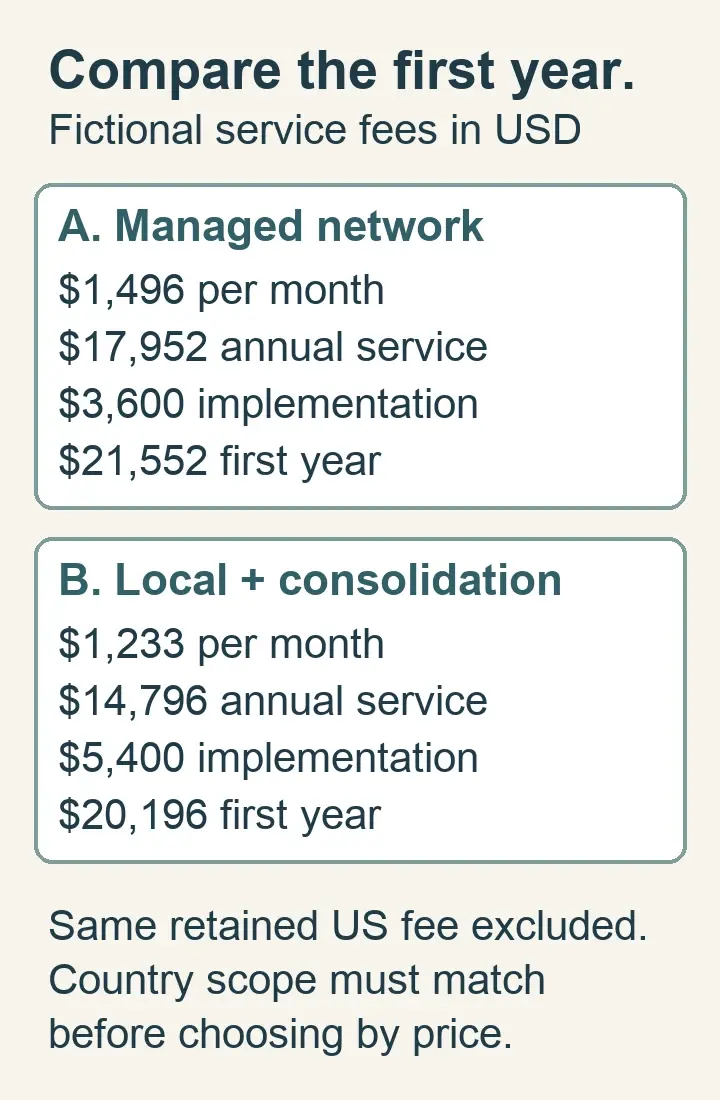
The lower listed total is not a buying decision until the country services and remaining work are comparable.
If the proposals leave different work with your team, SelectSoftware Reviews offers advisor-led help comparing payroll options. Confirm the relevant country services and obtain the provider's own written scope.
Country Service Responsibility Map
Create one map for each proposed country and employing entity, repeating it for each supplier you seriously compare. Keep shared headquarters decisions in a separate portfolio note so they are not mistaken for a country commitment. Attach evidence references rather than putting bank details, personal identifiers or employee medical information into a widely shared buying document.
Use a named party and a document reference in each field. Mark a requirement confirmed, conditional, unknown or excluded. Confirmed should identify the current written commitment; conditional should name the unresolved dependency and its owner. Unknown and excluded country essentials remain decisions to resolve, regardless of the proposal's overall score.
Country and population
Country, employing entity and registration reference: ____________________
Employee populations, headcount and pay frequencies: ____________________
Current arrangement and proposed country start date: ____________________
Essential local pay and reporting requirements: ____________________
Keep the country scope fixed while comparing proposals. If one supplier excludes a population, show the exclusion rather than quietly shrinking its denominator.
Calculation and service delivery
Contracting supplier, local processor and calculation system: ____________________
Included processing tasks and work retained by your team: ____________________
Source systems, local codes and consolidated-report mapping: ____________________
Input cutoff with time zone, review date and approval roles: ____________________
Authorized filer, required reports and acceptance evidence: ____________________
Correction owner, specialist access and escalation commitments: ____________________
Record both the operating party and the supplier responsible to you. If they differ, attach the agreed route between them.
Payments and data handling
Employee and statutory payment services included or excluded: ____________________
Funding account, currency, arrival time and release authority: ____________________
Conversion basis, charges and shortfall or return response: ____________________
Recipient outcome, reconciliation and replacement-payment evidence: ____________________
Processing locations, access roles and sub-processor review: ____________________
Export rights, format, history and retrieval after termination: ____________________
Payment and data references may belong in restricted supporting records. The map should identify who approved those arrangements and where an authorized reviewer can retrieve them.
Commercial and country acceptance decision
Recurring charges, minimums, implementation and excluded costs: ____________________
Same-case demonstration result and unresolved conditions: ____________________
Country migration, historical reporting and exit responsibilities: ____________________
Country decision, approving owner and evidence due before launch: ____________________
Compile the country decisions into a portfolio decision. List any country that needs a different arrangement, a later start or a retained local service.
Move countries in waves without losing their history
Select a migration order that reflects readiness and service risk rather than an attractive worldwide launch date. A country with stable source data and an agreed operating model can be a better first wave than a country with unresolved historical balances or a pending employer change. Define what the first wave is intended to prove and what it cannot establish for other countries.
For each country, agree which prior-period and year-to-date information the new calculation and reporting processes require. Name the party responsible for the last old-provider period, the first new-provider period and corrections affecting either. Have local specialists determine the required history and reporting treatment. A global project plan should not assume one country's tax-year boundary or correction method applies elsewhere.
Reconcile the country population, recurring components, relevant accumulated balances, results and reporting outputs before accepting the first live period. Then reconcile the common report to the underlying country output. These are two different acceptance checks: an accurate local payroll can still be translated incorrectly for headquarters.
Keep the old and new payment instructions separate until the authorized transition point. Test who disables superseded files or standing instructions, who can release the first new payment and how the team detects a duplicate. Include payslip access and an employee support route, especially if the new service changes the portal or the way questions are raised.
Treat the first wave's findings as evidence for the next wave's plan, not permission to skip country checks. If a local partner, integration or payment route differs, the relevant trial must be performed for that difference. Record any change in the service schedule before expanding the rollout.
Select the portfolio you can operate and eventually leave
Choose the arrangement whose country commitments your team can explain and verify. That may be a managed network across most countries, direct services in several large operations, or retained local providers with a common coordination layer. The defensible result is a deliberate portfolio, not necessarily the fewest logos on a slide.
Before signing, consolidate the accepted country schedules, unresolved conditions, first-year costs and retained internal work. Make clear who owns the cross-country view when the commercial relationship is global but the employment and operating responsibilities remain local.
Negotiate usable exit records before becoming dependent on the common platform. Ask for the country results, employee history, source mappings, filing and payment evidence, open corrections and annual-reporting responsibilities. Determine which records come from the lead supplier and which remain with a local processor. Have the contract address format, timing, assistance and continuing access rather than relying on a screenshot of an export menu.
The strongest next conversation is specific: these are our entities, this is the work we expect you to perform in each country, and this is the evidence we need before accepting the arrangement.
Bring that country-by-country scope to an advisor conversation if you want help developing a shortlist. SelectSoftware Reviews offers 1:1 payroll software matching assistance; confirm each proposed provider's coverage and commitments directly.
Browse the Decision Guides library.
Continue with Payroll Software Comparisons.
Get Help Choosing Payroll for provider-selection questions.

About the author
Ben Scott writes and maintains payroll decision guides for founders and operators. His work focuses on execution realities and how decisions hold up under growth, complexity, and controls and documentation pressure. He works hands-on in HR and leave-management roles that intersect with payroll-adjacent workflows such as benefits coordination, cutovers, and compliance-driven process controls.