Common Paymaster Payroll: Review Eligibility Before Combining Wage Bases

Updated: 9 hours ago

Before payroll combines wage bases for two corporate records, someone must establish who employs the worker and which payments the arrangement covers. A shared owner, one payroll login and an allocation between cost centers can coexist with separate employment-tax calculations. The payroll setup needs a supported instruction for the actual corporations, employee, services and payments.
A common paymaster is an employing corporation within a related group that pays covered employees on the group's behalf and keeps the relevant payroll records. The federal rules can give qualifying remuneration single-employer treatment for Social Security and federal unemployment tax purposes. That result depends on specific facts. Buying multi-company payroll software or assigning a parent company to fund the run does not establish those facts.
Use this guide to prepare those facts for the qualified tax reviewer, translate the resulting instruction into payroll, and reconcile the arrangement after payment. The Employer-by-Employee Paymaster Record below is an original operating aid for U.S. payroll and finance teams. It does not elect a tax treatment, replace professional advice or decide a real employee's legal status. The businesses, people and calculations in the worked examples are fictional.
Contents
Establish which question the proposed arrangement answers
Start with the reason the business wants a change. It might be combining a worker's covered wages, simplifying payments, allocating labor among companies or reducing the number of payroll subscriptions. Those requests can lead to different decisions. Record the intended tax result separately from the administrative convenience.
The IRS common-paymaster overview describes an arrangement involving related corporations, concurrent employment and payment through an employing member. The common paymaster has responsibility for the FICA and FUTA payments and associated reporting for the wages it disburses. This is a specific employment-tax framework. A shared-services team preparing several employers' payrolls may instead be carrying out ordinary administrative work.
Ask the proposer to name the legal entities and affected employees before discussing a configuration switch. Two departments inside one corporation present a different starting question from two corporations with separate employment relationships. Likewise, an employee moving permanently from one corporation to another may require a successor-employer or transfer analysis rather than a concurrent-employment analysis.
Clarify what a provider means by the term. A seller might use paymaster informally for a service that sends checks or handles administration. The IRS separately describes payroll service providers, reporting agents, section 3504 agents and certified professional employer organizations. Their authority and reporting arrangements are not established by a contract's marketing label.
Give the tax reviewer the proposed arrangement, contracts and actual work pattern. Request a conclusion that identifies the relevant authority, corporations, workers, remuneration, periods and conditions. Payroll should be able to tell which records the conclusion permits it to combine and which records remain separate. An approval that says only “common ownership confirmed” cannot specify the calculation population.
Document related corporations for the reviewed quarter
The federal regulation provides four routes for related-corporation treatment: a modified controlled-group test, specified governance or voting relationships for nonstock corporations, officer overlap, and concurrent employee overlap. The ownership route modifies the usual controlled-group provisions; a familiar ownership percentage from another tax rule is not a complete test here.
Have the reviewer identify the particular route and supporting facts. For ownership, that may require ownership records and an attribution analysis. For a nonstock corporation, obtain the relevant governing-body or voting information. For an officer or employee route, preserve the population, positions and dates that support the calculation. The employee-overlap test in the regulation uses a 30% threshold; the officer test uses 50%. These are defined tests with specific denominators, not percentages to apply indiscriminately to a consolidated group roster.
Section 31.3121(s)-1 treats corporations as related for a calendar quarter when the applicable test is satisfied at any time during that quarter. Keep that quarter determination distinct from an employee's service dates and from the date a system is activated. A single effective-date field should not silently replace all three.
Map the relationship to the proposed paymaster. A chart showing that several companies have some connection does not by itself explain which companies and employees belong in this particular arrangement. Record the reviewer-approved members and any excluded company. When the group changes, retain the version of the chart and the conclusion used for the affected quarter.
Collect each entity's legal form and relevant tax classification for the review. Do not infer eligibility from an abbreviation in a company name, and do not copy a state program's entity definition into the federal analysis. An LLC's classification and employment-tax treatment need their own supported instruction where relevant.
Keep sensitive evidence in the appropriate controlled location. An operational register can use internal entity references and links to approved records. It does not need to reproduce full tax identifiers, ownership documents or employee identity evidence in a broadly shared project worksheet.
Reconstruct the employee's overlapping work
Corporate relatedness is only one part of the review. Concurrent employment concerns an employment relationship with more than one corporation during the relevant services. The regulation describes an employment relationship as services performed for the benefit of the employing corporation, rather than merely the group, in exchange for remuneration. It presumes that an individual who does not perform substantial services in exchange for remuneration from a corporation is not employed by that corporation.
Build an employee-specific service history. Identify the corporations for which the person performs work, the duties, the relevant service intervals and the evidence of the relationships. A finance employee might perform substantial accounting work for two corporations while sitting in one office. The location of the desk would not answer the question. Conversely, charging part of an employee's cost to an affiliate does not establish that the affiliate employs that person.
The proposed common paymaster must itself employ the individual. A holding or administrative company cannot be assumed eligible for that role simply because it has the bank account or pays the group's invoices. Give the reviewer evidence of the person's services for that corporation, as well as for the other proposed employers.
Keep temporary inactivity separate from termination. The regulation says that leave or temporary inactivity does not defeat concurrency when the employment relationships continue. It also distinguishes a completely ended relationship from amounts and obligations that commonly remain after termination. A late final payment, retained benefits or an old employee record needs analysis; none is a reliable substitute for the underlying relationship.
Record the service period behind a payment, not just the pay date. The regulation ties the treatment to services performed while the individual was concurrently employed by the common paymaster and another related corporation. A payment after a relationship ends may relate to earlier qualifying services. A payment during a period of apparent overlap may relate to earlier services outside the approved scope.
Ask HR and the operating managers to confirm the work facts, then obtain the tax conclusion from the responsible reviewer. Preserve a reference to both. This keeps a manager's description of shared work from becoming an undocumented tax instruction, while giving the reviewer more useful information than a list of payroll company codes.
Trace every payment through the proposed paymaster
The disbursement route determines which remuneration receives the treatment. The federal regulation does not apply the common-paymaster provisions to remuneration that is not disbursed through a common paymaster. Paying a regular salary through the approved route does not automatically bring a separate member-issued bonus or manual check into the same calculation.
Inventory the actual payment channels: regular runs, bonuses, commissions, corrections, off-cycle checks and any other relevant remuneration. For each, identify who disburses the money, whose behalf it is paid on, the employee and service period, and where the payroll record is kept. A funding transfer from one member to another is a different event from a wage payment to the employee.
A federal common paymaster may use a combined paycheck or separate paychecks drawn by the paymaster on one or more employing corporations' accounts under the regulation. Therefore, counting bank accounts or checks is an incomplete test. Establish the actual disbursing party and documented arrangement. State requirements may be different.
An organization also need not place every worker in its related group under one common paymaster. Preserve the particular approved employee population. If only a subset of workers qualifies or uses the route, the system must distinguish that subset from workers who are paid separately. A group-level checkbox without an employee-level boundary can produce incorrect results.
Define a fallback for a payment that cannot use the intended route. Before the operator releases a separate check, establish the tax and reporting instruction for that payment. Do not repair the appearance of a combined total by deleting a payment record, changing the payer retrospectively without support, or assuming another company's reimbursement makes the wage disbursement equivalent.
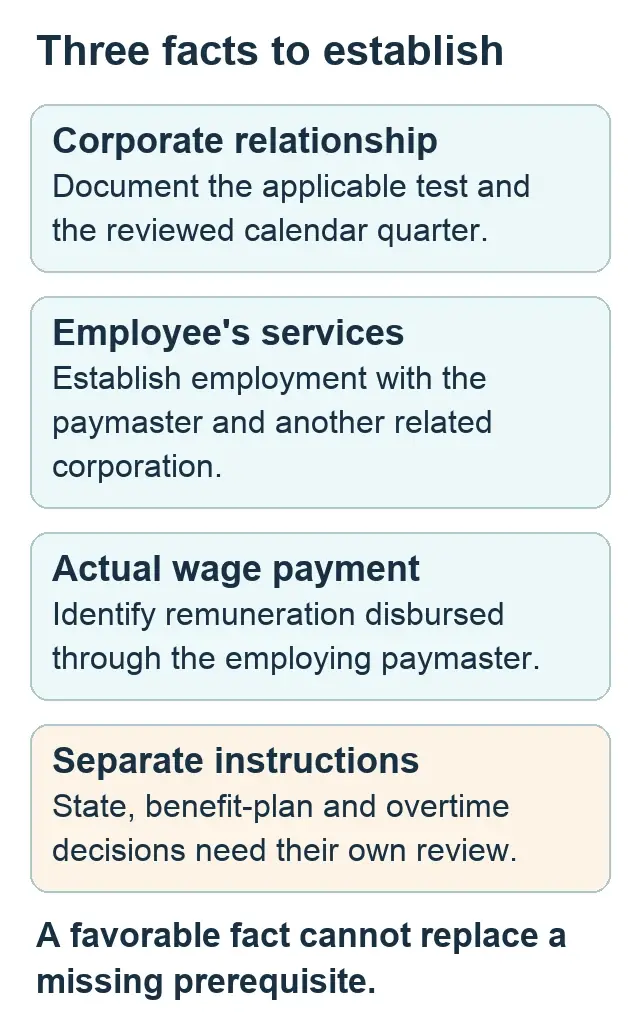
Match the corporate conclusion, the employee's service period and the actual wage payment before approving a shared calculation.
Give each tax and jurisdiction its own instruction
Specify Social Security wages and tax, Medicare wages and tax, Additional Medicare withholding, FUTA wages and state unemployment treatment separately in the implementation instruction. A total called taxable wages or year-to-date pay is too imprecise to direct every calculation.
Social Security has an annual taxable maximum. Medicare does not have an ordinary annual wage-base ceiling. The federal common-paymaster framework should not be described as a general cap on all FICA taxes. Use the applicable year's amounts and the approved treatment for each tax rather than transferring a Social Security stopping point into Medicare.
FUTA has its own common-paymaster regulation, section 31.3306(p)-1, which incorporates specified definitions and liability rules from the FICA regulation. Ask the preparer to document the FUTA route, including any relevant state-contribution credit treatment. A supported federal Social Security result does not substitute for the FUTA return's inputs.
Do the same for federal income-tax withholding and wage-statement reporting. The common paymaster's reporting responsibility must be translated into the forms and identifiers that the preparer will actually use. Identify any wages outside the arrangement and who reports or corrects them. A demonstration of one combined employee screen does not prove that the required return and statement outputs follow that instruction.
State unemployment rules need a separate decision. Pennsylvania's Department of Labor and Industry says common-paymaster reporting is not permitted under its unemployment-compensation law and requires separate employer accounts. Florida describes a state-approved common-paymaster group with its own requirements and application. Those examples show why a federal conclusion cannot be copied into every state account.
For Florida, approval does not eliminate the other corporations' quarterly filing requirements. Its published guidance also restricts whose wages can be included and disallows the separate direct-payment route it describes for employees reported through the common paymaster. Record the actual state's current approval, account, payment and return instructions. Do not build a national state-treatment table from two examples.
Leave benefit-plan aggregation and wage-and-hour questions with their responsible reviewers. A federal employment-tax determination does not decide a retirement plan's wage scope or whether hours must be combined for overtime. Attach those separate instructions when the operating model depends on them, rather than giving the common-paymaster approval a wider meaning.
Work a Social Security comparison and a timing exception
Consider a fictional employee, Morgan, who performs substantial services for Alder Services Inc. and Birch Studio Inc. throughout 2026. Assume a qualified reviewer has established that the corporations are related under the applicable rule, Alder is an employing common paymaster, all the example's remuneration is paid through Alder, and the other requirements are met. Morgan has no other wages relevant to this illustration.
The two corporations' remuneration for the year is $120,000 and $100,000, totaling $220,000. Assume it is all ordinary Social Security-covered wages before applying the annual maximum, with no wage exclusions or earlier amounts affecting the example. The SSA's table lists the 2026 Social Security taxable maximum as $184,500. At the 6.2% employee and employer Social Security rate, the tax on that maximum is $11,439 for each side.
For comparison, if the same amounts were subject to separate employer wage bases without qualifying common-paymaster treatment, neither corporation's individual amount would reach $184,500. The combined employer Social Security tax on $220,000 would be $13,640. The difference in this limited comparison is $2,201 of employer Social Security tax. This arithmetic does not establish eligibility, justify a refund, or describe the total employment-tax cost.
This is a Social Security-only illustration. It excludes Medicare, Additional Medicare withholding, FUTA, state taxes, income-tax withholding, benefits, special wage exclusions and any costs of operating the arrangement. An employee's possible excess-withholding credit or refund has its own requirements and correction route. It does not authorize payroll to combine employers that do not qualify.
Keep the year visible in the test record. SSA's current table lists different taxable maxima for different years. A 2026 demonstration should not become an unlabeled permanent expected result in the provider's configuration tests.
Now change the service facts. Morgan's employment with Birch ends June 30, while employment with Alder continues. Alder pays a July bonus. The date of the July payment alone cannot decide whether its remuneration belongs in the reviewed common-paymaster scope. The reviewer needs the bonus's underlying service period and employment facts.
If the bonus relates to qualifying concurrent services performed in May and June, that history matters even though payment follows the end of the Birch relationship. If it compensates only July services after that relationship ended, the earlier overlap does not automatically bring the new remuneration into the same scope. Obtain the supported conclusion and preserve the service-to-payment link rather than simply carrying forward June's configuration.
A change in status also does not, by itself, mean starting the continuing payer's annual wage base over. In the regulation's payment-timing example, the corporation still counts amounts it previously disbursed while the person was concurrently employed toward its wage base for later services performed for that corporation. Have the reviewer specify both the later payment's treatment and the history the continuing payer must retain.
Keep the corporate-quarter determination separate as well. The regulation's related-corporation timing rule and its employee-concurrency rule answer different questions. A quarter-level corporate conclusion is not evidence that Morgan performed qualifying services for both corporations throughout that quarter.

The service interval and the payment date belong in separate fields. A late payment can require an earlier employment history.
Capture the decision in an Employer-by-Employee Paymaster Record
Use one record for an employee and a defined review period, with a linked group-level corporate analysis. Repeat or split the record when the relevant companies, services or tax instructions differ. Store sensitive supporting documents separately and put controlled references in the operational copy.
Write a supported conclusion or an open action in each field. “Unknown” should identify who will obtain the missing information and which setup decision remains on hold. The record has no eligibility score; adding several favorable facts cannot cancel a failed prerequisite.
A. Set the corporate boundary
Review period: Wage year, calendar quarter and the particular setup or change being considered: ____________________.
Entity references: Proposed corporations, legal forms, relevant tax classifications and controlled employer-identifier references: ____________________.
Relatedness evidence: Selected regulatory test, supporting population or ownership records, reviewer and dated conclusion: ____________________.
Employing paymaster: Proposed disbursing corporation and evidence that it employs this individual: ____________________.
B. Connect the person to the services
Worker reference: Internal employee reference and the records used to distinguish this person across company accounts: ____________________.
Work for each employer: Actual duties, benefiting corporation, remuneration basis and factual confirmation owner: ____________________.
Employment intervals: Concurrent periods, leave, transfers and ended relationships, with evidence references: ____________________.
Remuneration detail: Amounts attributable to each corporation and the service periods behind them: ____________________.
Payment exceptions: Member-issued checks, bonuses, corrections or other payments outside the proposed paymaster route: ____________________.
C. Specify the payroll result
Approved tax scope: Reviewer-approved employee, employer, remuneration and effective-period treatment for each relevant tax: ____________________.
Opening history: Source wages and taxes, applicable year, calculation-only history and reporting history kept distinguishable: ____________________.
Payer and return map: Disbursing party, funding authority, filing identity, wage-statement owner and state account instructions: ____________________.
Member settlement: Wage and tax reimbursement responsibilities, remuneration allocation basis and supporting evidence: ____________________.
Acceptance evidence: Approved scenario, expected payroll and reporting outputs, actual result and unresolved differences: ____________________.
D. Authorize and maintain the instruction
Review conclusion: Qualified reviewer, supporting authority, approved scope and any exclusion or condition: ____________________.
Open action: Missing evidence, accountable owner, due date and the payroll decision it prevents: ____________________.
Release approval: Person authorized to implement the instruction and the person verifying the first affected run: ____________________.
Review trigger: Ownership, workforce, service, payer, jurisdiction or year change requiring another scoped review: ____________________.
Keep each field as a separate row or compact list item when copying the record. Retain the section labels and separate instructions. The completed record supports an implementation decision; the underlying corporate and employee analyses remain the evidence for the tax conclusion.
Test the approved scope before changing a live calculation
Give the implementer a written configuration specification derived from the approved record. Identify the company and employee identifiers, accepted wage history, tax types, effective periods, payment routes and outputs. State how to handle a worker or payment outside the approved population. A general request to “turn on common paymaster” cannot describe those boundaries.
Use synthetic cases that expose a wrong population or date rule. Include a qualifying employee approaching the year's Social Security maximum, an employee of only one member, a payment outside the common paymaster, and a service-period change. Add state-specific examples when the federal and state reporting routes differ.
For each case, record the expected result before running the demonstration. Examine the current-period wages and tax, cumulative calculation wages, employer identity, payment record, return allocation and employee statement. A correct net-pay total can conceal an incorrect tax base or reporting owner. Preserve the relevant exported evidence, not just the screen on which a feature was enabled.
Distinguish historical amounts used for a calculation from wages the new payer is responsible for reporting. If a change occurs during the year, obtain the approved instruction for prior disbursements, later payments and any correction. Do not import a combined gross-pay figure into every tax or reporting field because it makes a preview look continuous.
Have someone independent of the setup compare the outputs with the specification. Resolve discrepancies with the provider and tax reviewer before authorizing the affected treatment. If a product cannot represent the approved boundary, identify a supported alternative or leave the change unapproved. Software convenience should not expand a tax conclusion.
Plan how the first real payroll will be checked. Name the affected population, the records the reviewer will receive and the point at which a failed check stops release or triggers the approved exception route. Keep the decision authority with the people responsible for the employer's tax and payment obligations.
Reconcile member reimbursements and reporting after payment
The arrangement still needs records showing whose services generated the remuneration, who paid the worker, who funded the run and how the corporations settled their shares. These events can occur in different systems. A consolidated payroll expense total does not explain the underlying employer and payment responsibilities.
Publication 15-A says each corporation must pay its own share of employment taxes and may deduct only its own part of wages; it also addresses reimbursement of the common paymaster for wage and tax payments as a condition for those deductions. Give finance the tax reviewer's instruction for the actual arrangement rather than treating an intercompany journal as sufficient evidence of reimbursement.
The regulation distinguishes remuneration-based allocation from its other allocation provisions. Where the approved remuneration-based method applies, the relevant remuneration records matter for each payment. In a simple fictional payment of $4,000, supported remuneration of $3,000 for one corporation and $1,000 for another gives proportions of 75% and 25%. Apply the approved method to the tax actually required for that payment; do not assume a flat rate remains correct after wage bases or other tax rules affect it.
Reconcile those payment-level records to the wage register, bank evidence, member settlements, tax deposits and reporting outputs. Follow a mismatch to its source: an unrecorded bonus, an incorrect service allocation, a missed reimbursement or a return filed under the wrong identity may require different actions. Mark a difference resolved only when the responsible owner can explain the corrected records.
Tax responsibility does not disappear if the common paymaster fails to remit. The regulation retains the paymaster's liability and describes the other related corporations' liability for their appropriate shares. Its allocation rules are more specific than a casual assumption that each member owes the same percentage. Escalate a missed payment promptly to the tax and finance owners with the actual payment and allocation records.
Keep the employee-facing result in the review. Confirm that wage statements and access instructions follow the approved reporting route, especially for workers also receiving wages outside the arrangement. If a mistake affects prior returns or statements, have the responsible preparer determine the correction route and keep it separate from a prospective setup change.
Review the boundary when people, companies or payment routes change
Make the approved population maintainable. A new corporation, ownership change, changed officer or employee population, or different service relationship may affect the evidence supporting the arrangement. Record who receives those events and who decides whether a new tax review is needed before payroll expands the scope.
A worker transfer deserves more than moving a record between company codes. Establish whether the earlier relationship continues, which services are compensated by later payments and whether the paying corporation still fits the approved role. Preserve the old instruction and the new conclusion with their effective periods so a later reviewer can reconstruct the result.
Treat a new payment channel as a review event too. A business unit introducing manual bonuses or a separate bank process can change which wages actually pass through the common paymaster. Include those payments in the exception inventory and obtain the supported treatment before excluding them from normal reconciliation.
At year change, update the year's tax parameters and rerun the affected acceptance cases. At a provider migration, carry the evidence and approved historical-treatment specification into the receiving system. Neither event automatically changes the legal facts, but either can change how the instruction is implemented.
Use a documented stop or escalation condition for unresolved changes. The employer may need to preserve an existing approved scope while a proposed expansion remains pending. The record should identify that boundary clearly enough that a backup operator can apply it without making a new legal interpretation during a payroll deadline.
Questions to resolve before a common paymaster launch
Does a common owner establish eligibility?
No. The reviewer must apply the relevant related-corporation test and establish the employee and disbursement conditions. Collect the ownership or other relationship evidence, but keep the resulting determination explicit. A corporate diagram alone does not identify every covered wage payment.
Can a payroll service provider be the common paymaster?
The federal framework requires an employing corporation in the related group to be the common paymaster. A third party may perform authorized processing or act for that corporation, but its service agreement does not by itself establish the employing-member condition. Document the actual employer, disburser and authorized service roles.
Must every employee in the corporate group be included?
No. The regulation allows arrangements covering particular concurrently employed workers. Keep the approved employee and remuneration population identified, and specify the treatment for everyone outside it. Do not apply one qualifying person's result to the entire group roster.
Does a second paycheck always mean separate treatment?
Check who disbursed it, on whose behalf, for which services and under which approved rules. Federal regulations contemplate more than one check in specified circumstances, while state requirements can differ. The appearance of the payment alone cannot establish the complete instruction.
Can a transferred employee's earlier wages always be combined?
No. Reconstruct the employment, service and payment history and obtain the applicable tax conclusion. Common-paymaster concurrency, successor-employer treatment, CPEO transition provisions and plan-specific aggregation are separate questions. Use the route supported by the actual facts rather than selecting the one that produces the lowest preview tax.
Can a common-paymaster approval be used for all states and benefit plans?
No. Obtain each jurisdiction's and plan's applicable instruction. The Pennsylvania and Florida examples illustrate different unemployment-reporting approaches, and a retirement-plan decision can use a different employer scope. Record those distinctions alongside the federal instruction instead of treating approval as a single universal status.
Continue with payroll operating resources:

About the author
Ben Scott writes and maintains payroll decision guides for founders and operators. His work focuses on execution realities and how decisions hold up under growth, complexity, and controls and documentation pressure. He works hands-on in HR and leave-management roles that intersect with payroll-adjacent workflows such as benefits coordination, cutovers, and compliance-driven process controls.