
Third-Party Sick Pay: Reconcile Insurer Payments and Payroll Reporting

Updated: 4 days ago

An insurer's annual sick-pay statement can arrive after your payroll service has already prepared wage statements. A missing payment or the wrong reporting party can then affect quarterly returns, employee Forms W-2 and taxes deposited under another employer identification number. The practical control starts when benefit payments begin, while the insurer and employer can still resolve their responsibilities and exchange usable records.
Reconcile the benefit as a payment, a set of tax bases and an assignment of reporting duties. A claim approval establishes none of those totals by itself. Equally, adding an insurer's payment to a payroll record does not mean the employee should receive that money again.
The federal workflow below applies to ordinary U.S. employer coordination of third-party sick pay. The examples are fictional federal reporting illustrations, not a determination of an employee's personal tax return or entitlement to benefits. State programs, railroad employment, disability retirement, workers' compensation and other special arrangements need their applicable rules. Use the Sick Pay Reporting Reconciliation Sheet to connect the actual agreement, payer records and filing outputs.

If insurer files keep exposing gaps in your payroll service, a free SelectSoftware Reviews advisor conversation can help you explore payroll options. Bring the payment and reporting handoffs you need a prospective provider to demonstrate.
Contents
Establish what the insurer actually paid
Start with the payment type and payment dates. Sick pay generally replaces wages during a temporary absence caused by sickness, injury or disability under an applicable plan. A benefit called short-term or long-term disability can fall within that definition. The product's name alone does not determine its federal tax treatment.
Distinguish those payments from ordinary employer sick leave, disability retirement, medical-expense reimbursements and workers' compensation paid under a workers' compensation law. IRS Publication 15-A treats those categories differently. A leave status in the HR system is useful context, but it is not a substitute for identifying the benefit and its payer.
Obtain the legal employer and EIN, insurer or administrator, policy or plan reference, employee identifier, payment dates, gross amounts, deductions or withholding, and net payments. Keep the payment date separate from the disability period covered. An insurer can pay several weeks together or issue a retroactive adjustment, so a benefit-period total may not describe the payments in one reporting quarter.
Ask whether the file is a complete payment history, a monthly movement file, a year-to-date replacement or a corrected annual statement. A replacement file loaded as an addition can double reported wages without generating any visible payment error. Give each received version a date and retain its relationship to the earlier file.
Benefits can confirm the claim and coverage facts, payroll can identify the entry and filing treatment, and finance can reconcile employer tax cash. Assign a person to obtain missing information from the insurer. A group inbox without an accountable owner tends to preserve the file while leaving the reporting decision unresolved.
Determine whether the payer is an agent or an insurer bearing risk
Read the actual agreement before assigning federal tax duties. Publication 15-A distinguishes an employer's agent, which bears no insurance risk and is reimbursed on a cost-plus-fee basis, from an insurer paid a premium that bears the insurance risk. Administrative responsibility for deciding claim eligibility does not by itself settle that classification.
An agent pays for the employer
When an agent pays sick pay for an employer, the employer generally retains employment-tax responsibility. An agreement can assign responsibilities to the agent under the applicable rules. Document the work assumed and the name and EIN used for it; an administrator's statement that it handles payroll is too imprecise.
Separate the tax agreement from the service desk's file-upload instructions. A vendor may accept a file while the employer still owns withholding, deposits or the wage statement. Ask for confirmation of the actual arrangement from the party responsible for tax reporting, particularly if the benefits contract and payroll-service contract describe different duties.
A non-agent insurer keeps the employer-side liability
A non-agent third party generally withholds and deposits the employee Social Security and Medicare taxes and federal income tax when the employee requests that withholding. It also bears the employer Social Security, Medicare and FUTA responsibilities unless it validly transfers the employer-side liability.
When that liability is not transferred, Publication 15-A places the sick-pay employment-tax and wage-reporting responsibilities with the third party. Do not add the same sick pay to the employer's wage statements merely because an insurer report is available. First determine whether the report is informational or directs employer reporting under a different arrangement.
A non-agent insurer transfers the employer-side liability
The transfer requires more than a sentence in a renewal notice. The third party must withhold the employee Social Security and Medicare taxes, deposit them timely and notify the employer within the time required for the third party's deposit. Preserve evidence of the applicable steps and notice timing.
In that arrangement, the insurer deposits the employee taxes under its EIN, while the employer handles its employer-side taxes under the employer EIN. Publication 15-A says the employer's deposit liability begins when it receives the insurer's notice. An annual statement is therefore not a reason to postpone monthly or quarterly coordination.
Ask who monitors the notice and who gives finance the actual deposit instruction. Do not assume the insurer and employer have the same deposit schedule. Collectively bargained multiemployer arrangements have additional timing rules; route those through the plan's specialist rather than applying this ordinary insurer-to-employer sequence unchanged.
Separate plan funding from the employee's current deduction
Employer-funded benefits and benefits attributable to an employee's after-tax contributions can have different federal tax results. Employee contributions through pre-tax salary reduction under a cafeteria plan count as employer contributions for these purposes. A deduction appearing on a pay statement does not establish that it was after tax.
Obtain the contribution basis from the plan and payroll records. For a group policy funded by both employer contributions and employee after-tax contributions, Publication 15-A generally uses the employer's share of policy cost for the three policy years before the calendar year of payment. It supplies shorter-policy rules where three years do not exist. Do not substitute the employee's current monthly premium percentage for that historical calculation.
For example, assume the insurer has verified that 60% of a fictional $4,000 benefit is attributable to employer contributions under the applicable group-policy rule. The resulting employer-funded portion is $2,400 and the employee after-tax portion is $1,600. That arithmetic does not establish the 60% allocation; the underlying policy-cost evidence must establish it first.
Keep an exclusion's reason with the amount. An amount attributable to after-tax contributions, an amount paid beyond the six-month absence boundary and an amount above the Social Security wage base do not all have the same effect on income-tax wages, Social Security wages and Medicare wages. A single field labelled tax exempt cannot explain those differences.
Federal treatment is also not a universal state withholding answer. Minnesota's third-party sick-pay guidance, for example, assigns state withholding and reporting by reference to who paid the premiums and whether the payer is an agent. Check the actual employee's state and local requirements separately. Do not use that example as a rule for every state or for a state paid-family-leave program.
Count calendar months from the last month worked
For the ordinary six-month absence rule, Social Security, Medicare and FUTA taxes cease to apply to sick pay paid more than six calendar months after the last calendar month in which the employee worked. The official Social Security regulation describes the calendar-month boundary. This is not a blanket exemption from federal income tax, and it is not a count of 180 days.
Consider an employee whose last work occurs in January 2026 and who performs no services during the following absence. The six subsequent calendar months are February through July. In this simplified case, payments made in August and September fall beyond that boundary. Payment dates matter even if a later payment relates to an earlier benefit period.
Assume the plan is fully employer funded, the insurer pays $2,200 in each month from February through September, no other exclusion applies, and the Social Security wage base is not reached. Eight payments total $17,600. The first six total $13,200 for the Social Security and Medicare sick-pay wage bases; the final two total $4,400 beyond the six-month boundary. The sick-pay amount includible in federal income remains $17,600 under these assumptions.
The corresponding sick-pay portions of Form W-2 boxes 1, 3 and 5 can therefore legitimately differ. They are not the employee's complete annual wage-statement amounts if the employee also received ordinary wages. A reviewer should preserve the monthly explanation instead of changing one box to force all three to agree.
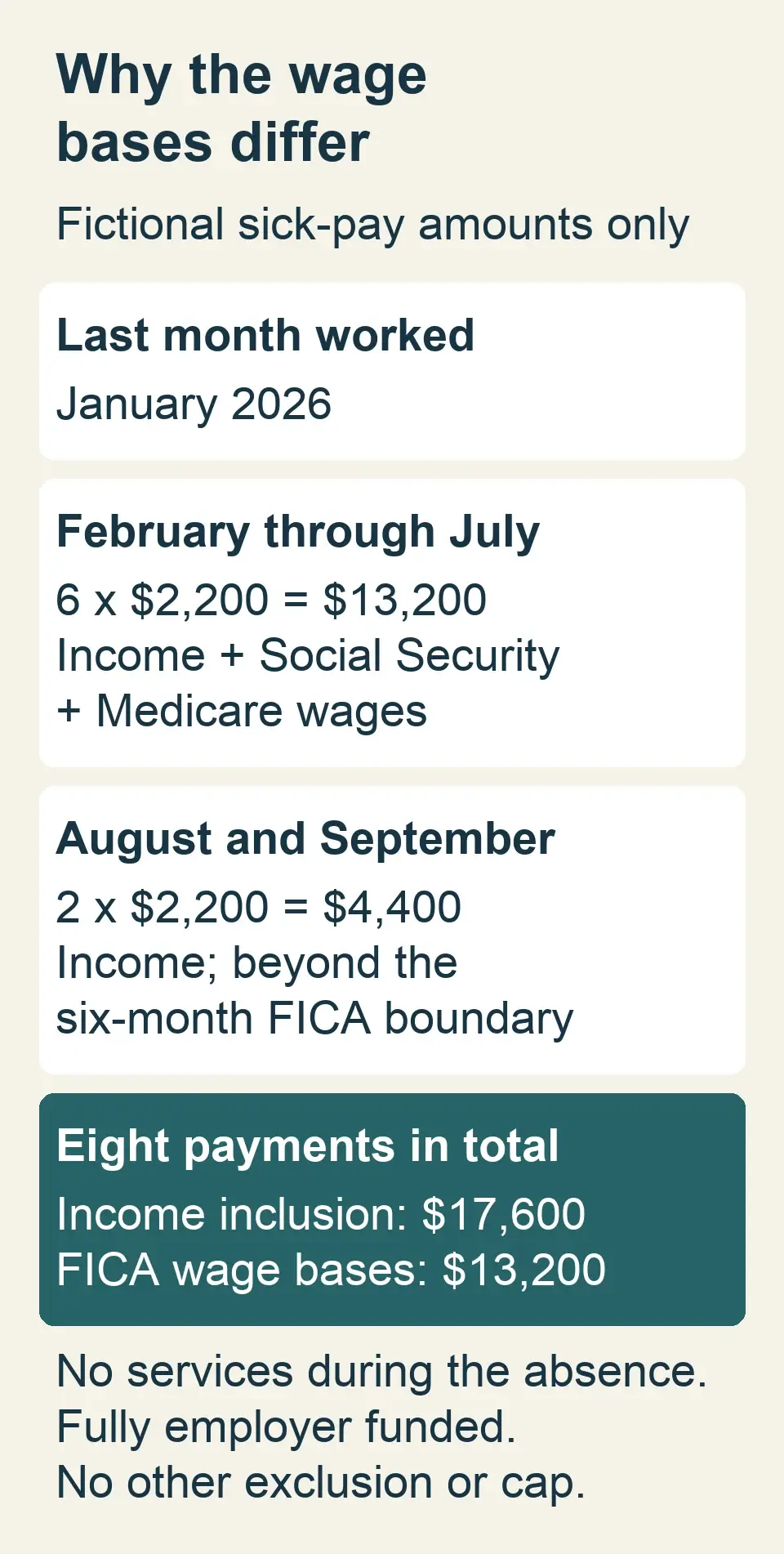
The illustration assumes January 2026 was the last month worked, no services during the absence, a fully employer-funded plan and no other relevant exclusion or wage-base limitation.
Confirm actual work rather than relying only on an absence start date. Work during the absence can restart the calendar-month count. A return-to-work entry, partial work arrangement or correction to the last-work date must reach the insurer and the payroll reviewer before they rely on the old exclusion date.
Keep this calculation separate from the applicable annual wage bases. Social Security and FUTA have different annual limits, while Medicare has no comparable wage-base ceiling. Additional Medicare withholding also has its own threshold and no employer match. A case can need more than one explanation for why the tax bases differ.
Record a paid benefit without paying it twice
Before entering an insurer file, ask what the payroll transaction will do to employee cash. Reporting previously paid sick pay is different from instructing payroll to deliver wages. Use the provider's supported third-party sick-pay process and verify the resulting employee payment, taxable bases, recorded withholding and employer tax liability.
Do not assume every system uses the same earning code, offset or historical-adjustment workflow. A normal wage code followed by an improvised negative deduction can create incorrect withholding, deduction records or employee statements. Have the provider identify the supported entry and show the resulting payroll and filing outputs.
In an original fictional example, a non-agent insurer pays a fully employer-funded $5,000 benefit during the first six applicable calendar months. The employee is below the Social Security wage base and Additional Medicare threshold. Assume an effective Form W-4S request produces $400 federal income-tax withholding, employee Social Security is $310 and employee Medicare is $72.50.
The insurer's employee-tax withholding is $782.50, so the employee receives $4,217.50. Assume the insurer has validly transferred the employer-side tax liability. The employer's matching Social Security and Medicare taxes are another $382.50. Assume ordinary wages have already exhausted the employee's FUTA wage base; FUTA adds nothing to this particular example.
The employer needs the appropriate $5,000 reporting record and its own $382.50 tax obligation, without sending the employee another $4,217.50 or $5,000. The insurer's $782.50 of withholding is not an additional employee deduction to collect again through the employer's next payroll.
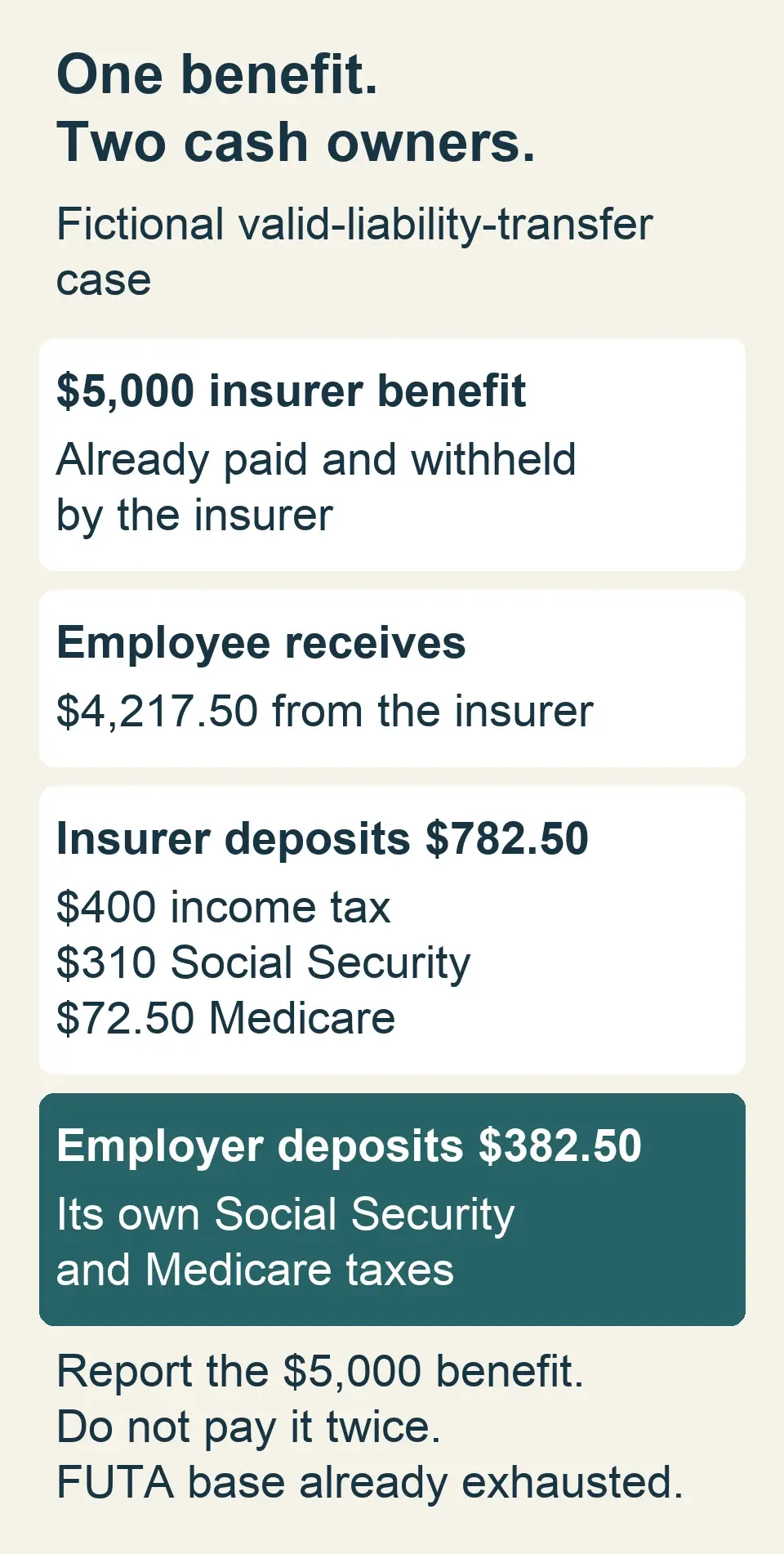
This worked case uses ordinary 2026 employee and employer tax rates, an assumed valid transfer and an already-exhausted FUTA base. It is not a universal insurer debit or payroll-entry template.
Retain the preview showing that no duplicate employee payment will be generated. Compare the actual tax-payment instruction with the assigned responsibility, and identify any employer amount that has already been deposited. Recording a tax liability and paying it are separate controls, just as recording an insurer benefit and paying an employee are separate actions.
Reconcile the bases before reconciling the tax dollars
Ask for separate insurer totals for gross benefits, income-taxable benefits, Social Security wages, Medicare wages and employee taxes withheld. Add net benefits delivered as a cash control. A gross total that agrees between the insurer and payroll can coexist with an incorrect tax base or duplicated withholding.
Use a consistent employee identifier and reporting period for each comparison. Then show insurer amount, payroll amount and difference for each category. Establish whether the payroll report includes only sick pay or combines it with ordinary wages. If it combines them, isolate the sick-pay portion through a supported report or a documented bridge.
For a difference, test the reason before changing the entry. Common possibilities include a missing payment, a cumulative file loaded as a new movement, a corrected last-work date, different treatment of after-tax funding, a payment crossing a quarter boundary or a tax already reported elsewhere. The same dollar variance can require a different correction in each case.
Federal income-tax withholding needs particular care. The current Form W-4S is the employee's request to a third-party sick-pay payer. It is not the form for ordinary employer or employer-agent sick pay, where the applicable mandatory withholding rules operate. Do not treat an insurer's zero federal withholding as proof that the benefit is excluded from income.
Have the insurer resolve missing or inconsistent withholding information through its process. Payroll should not invent an employee election or backfill a tax amount merely to resemble an ordinary payroll. Preserve the actual withholding already performed, the responsible payer and any accepted correction.
Once the employee-level differences are understood, aggregate by quarter and EIN. Reconcile the employer's own tax obligation separately from employee taxes deposited by the insurer. Keep the supporting notice and deposit evidence available to the person who reviews the quarterly return.
Explain the split on the quarterly return
In the ordinary non-agent arrangement with a valid transfer, the employer and insurer each have reporting duties. The employer's Form 941 includes the relevant sick-pay wages, while its income-tax withholding line excludes federal income tax withheld by the insurer. Form 941's instructions explain this distinction on lines 2 and 3.
The employer also includes the applicable Social Security and Medicare wage bases and uses the required sick-pay adjustment for employee taxes withheld and deposited by the non-agent insurer. Current Form 941 line 8 instructions describe the negative adjustment for that employee share. The insurer has its corresponding reporting and adjustment duties.
That is why simply comparing every employer Form W-2 withholding total with the employer's Form 941 line 3 can produce an apparent mismatch. Identify the insurer-withheld income tax and the reporting bridge. Do not change a correctly prepared quarterly return to absorb tax another EIN withheld.
The agent case must remain distinct. Current Form 941 instructions say there is no line 8 adjustment for sick pay paid through an employer's agent, and describe the effect of an agency agreement assigning tax work. Do not apply the non-agent transfer example to an agent solely because both files arrived from an outside company.
The $5,000 illustration above has $382.50 of employee Social Security and Medicare withholding and an equal employer share. Under its stated non-agent transfer assumptions, the employer's sick-pay adjustment removes the employee share from the combined Social Security and Medicare tax calculation. It does not erase the employer share or transfer the insurer's $400 income-tax withholding into the employer's line 3.
Check the complete return with the filing specialist, including liability dates, deposits, other adjustments and any Additional Medicare withholding. A Form 944 filer or another return type needs its corresponding instructions. Keep the quarterly tax tie-out connected to the sick-pay workpaper rather than turning this simplified example into an entire return.
Assign Form W-2 and Form 8922 together
Record the party preparing the employee's Form W-2, the name and EIN it will show, and the agreed reporting route. A payroll service transmitting a form is not necessarily the payer named on it. Obtain confirmation before both the insurer and employer include the same payment in annual wage statements.
Under the ordinary transferred-liability arrangement, the employer generally reports the sick pay on Form W-2 using the required insurer information. Publication 15-A also describes an optional legally binding agreement under which the third party prepares the wage statements. Confirm that agreement and its conditions rather than inferring the W-2 issuer from last year's practice.
Form 8922 reconciles the employment-tax returns and wage statements when the required third-party sick-pay reporting is split. The current Form 8922 instructions generally place the filing with the insurer or agent when the employer reports the sick pay on Forms W-2 under the employer name and EIN, and with the employer when the insurer or agent reports it under its name and EIN, where employer-side Social Security and Medicare liability is on the employer's return.
Publication 15-A supplies the fuller rules, including the optional W-2 arrangement and certain agency agreements. It also explains that when a non-agent third party pays all the employment taxes and reports the sick pay under its own EIN, neither party reports that sick pay on Form 8922. The recap is therefore not a form every employer files whenever an employee has a disability claim.
For the reviewer, write a short decision: which arrangement applies, who files the wage statement, who files the recap or why no recap applies, and which evidence supports that allocation. Form 8922 carries aggregate wages and withholding, not an employee-by-employee benefits listing, and goes to the IRS rather than the Social Security Administration.
The wage statement also needs the correct categories. The W-2 instructions distinguish income-tax wages, Social Security wages, Medicare wages and withholding. They direct use of code J for the applicable nontaxable sick pay attributable to employee contributions, and the third-party sick-pay checkbox for the specified payer or employer reporting situations. Do not use code J as a catch-all for every tax exclusion.
Ask the filer to show the completed wage-statement output, including any required W-3 treatment for insurer-withheld income tax. Verify it against the approved employee-level reconciliation and the assigned EIN. An acknowledgment that a file uploaded proves neither that the allocation was right nor that a second party did not report the same payment.
Build the annual timetable around the earlier notices
For arrangements requiring the insurer's annual sick-pay statement, Publication 15-A specifies January 15 of the following year. Its optional W-2 rule changes that statement responsibility, so confirm which route actually applies. The annual statement supports annual reporting; it does not replace the earlier notices needed for a valid tax-liability transfer and timely deposits.
For 2026 reporting, the current W-2 instructions give February 1, 2027 as the ordinary filing and employee-furnishing deadline. The current Form 8922 uses the last day of February, moving to the next business day when necessary; for the 2026 calendar year that ordinarily means March 1, 2027. Check applicable relief and arrangement-specific requirements before finalizing the calendar.
Plan backward from those dates. Agree when benefits will identify all insurers, when each payer will provide a usable annual file, when payroll will reconcile employee totals, and when the filer will return a complete preview. Give the reviewer time to resolve differences while the relevant insurer contact is available.
Control the population as well as the amounts. Start with the year's claims and payments, not only the files that arrived. A missing insurer is invisible if the annual process begins by totalling an incomplete mailbox. Ask benefits to explain open claims, closed claims with late payments and payments made after an employee left ordinary payroll.
Cross-foot the approved employee schedules into the annual wage statements and any recap. Preserve explanations for legitimate differences between income-tax and FICA wage bases, and between employer and insurer withholding. A total that was accepted by a filing service still needs a traceable reconciliation to the underlying payments.
Use the Sick Pay Reporting Reconciliation Sheet
Create one record for an employee, reporting year and employer EIN. Repeat the amount comparisons by quarter where needed, and keep a separate aggregate schedule for any recap filing. In each amount field, enter the insurer figure, the payroll figure and the difference, in that order. Define the difference as payroll minus insurer; explain every nonzero amount.
Keep the full employee identity and tax documents in the restricted working file. The shared checklist can point to that evidence without repeating medical details, full Social Security numbers or bank information. This sheet organizes review; it does not replace the payer agreement, actual tax forms or a specialist's determination.
Plan and responsibility
Employee reference and reporting year: ____________________
Employer name and EIN: ____________________
Insurer or agent and agreement reference: ____________________
Payer classification and tax-duty evidence: ____________________
Last month worked and return-to-work evidence: ____________________
Plan-funding allocation and support: ____________________
Keep the legal arrangement, work history and contribution evidence together. A claim number or benefit approval alone does not establish any of them.
Payment and wage-base comparisons
Payment dates and quarter: ____________________
Gross benefits paid: ____________________
Net benefits already delivered: ____________________
Income-taxable sick pay: ____________________
Social Security sick-pay wages: ____________________
Medicare sick-pay wages: ____________________
Compare the same employee and period. Mark amounts attributable to ordinary wages separately, and retain the explanation for any legitimate difference among tax bases.
Withholding, deposits and payroll entry
Federal income tax withheld: ____________________
Employee Social Security tax withheld: ____________________
Employee Medicare tax withheld: ____________________
Employer taxes, notice and deposit references: ____________________
Paid-elsewhere payroll entry and cash check: ____________________
Quarterly return and adjustment evidence: ____________________
The employee-tax amounts belong to the party that actually withheld and deposited them. Match each deposit and return reference to its responsible EIN before accepting the bridge.
Annual reporting and resolution
W-2 issuer, reporting EIN and duplicate check: ____________________
8922 decision, filer and due date: ____________________
Annual payer statement or agreed alternative: ____________________
State and local review reference: ____________________
Open differences, correction owner and deadline: ____________________
Reviewer, approved version and handoff date: ____________________
Complete the sheet only when its remaining differences have a supported resolution or a named, timely correction route. Keep the version reviewed with the actual wage statements, returns and relevant acceptance evidence.
Correct the record at the party and period where it failed
If the insurer file omits a payment, obtain a corrected insurer record before editing payroll to match an estimate. Identify which previously accepted version it replaces and whether the change affects a current preview, a filed quarterly return, a furnished wage statement or all three. Assign the corrective action to the party that controls that output.
For a current-year missing payment not yet included in filed forms, use the provider's supported entry and recheck both reporting and employee cash. For an already-filed quarterly return, evaluate the applicable Form 941-X process. A later payroll adjustment by itself does not correct a previously filed return.
A furnished or filed wage statement can require the Form W-2c route. Confirm whether the original statement was accepted, rejected or still a draft, and coordinate corrected employee copies and agency records. Do not issue an ordinary duplicate W-2 simply to make a corrected number available.
If Form 8922 itself is wrong, its instructions require correction as soon as possible, completing all entries and marking the corrected checkbox. Reconcile the replacement recap to the corrected wage statements and returns. Treating it as an isolated spreadsheet edit can leave the same mismatch in the other party's filed records.
Preserve the original and corrected schedules, the reason for change and the date each party accepted the correction. Notify the employee through the appropriate channel when their wage statement changes, without sharing medical details or another employee's information. Reopen any related employer tax payment or year-end task that the correction affects.
Keep the insurer history intact when payroll providers change
An ordinary payroll conversion does not make insurer-paid benefits disappear from the reporting year. Inventory the insurers, payer agreements, prior payment files, transferred tax responsibilities, open differences and accepted quarterly filings before the old provider's access ends. Identify who will receive the remaining payments and corrected annual records.
Distinguish the system carrying year-to-date history from the party assigned to prepare wage statements. The new provider might need a reporting history without taking over an already-filed quarter or a recap. Conversely, an insurer might continue issuing its agreed wage statement while the new payroll service handles ordinary wages.
Use an employee-level bridge showing old-provider sick-pay records, insurer totals, new-provider imported history and any subsequent payments. Keep the paid-elsewhere treatment and each tax base visible. A successful import count cannot prove that the new system will avoid issuing a second payment or combining wage statements incorrectly.
Arrange a sample preview before the final handoff. Ask the receiving provider to show the sick-pay wage bases, insurer-withheld tax, employer tax responsibility and intended annual output using the actual arrangement. Obtain an explicit answer about who corrects a pre-conversion error discovered after conversion.
The broader year-end provider-switch process still needs its own cutoff, filing and access decisions. Add this insurer schedule to that process rather than opening a second reporting plan with competing owners. Retain the old evidence until the new reporting outcome has been verified.
Need payroll software or service support for a more reliable insurer-to-payroll handoff? SelectSoftware Reviews offers free 1:1 help with payroll software matching. Use your sick-pay scenarios to ask each prospective provider what it will handle and what your team must supply.
Make the payer handoff a recurring control
Choose a cadence that brings insurer activity into payroll and tax review soon enough for the applicable notices, deposits and returns. Benefits should identify new payment activity and work-status changes; payroll should reconcile the file and preview; finance should verify employer tax cash; the filing reviewer should confirm the intended EIN and form set.
Start with one real payment record and follow it through those handoffs using authorized access. Identify the point where the evidence becomes unavailable or the owner changes. Then define the report, responsible person and response time that will close that gap. Do not measure success only by whether the annual statement eventually arrived.
If the payroll service cannot demonstrate its supported treatment, ask for a specific walkthrough of a paid benefit, a six-month exclusion, insurer withholding and a corrected annual file. Confirm what the contracted package includes, what the employer must supply and which deadlines depend on receiving insurer information. A generic claim that a system supports disability pay does not answer those questions.
The reconciliation is ready for filing when the payments are accounted for, tax bases are explained, liabilities sit with the correct parties and the wage-statement and recap decisions agree. Leave unresolved items with a named owner and deadline. That gives the next reviewer a usable explanation of the payment, instead of an unexplained number in year-end wages.
Browse the Decision Guides library.
Continue with Payroll Operations & Controls.
Use the Payroll Operations Resource Library for full guides with embedded tools.

About the author
Ben Scott writes and maintains payroll decision guides for founders and operators. His work focuses on execution realities and how decisions hold up under growth, complexity, and controls and documentation pressure. He works hands-on in HR and leave-management roles that intersect with payroll-adjacent workflows such as benefits coordination, cutovers, and compliance-driven process controls.


