
Earned Wage Access and Payroll Advances: Reconcile the Early Payment at Payday

Updated: Nov 3

An early payment changes what an employee should receive on payday. It also creates a transaction that someone must match to payroll, a provider settlement or an employer advance balance. The amount displayed in an app cannot, by itself, establish which of those records should change.
For employer-integrated earned wage access, approve the actual money path before enabling the service. Identify who supplies the early funds, how the amount reaches the employee, how settlement reaches the funder and what happens when the next paycheck cannot support the expected amount. For an employer advance, establish whether the arrangement is a wage payment or a loan before configuring payroll.
This guide helps U.S. payroll and finance teams operate an approved arrangement. The Advance Settlement Ticket below connects early disbursements to their payday outcome. Legal classification, wage deductions and tax timing require review of the particular product and jurisdiction. The examples are fictional, and the control recommendations do not represent testing of a provider or a nationwide legal determination.

If the extra settlement work changes your software requirements, SelectSoftware Reviews makes its HR software advice available at no charge. Specify the transaction-level records and exception ownership you need, then verify those details in a demonstration of any suggested service.
Table of contents
Start with the money path behind the product name
Earned wage access generally describes access to earned pay before the scheduled payday. An employer may participate through payroll data, settlement instructions or both. An employer-funded advance can have different terms, including payment against future work or an actual lending arrangement. A bank making a deposited paycheck available early creates another money path. Record what the arrangement does before choosing a payroll code.
Draw four connections: funder to employee, employee work to available amount, payroll to employee on payday, and employer or payroll processor to funder. If the provider collects from the employee's bank account after payday, mark that connection explicitly. Do not add a payroll settlement entry merely because the employee uses an advance app independently.
Give each connection an owner and a piece of evidence. A payroll data feed might establish accrued earnings without proving that an advance was disbursed. A settlement file might request money without establishing that payroll accepted the instruction. A bank debit might prove that the employer paid the provider without showing which employees' transactions it cleared.
Ask the provider to explain the entire path using one employee and one pay period. Include the parties' legal names, funding account owner, settlement account owner, file cutoff and treatment of a rejected transfer. Keep the explanation with the approved configuration. A sales description of an integration is insufficient evidence for the first settlement.
Keep the legal and tax decisions attached to the arrangement
The CFPB's December 23, 2025 advisory opinion says its defined Covered EWA is not credit under Regulation Z. Its conditions concern payroll-data-supported accrued wages, payroll-process settlement, contractual nonrecourse protections and no individual credit-risk assessment. Read all conditions and exceptions for the actual arrangement. The opinion does not interpret laws outside Regulation Z or decide that every other EWA product is credit.
State review remains necessary. California DFPI says its income-based-advance registration framework can cover employer-integrated and direct-to-consumer products meeting its definition, subject to exemptions. Its payroll-service-provider exemption has conditions about funding and control. Have the responsible reviewer establish which parties and activities are covered rather than treating an integration as an exemption.
Wage-deduction authority also needs its own answer. California's Labor Commissioner describes significant limits on offsets, including a final-pay balloon deduction for an employee debt even when authorized in writing. A signed form therefore cannot establish nationwide permission to sweep an advance balance from final wages. Review the employee's applicable rules, notices, consent, protected pay and separation requirements before collection.
Tax treatment is another decision. IRS Publication 15 generally includes pay for services in wages and addresses withholding when wages are paid. Have the tax owner document whether the particular disbursement is a wage payment or a bona fide loan, when withholding and deposit obligations arise, and how later payroll avoids duplicating wages or taxes. A product's consumer-credit label does not answer those employment-tax questions.
Keep the dated legal and tax decisions, relevant agreements and approved payroll configuration together. Revisit them when funding, collection rights, fees, jurisdictions or settlement mechanics change. Payroll needs the resulting instruction and its limits; the operator should not have to infer legal treatment from a deduction-code name during the close.
Set an available amount that can survive payroll changes
The source for available earnings needs a timestamp and a defined population. Identify whether it includes approved hours, unapproved time, salary accruals, commissions, tips or adjustments. Record which components the approved program permits and how the provider obtains them. An interface that transmits hours successfully can still transmit a category that the program should exclude.
For a program relying on accrued wages, predicted future shifts should not silently become current earnings. The CFPB opinion's Covered EWA definition specifically uses payroll data evidencing accrued wages rather than predictions. An operator should be able to trace a selected available amount to the underlying work records and earlier transactions for that period.
Separate the supported earnings amount from the program's operational limit. A company can choose a more conservative availability rule after legal and product review. Label that choice as company policy. Do not present a percentage of earnings as a statutory safe harbor, or promise that any fixed reserve will accommodate every later garnishment, benefit change or tax adjustment.
Define the event that reduces availability after an advance. Test multiple requests in one period, concurrent requests and a request immediately before a feed refresh. The remaining balance must reflect the approved treatment of earlier disbursements. A batch total cannot show whether the same employee's available amount was used twice.
Give time corrections and employment changes a route back to the program. A corrected shift can change the source basis after money has left. Freeze further requests for review when the approved conditions no longer hold, while assigning the outstanding transaction its own disposition. Deleting the transaction from a feed does not recover money already received.
Carry one transaction identity across the cutoff
Use a stable employee identifier, employer entity, pay period and advance transaction identifier in the settlement connection. Keep the provider's original identifier when an internal reference is added. Names, round-dollar amounts and file totals are weak matching keys, particularly when an employee receives several small transfers in a week.
Specify the event represented by each status. Requested, approved, disbursed, cancelled, submitted to payroll, accepted by payroll and settled describe different events. A requested amount should not be treated as employee cash received. A cancellation request should not erase a disbursement unless the payment outcome supports that change.
Set a cutoff agreement covering both systems. Record the last transaction included in the payroll input and how the provider marks later activity. If another file arrives, establish whether it replaces the first file or adds new transactions. Reimporting a cumulative file as a new incremental file can produce duplicate settlement entries even when both files are internally valid.
Preserve the version used for approval. The reviewer needs the settlement input, its acceptance or rejection report and the resulting payroll preview. Ask someone other than the person loading the file to compare the selected employees and amounts. Exceptions should identify the missing or mismatched transaction, its current money status and who will resolve it before the affected instruction proceeds.

Use a different receipt for each outcome. The advance identifier connects them, while the evidence establishes what happened at each stage.
Reconcile employee cash without rewriting earned wages
Start the payday comparison with the approved wage and tax treatment. Early access and final settlement should not cause the same compensation to enter taxable wages twice or cause earned wages to disappear. Inspect what the code actually changes: earnings, taxable bases, withholding, a settlement amount, a payable or cash distribution. A label such as advance repayment does not prove the configuration.
In this fictional example, the employer's reviewers have approved the product and its tax timing. The completed wage calculation is $2,500 gross, with $700 of valid taxes and other deductions, leaving $1,800 before advance settlement. The employee already received $300 through the approved provider-funded arrangement. The approved payday distribution is $1,500 to the employee and $300 to the provider. Employee cash across both dates is $1,800. The provider remittance is not another $300 paid to the employee.
This is a cash-allocation illustration, not an instruction to defer withholding until payday. It assumes the tax owner has established how all required wage reporting and taxes are handled. An employer paying wages early must apply its approved payment-date treatment. An employer loan requires its own documentation and accounting rather than automatic use of this illustration.
Compare three amounts for each transaction: money the employee received early, the approved amount assigned to payroll settlement, and money actually remitted to the funder. Explain any difference. An employee settlement can be correct while the provider payable remains outstanding. Conversely, paying a provider invoice cannot establish that the employee's payday cash was correct.
Finance should map the arrangement into the payroll-accounting reconciliation. Identify the advance receivable or provider payable used by the approved model, the clearing entry and the bank settlement. Avoid a plug that removes a difference from wage expense while leaving the employee or provider account unexplained. Retain a transaction-level bridge beneath an aggregate journal.
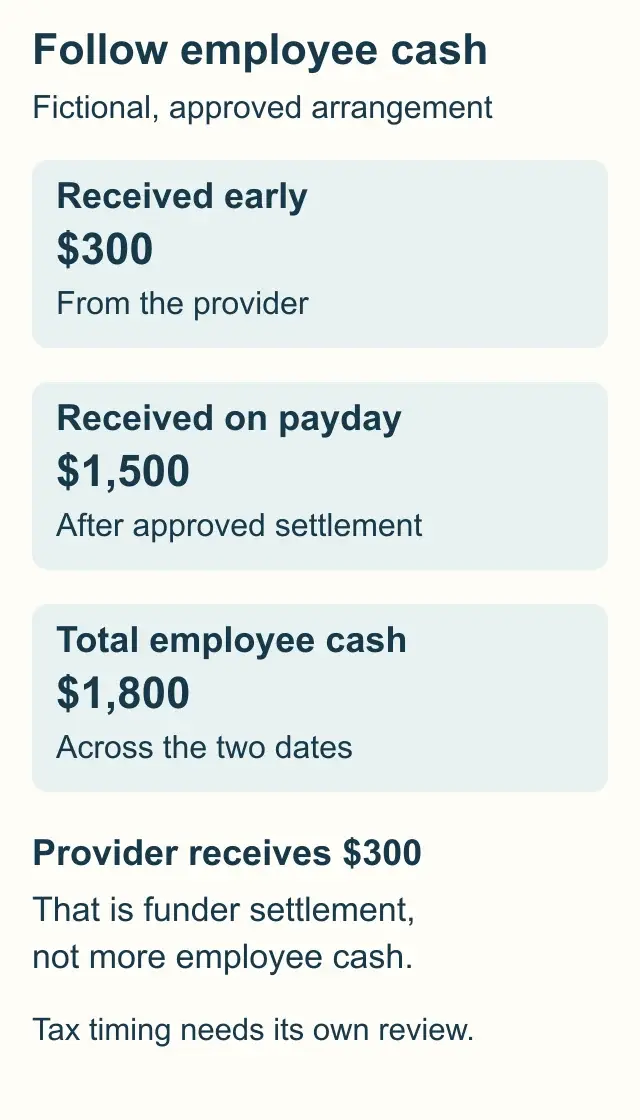
The fictional employee receives $1,800 across two dates. The $300 remittance goes to the provider. This cash bridge assumes the arrangement and tax timing have been reviewed.
Questions about settlement files can shape a free consultation with SelectSoftware Reviews. An upload receipt, a rejected-item report and a replacement-file history are different requirements. Check the proposed service against all three, along with export access, ownership and charges.
Advance Settlement Ticket
Copy one ticket for each employee, pay period and arrangement when setting up the program or handling an exception. For routine volume, keep the same fields in a controlled register and use a batch approval supported by transaction-level records. Record references to restricted evidence rather than copying bank credentials or a full employee agreement into a widely shared worksheet.
Identify the early payment
Arrangement and authority: Product or employer program, funder, employer entity, applicable jurisdiction, dated legal and tax review references, approved settlement method and owner. State whether the ticket concerns accrued-wage access, an early wage payment or a documented loan. If classification is unresolved, route it for review before creating the instruction.
Employee and period: Stable employee identifier, work/pay period, scheduled payday, source earnings timestamp and source version. Identify any termination, leave, transfer or special-pay event affecting this transaction. Use the employer entity associated with the actual obligation, not whichever payroll account is easiest to access.
Disbursement evidence: Provider transaction identifiers, amounts requested, amounts actually delivered, dates, payment status and evidence references. List a cancellation or reversal separately with its confirmed outcome. For several advances, preserve each identifier and calculate the cumulative amount so that one missing transaction cannot hide in a total.
Match the payday instruction
Available amount and reserve: Source-supported amount, earlier transactions already counted, program availability rule and resulting permitted amount at the request time. Explain excluded earnings or a later source correction. Record who reviewed the exception when the available amount and eventual payroll result differ.
Settlement version: File or API batch reference, cutoff, incremental or replacement basis, accepted amount by transaction, rejected items and payroll preview reference. Record whether another route can still collect or remit the amount. A successful upload receipt is not the same as acceptance into the calculation.
Employee cash bridge: Approved wage/tax calculation reference, net amount before settlement, early cash received, approved settlement amount, payday cash and any remaining difference. Document the expected pay-statement description. The reviewer should be able to explain the employee's total cash without treating the funder's remittance as a second employee payment.
Resolve the remaining balance
Funder bridge: Opening unsettled amount, new delivered advances, confirmed cancellations or other authorized reductions, actual funder receipts, closing amount and accounting references. Keep fees separate from principal. Identify whether an unresolved balance belongs to the employer, provider or employee under the reviewed arrangement; an accounting balance alone does not authorize payroll collection.
Decision and follow-up: Authorized instruction, rejected instruction, reviewer, date, employee communication owner, next event and closure evidence. Choose a specific next action for every difference. Record when both employee cash and funder settlement are confirmed, or why an authorized disposition leaves one balance open for another owner.
Before approving the instruction, apply five checks. Mark each Yes, No or Unresolved and attach the evidence. These are operating checks rather than a numerical score; one unresolved money path cannot be averaged away by four successful checks.
Delivery check: Does each settlement item connect to an actual delivered advance, with confirmed reversals excluded once? Inspect a selected transaction from the provider record through the payroll preview. A file containing a plausible amount without delivery evidence needs investigation before it changes employee cash.
Authority check: Does the instruction follow the reviewed agreement, jurisdiction and payroll/tax treatment for this employee and event? Check changed employment status and collection rights. A technically possible deduction or a positive net-pay preview does not supply the missing approval.
Uniqueness check: Is this the only active settlement route for the transaction? Compare earlier imports, replacement files, manual entries and any provider retry. Identify who can disable or confirm each route. Remove a duplicate only after establishing which instruction remains authorized and what has already moved.
Cash check: Can the reviewer explain early employee cash, payday employee cash, provider receipts and the remaining balance independently? Confirm fees and reversals against their own records. Do not offset two employees' unexplained differences or use a provider total to conceal an employee-level mismatch.
Outcome check: Is someone assigned to confirm the bank and provider results after release and to address a rejected settlement? Name the evidence needed to close the ticket. If the outcome is pending, record a dated follow-up rather than marking the transaction fully reconciled at submission.
A smaller paycheck leaves a settlement question
Consider a fictional employee who received $300 early. After an approved correction to work records and the required payroll calculation, only $180 is available for the proposed settlement under the arrangement's reviewed rules. The provider file still requests $300. The mismatch is $120, and a system capable of carrying that amount forward has not decided whether doing so is permitted.
Payroll should send the actual facts to the responsible program reviewer before releasing the disputed settlement. Verify whether $180 is itself authorized, what the employee should receive on payday and how the provider handles the remaining amount. A later payroll deduction, bank debit, invoice to the employer or write-off has different consequences. Do not enable one simply to make the provider report balance.
Where the arrangement relies on the CFPB opinion's Covered EWA conditions, its nonrecourse and settlement limits matter. An insufficient paycheck is not blanket permission for repeated future collection. Have the reviewer apply the opinion's specific technical-error exception where relevant, rather than labeling every shortfall an administrative mistake.
Record the permitted employee result and the disposition of the $120 on the ticket. If the employer has a contractual obligation to the provider, finance needs that decision even when payroll cannot collect from the employee. If wages were calculated incorrectly, correct that separate error through the applicable pay-correction process. A settlement problem should not be repaired by inventing earnings.
A late cancellation must be matched to money already delivered
In a second fictional case, a provider disburses $200 before the cutoff. Payroll imports the $200 settlement. A later message labels the transaction cancelled, but no evidence shows that the employee's transfer was reversed. Removing the payroll entry immediately could leave the employee with both the early funds and the full payday amount.
Ask what cancelled means in this system. It may refer to a request, an eligibility record, a settlement instruction or a completed payment reversal. Compare the transaction identifier and timestamps with the imported version. Obtain a confirmed payment outcome before deciding what the cancellation should do to payroll.
If the delivery was reversed, identify whether a replacement settlement file already removes it. If delivery remains valid, obtain the authorized settlement instruction for that situation. When the money status cannot be established before cutoff, escalate the affected item with the current facts and a deadline for resolution. Keep employee wage-payment obligations with the responsible payroll and legal reviewers; an unresolved provider message does not erase those obligations.
Retain the cancellation message and the final decision. The useful prevention change is a status mapping that distinguishes request cancellation from cash reversal, with a test showing the correct payroll effect. Telling operators to be more careful leaves the same ambiguous status in the next file.
Program exit needs both a final transaction list and a cutoff
When an employee leaves the program, payroll changes providers or an employer closes an entity, establish the last permitted request and the last included settlement. Stop new availability at the approved time and obtain the outstanding transaction list. A disconnected feed can stop new records while leaving completed advances unsettled.
For a departing employee, route final-pay deductions through the applicable legal review. Do not accelerate a loan or advance balance into the final paycheck by default. Record the authorized amount, if any, and assign any remaining balance to the party responsible under the arrangement. Communicate the confirmed paycheck result without promising a later collection action that has not been approved.
For a system conversion, reconcile the closing list against both old and new payroll inputs. Designate which system owns each transaction and which provider can still attempt settlement. Keep historical identifiers and prior outcomes available. A clean opening balance in the new system should come from that reconciliation, not from reloading the provider's whole history as new deductions.
Obtain closure evidence for the program as well as the payroll run. Confirm that new requests are disabled, final settlement files were processed as intended, residual balances have named owners and the employee support route remains available for a disputed historical transaction. Preserve relevant payroll and settlement records under the organization's retention and legal-hold decisions.
Require an exception demonstration before expanding the program
An employer-integrated service fits an operation that can support timely earnings data and an accountable settlement review. An employer-funded advance policy adds funding, classification and balance-management work that needs an owner. Choose the arrangement only after the actual legal, tax, cash and employee-support responsibilities are understood and affordable for the team running it.
Ask prospective providers to demonstrate a normal transaction, two requests before a feed update, a smaller-than-expected paycheck, a late cancellation and an employee exit. Use fictional records. Require the source, transaction identifier, accepted payroll instruction and final settlement evidence for each. Confirm which records can be exported and what the agreement says about failed settlement, fees and support ownership.
During a limited introduction, review every exception and a selected set of routine transactions across the whole path. Measure unresolved employee differences, unmatched provider amounts, duplicate instructions and the age of open tickets. These measures describe the employer's actual control work; they do not establish an employee-wellness or retention benefit.
Expand only when the team can reproduce the employee cash result and explain the funder balance without manual guesses. If a demonstration ends at file acceptance, ask for the settled outcome. The decisive evidence is the connection from an early payment to the correct payday result and the approved disposition of anything left over.
A provider agreement should say who investigates a missing funder receipt and who answers an employee's settlement dispute. SelectSoftware Reviews offers free advice on HR software selection; confirm these service responsibilities with the provider before deciding. Keep the demonstration and the quoted scope together.
Explore the Decision Guides library.
See the Payroll Operations & Controls hub.

About the author
Ben Scott writes and maintains payroll decision guides for founders and operators. His work focuses on execution realities and how decisions hold up under growth, complexity, and controls and documentation pressure. He works hands-on in HR and leave-management roles that intersect with payroll-adjacent workflows such as benefits coordination, cutovers, and compliance-driven process controls.


