
Bonus Overtime Calculations: Allocate the Bonus to the Right Workweeks


A $420 bonus can require more than $420 of additional gross pay. If a covered, nonexempt employee earned that bonus during workweeks with overtime, the bonus may increase the regular rate used for those weeks. Payroll needs the earning period and weekly hours, even when the payment arrives on a later check.
The essential calculation is weekly. Decide whether the bonus belongs in the regular rate, allocate it to the workweeks in which it was earned, and calculate any additional overtime for each affected week. Then compare the required amount with bonus-related overtime already paid. Putting the entire bonus into the payment week's earnings can produce a different answer from the required allocation.
Use this guide for an ordinary U.S. hourly payroll subject to the federal Fair Labor Standards Act, with overtime after 40 hours in a workweek. It provides a Bonus Overtime Review Sheet and fictional calculations. State requirements, collective bargaining agreements and special federal overtime arrangements need their own review; the examples do not establish the correct calculation for every employee or jurisdiction.
The broader bonus approval process still controls who receives the bonus, its authorized amount, withholding and payment timing. This guide supplies the workweek calculation that sits inside that process. Start when a plan is approved, rather than waiting for a bonus file that contains only employee names and dollars.

If your payroll software cannot carry a bonus back to its earning weeks, SelectSoftware Reviews advisors can suggest providers to evaluate at no cost. Ask each candidate to demonstrate earning-week allocation, historical hours and the handling of overtime already paid. Confirm the responsibilities in its service scope.
Table of contents
Read the promise before choosing the pay code
An earnings-code label cannot decide whether a bonus is discretionary. Under the federal discretionary-bonus rule, the employer must retain sole discretion over both whether payment will occur and its amount until at or near the end of the relevant period. There must also be no prior contract, agreement or promise causing employees to expect the payment regularly.
A promised production bonus, an announced attendance incentive or an award under a predetermined quality formula generally belongs in the regular rate unless another statutory exclusion applies. A manager's final approval does not turn a previously promised formula into a discretionary award. The Department of Labor's bonus guidance explains why the facts and employee expectations matter more than the name assigned to the payment.
Get the plan version, employee communication, formula, qualifying conditions and earning dates. Ask HR or the authorized wage-and-hour reviewer to document the classification and any claimed exclusion. Payroll should receive the reason behind that decision, not simply an instruction to use a code called discretionary.
Consider two fictional employers. One announces a $5 bonus for every eligible hour worked during a two-week production push. The other decides, after an unexpected difficult event, to recognize an employee with an unannounced payment whose fact and amount were never promised. These facts point toward different analyses. The second payment still needs a documented review of the circumstances before exclusion.
Do not treat every bonus that fails the discretionary test as automatically included without considering other statutory exclusions. Gifts, certain plan contributions and other payments have separate rules. Route a claimed exclusion to the reviewer who can identify its legal basis and conditions. A generic exception note is not enough to explain a later payroll decision.
Keep classification separate from supplemental-wage withholding. A payment can require a withholding decision and also change overtime. Selecting a tax method does not perform the regular-rate calculation. Similarly, a discretionary bonus excluded from the regular rate cannot be used to satisfy overtime compensation owed under the FLSA.
For a recurring plan, document the classification once for the approved version, then check each payment for changes in eligibility, formula or communications. A plan amendment can change the facts that supported the earlier decision. Preserve the original version so a reviewer can tell which promise governed the period being calculated.
Recover the earning weeks before calculating a rate
The payment date tells payroll when money is being delivered. The earning period tells payroll where an included bonus belongs for overtime calculation. A quarterly incentive paid in October may concern workweeks from the preceding quarter. Processing it in October does not move those earlier earnings into the current workweek.
The federal allocation rule requires a bonus whose amount becomes ascertainable later to be apportioned back over the workweeks during which it was earned. Each overtime week then needs the additional compensation attributable to that week's bonus. A bonus known for a single workweek can be included with the week's other includable earnings when overtime is first calculated.
Use the employee's established workweek boundaries. The ordinary federal workweek is a recurring 168-hour period, and hours cannot be averaged across two or more weeks to avoid overtime. A biweekly check containing 38 hours in one week and 46 in the other therefore requires two separate weekly calculations, not one 84-hour total averaged to 42 hours a week.
Build a list of earning weeks with the dates, actual hours worked, statutory overtime hours and original calculation. Reconcile the list to the bonus plan's period. If a period starts or ends inside a workweek, establish the earnings attributable to that week from the plan facts; do not substitute a payroll period merely because it is easier to export.
When the records identify the amount earned each week, use that allocation. An hourly production formula may identify weekly earnings from eligible hours. A documented weekly output measure may identify them from completed units. The allocation should explain the amount actually earned, while the regular-rate denominator uses the relevant total hours worked in that workweek.
If it is impossible to identify actual weekly bonus earnings, section 778.209(b) requires another reasonable and equitable allocation. Equal weekly amounts or an equal amount per hour can be appropriate when the facts support the method. Neither is a universal default, and the team should not choose whichever produces the smallest overtime adjustment.
Record why direct allocation is impossible, the supporting facts for the alternative and the reviewer's approval. If attendance, leave or the plan's earning conditions make equal weeks implausible, resolve that before calculating. An allocation choice can be consequential even when the bonus total remains unchanged.
A week with no worked hours needs a review decision before any hourly division. Identify paid leave separately and confirm whether the plan attributes bonus earnings to that week. Do not convert leave hours into worked hours to make the denominator usable.
Missing historical hours are a calculation dependency. Assign someone to retrieve or reconstruct them under an approved method and give that work a deadline. Do not classify the employee as having no overtime because a report is unavailable. If a provider switch divides the earning period, obtain the records from both systems and reconcile any bonus-related adjustments already made.
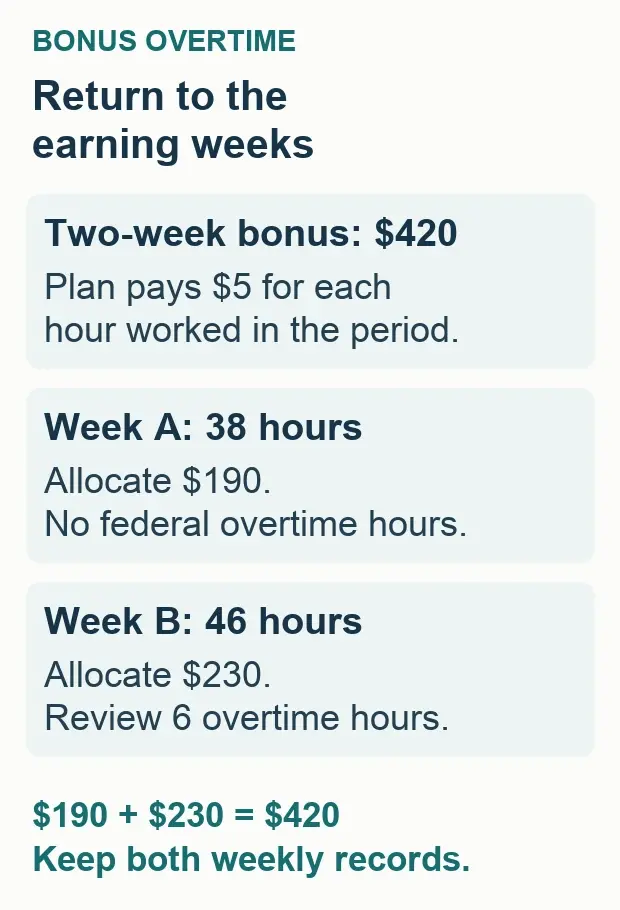
Allocate the bonus to its earning weeks before examining overtime. This fictional plan pays $5 for every worked hour.
Calculate the added premium without paying the bonus twice
For the ordinary hourly arrangement used here, the regular rate is the week's includable compensation divided by its hours worked. It is not necessarily the employee's stated hourly wage. The full calculation must include other relevant remuneration and apply valid exclusions; an hourly wage plus a bonus is only the simplified example below.
When straight-time compensation for all hours and the original overtime premium have already been paid correctly, the later bonus's additional federal overtime premium for a week is:
Allocated bonus ÷ hours worked × 0.5 × statutory overtime hours.
Carry sufficient precision through the hourly increment and premium calculation, then document the rounding convention used for payment. If the system and independent calculation differ by cents, explain the difference rather than hiding it in a tolerance. Preserve the underlying inputs and unrounded calculation.
This is the bonus increment, not a replacement for all wages owed. The allocated bonus itself must also be paid if it has not already been paid. Do not multiply it by 1.5 and add that result to a separate payment of the entire bonus. That would count part of the compensation twice.
A two-week hourly bonus
In this fictional case, the employee earns $20 per hour and is promised $5 for every hour worked during a two-week production period. All worked hours qualify under the plan. There are no other includable earnings, exclusions or special overtime rules, and the original straight-time wages and federal overtime premium were correctly paid.
Week A: 38 hours, no overtime.
Original straight-time wages: 38 × $20 = $760.
Bonus earned: 38 × $5 = $190.
Bonus increase to the regular rate: $190 ÷ 38 = $5 per hour.
Additional overtime premium: $5 × 0.5 × 0 = $0.
Total gross compensation for the week after the bonus: $950.
Week B: 46 hours, including six overtime hours.
Original straight-time wages: 46 × $20 = $920.
Original overtime premium: six × $20 × 0.5 = $60.
Original gross compensation: $980.
Bonus earned: 46 × $5 = $230.
Bonus increase to the regular rate: $230 ÷ 46 = $5 per hour.
Additional overtime premium: $5 × 0.5 × six = $15.
Total gross compensation for the week after the bonus and adjustment: $1,225.
The bonus file totals $420, while the additional gross payment is $435: the $420 bonus plus $15 of additional overtime. Combined compensation for the two weeks is $2,175. These are gross figures before withholding and deductions, not an estimate of take-home pay.
The reviewer can prove Week B a second way. Its revised regular rate is ($920 + $230) ÷ 46 = $25. The required half-time premium is $25 × 0.5 × six = $75. Subtract the correctly paid $60 premium and the remaining amount is $15. Agreement between the two methods is a useful check under these assumptions.

The $15 increment assumes the original straight-time wages and overtime premium were correctly paid. It is added to the $230 bonus for Week B.
A bonus known before the week's payroll
Suppose the same Week B bonus is known before the initial payroll runs. Add $230 to the $920 straight-time compensation, calculate the $25 regular rate, and pay $75 of overtime premium. The week's gross total is $1,225. There is no separate later $15 adjustment because the initial calculation already included the bonus.
This distinction belongs in the processing instruction. A field saying overtime calculated should specify whether the initial run included the bonus or a later run paid its increment. Otherwise the team can pay a correct initial amount and create an unnecessary correction when the bonus review file arrives.
Corrected hours change the inputs
If Week B actually contained 47 hours rather than 46, do not merely reuse the $15 result. Under this example's plan, the bonus becomes $235, the overtime hours become seven and the additional bonus premium becomes $17.50. Correcting the missing hour also creates its own wage and overtime calculation, which must be addressed alongside the bonus adjustment.
A revised hours file should therefore create a new calculation version. Identify the prior version, the changed inputs and the difference still owed after amounts already paid. That keeps an hours correction from being mistaken for a second bonus award.
Test percentage plans against what they actually include
Some percentage plans pay the bonus's overtime component at the same time as the bonus. Section 778.210 describes a plan established before services are performed that pays the same percentage of straight-time and overtime earnings. Payment according to such a qualifying plan can satisfy the overtime requirement without a separate recomputation. An arrangement used to evade overtime requirements does not qualify.
The word percentage is insufficient. A bonus calculated as a percentage of straight-time earnings alone does not establish that overtime was included. Review the written formula, the actual base supplied to payroll and the result. A spreadsheet heading called total earnings can still omit the overtime premium.
In a separate fictional week, an employee works 45 hours at $20 per hour. Original straight-time compensation is $900 and the correctly calculated overtime premium is $50, for $950 total. A qualifying pre-established 10% plan applied to both components produces $90 attributable to straight-time compensation and $5 attributable to overtime, or $95 additional compensation.
Compare a plan that instead awards only 10% of the $900 straight-time amount. Its $90 bonus increases the regular rate by $2 per hour. Five overtime hours require another $5: $90 ÷ 45 × 0.5 × five. Both examples produce $95 of additional compensation, but through different documented calculations. The $90-only payment would be incomplete under these stated facts.
Do not apply both routes to the same payment. If a reviewed section 778.210 plan has already paid its overtime component, entering another $5 adjustment for this example duplicates it. Conversely, selecting the percentage-plan route when the actual bonus base excludes overtime can conceal an underpayment.
Ask the reviewer to identify the qualifying plan provision and the system fields that implement it. Retain a sample calculation showing both straight-time and overtime components. If the formula, pay categories or covered population change, revalidate the route before relying on the earlier approval.
Copy the Bonus Overtime Review Sheet
Use one cover record per employee and bonus plan version, with one weekly calculation card for every affected workweek. An approved exclusion or qualifying percentage-plan route needs its own evidence. The cards are intended to be copied into a controlled document or spreadsheet; do not place employee records in a public page or unrestricted shared file.
Cover record: establish the calculation route
1. Employee and employer: employee identifier, employing entity and work location.
2. Pay arrangement: applicable workweek boundaries, ordinary hourly method or reason specialist review is needed.
3. Bonus authority: approved plan version, qualifying conditions and employee communication reference.
4. Earning period: beginning and ending dates, with explanation of partial weeks where relevant.
5. Classification: included bonus, documented exclusion or qualifying percentage-plan route, with reviewer and basis.
6. Approved bonus total: amount, source calculation and version; distinguish an estimate from an ascertainable final amount.
7. Allocation decision: direct weekly earnings or supported reasonable and equitable alternative, including approval.
8. Execution reference: intended run, payment deadline decision, adjustment identifier and person responsible for confirmation.
Weekly card: show the arithmetic
9. Workweek: exact starting and ending date and time.
10. Worked hours: verified total hours and source/version; identify paid nonwork hours separately.
11. Overtime hours and method: statutory overtime hours for the applicable arrangement, plus any jurisdictional review.
12. Original includable compensation: relevant straight-time earnings and other included remuneration, with valid exclusions identified.
13. Original premium and prior bonus adjustment: amounts actually paid, their references and whether the bonus was already included.
14. Bonus allocated to this week: amount and calculation tied to the cover record's allocation decision.
15. Required result: revised regular rate and total required premium, or verified percentage-plan components.
16. Remaining payment and proof: bonus principal still unpaid, incremental premium still unpaid, run output and confirmation reference.
For the $420 example, the cover record cites the $5-per-worked-hour plan. Week A's card shows $190 and zero overtime; Week B's shows $230 and a $15 unpaid increment. The sum of allocated bonuses matches $420. The payment instruction carries $420 bonus principal and $15 overtime adjustment as identifiable components.
If a calculation produces a negative remaining premium, stop and investigate its cause. A negative figure can reflect an earlier adjustment, mismatched scope or an error in either version. It is not automatic authority to recover money from an employee. Keep any repayment or wage-deduction decision separate and obtain the appropriate review.
Seven checks before authorizing the result
The classification cites the promise and a supported rule, rather than a pay-code name.
Every earning week is present, with verified hours and the correct workweek boundaries.
Weekly allocations reconcile to the approved bonus total; any alternative allocation has a factual reason and approval.
The calculation uses the applicable overtime method and includes all relevant remuneration.
Original premiums and bonus-related adjustments are compared on the same employee, week and plan basis.
The instruction distinguishes unpaid bonus principal from unpaid incremental premium and uses one identifiable version.
The reviewer can trace the expected result into actual payroll output and required payment evidence.
These checks should produce a specific next action when one fails. An unavailable weekly extract needs retrieval; an unexplained exclusion needs classification review; a mismatch to the approved bonus total needs allocation correction. Recording review pending without an owner and deadline leaves the payment decision unresolved.
For teams missing historical calculation support, a no-cost conversation with SelectSoftware Reviews can identify payroll services to investigate. Bring the Review Sheet and the worked example, then verify the candidate's calculation and employer-supplied inputs.
Make payroll demonstrate the historical calculation
A provider that supports a bonus code may still require employer-supplied historical allocation or a manual overtime adjustment. Ask which inputs its calculation uses, who supplies prior-provider hours, and whether it allocates a later bonus across earning workweeks. Obtain a demonstration with your approved sample facts before relying on an automatic result.
Use the two-week example as a test script. Enter the 38-hour and 46-hour weeks, the $20 rate and the $420 bonus earned at $5 per worked hour. The expected additional gross amount is $435 under the example's assumptions. Require the output to identify the $420 principal, $15 incremental premium and affected historical week.
Then change the payment week to a week with no overtime. The historical Week B result should remain $15 because the earning-period facts have not changed. If the system instead calculates only on current payment-week hours, investigate its configuration or documented operating limitations before release.
Also test a bonus already included in the initial payroll, a previous adjustment and a corrected hours version. The purpose is to learn how the workflow prevents omissions and duplication. These are proposed employer validation cases, not claims that this guide has tested any vendor or that every product can perform them automatically.
Keep a manual route available when the service scope requires it. A reviewer can approve weekly calculations outside the system, while payroll enters authorized components through a governed file. Define which team owns the mathematical result, the import, the final payroll review and the employee payment. A provider's acceptance of the file does not prove that its contents are correct.
Release the adjustment and retain a weekly explanation
The federal timing rule generally ties overtime payment to the regular payday. When the correct amount cannot be determined then, section 778.106 permits only the delay described by that rule: payment as soon as practicable, with its outside limit tied to the next payday after computation can be made. Check the obligation and applicable state rules rather than scheduling a bonus correction whenever administratively convenient.
Document when the amount became ascertainable, who completed the calculation and the approved payment route. Internal cutoff rules should trigger escalation when they interfere with an applicable wage deadline. A large batch can have different unresolved dependencies, so give incomplete records named decision owners and deadlines while qualified reviewers direct the required payment action.
Before release, compare the processed register with the authorized employee and weekly totals. Check both principal and incremental premium, not only a combined bonus-code total. Confirm that withholding, deductions, funding and accounting follow the approved treatment without assuming that this wage calculation settles those separate questions.
After processing, retain the result and the current payment outcome. If a payment fails, track its replacement separately from the calculation so a reissue does not generate another bonus award. Preserve any subsequent reporting correction or accounting task with its own owner and evidence of completion.
An employee explanation can be short: identify the bonus earning period, gross bonus amount, additional overtime amount where applicable and payment date. Provide a route for questions about hours or eligibility. Avoid attributing a net-pay difference to an overtime error without checking withholding and deductions.
Retain the plan version, classification decision, weekly hours, allocation, original premiums, calculations, approval and processing proof together under the relevant record-retention requirements. The weekly explanation should remain reconstructable after a provider change or staff handoff. Use employee identifiers and controlled access appropriate to the sensitive payroll information.
Review recurring errors by cause. If a bonus feed omits earning dates, repair the source handoff. If historical hours cannot be retrieved, address retention and provider access. If a percentage formula omits overtime earnings, correct and review the configuration and affected population. Repeating a manual adjustment each quarter may pay one batch correctly while leaving the same defect in place.
For the next bonus, request the plan and earning period before its final dollars arrive. Populate the cover record, establish the allocation route and retrieve the weekly records. When the amount becomes ascertainable, the remaining work should be a checked calculation and timely execution, with a clear explanation of what each employee earned.
Continue with related resources:
SelectSoftware Reviews can match you with payroll providers to compare, free of charge. Use the weekly records to ask candidates who computes the adjustment, who approves it and what evidence the service returns. Compare demonstrated capabilities and retained employer work.

About the author
Ben Scott writes and maintains payroll decision guides for founders and operators. His work focuses on execution realities and how decisions hold up under growth, complexity, and controls and documentation pressure. He works hands-on in HR and leave-management roles that intersect with payroll-adjacent workflows such as benefits coordination, cutovers, and compliance-driven process controls.


