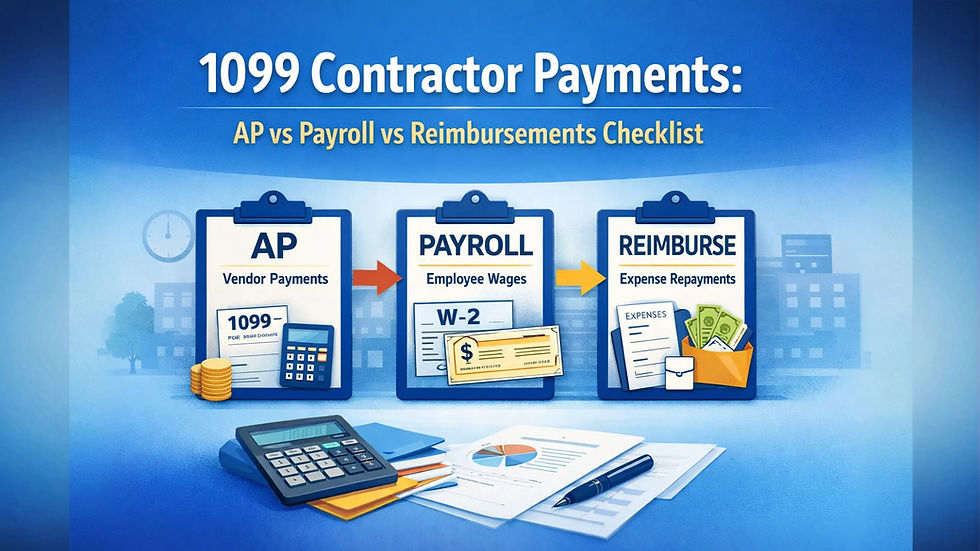
Payroll vs Accounts Payable: Who Should Pay the Worker, Reimbursement, or Vendor Item?

Updated: Sep 18
A practical guide to deciding when a payment belongs in payroll, when it belongs in accounts payable, and how to stop worker payments, reimbursements, stipends, and vendor-like spend from drifting into the wrong system.


For teams evaluating a payroll provider change, this advisor-led matching option may help.
Most payroll-versus-AP mistakes do not begin with the payment method
They begin with the wrong question.
A company wants to pay someone quickly, reimburse an expense, clear a stipend, pay a contractor invoice, or move money for something that feels payroll-adjacent. The operational question often becomes:
can AP process this faster
can payroll just add it to the next run
can we reimburse this through payroll
can we avoid a payroll change by sending it through AP
can we treat this person like a vendor for this item only
That framing is exactly where the confusion starts.
The stronger question is not which system is more convenient.
The stronger question is which payment path matches the underlying reality of the item:
wages for an employee
reimbursement under an accountable plan
taxable reimbursement or allowance
contractor compensation
vendor spend
something that looks like one category operationally but belongs in another for tax, wage, or reporting reasons
That distinction matters because AP and payroll do not just use different workflows. They sit on top of different rules.
The IRS says worker status matters for federal employment tax purposes and that businesses must look at the full relationship to determine whether a worker is an employee or an independent contractor. The IRS also emphasizes that no single factor controls and that businesses should document the factors used in the determination.
That means a payment route cannot safely substitute for worker classification.
If someone is an employee, routing compensation through AP does not make the worker a vendor. If someone is a contractor, routing the payment through payroll does not automatically make payroll the correct system either. The underlying relationship still controls the tax and reporting treatment.
The rule gets even messier once reimbursements enter the picture
This is one of the biggest reasons the boundary problem belongs on HRDecisionGuide.
A lot of companies have at least three payment types that look similar on the surface:
compensation for services
reimbursement of business expenses
allowances or stipends that are not handled under a clean accountable-plan structure
Those should not automatically go through the same path.
IRS guidance on fringe benefits and reimbursements is clear that reimbursements paid under an accountable plan are not taxable and not reportable, while reimbursements not paid under an accountable plan are taxable and reportable as wages on Form W-2.
That creates a very practical routing problem for employers.
If the payment is a true employee business-expense reimbursement under an accountable plan, AP may be the cleaner operational path in many companies because it avoids turning a non-taxable reimbursement into a payroll-shaped event unnecessarily.
But if the payment is really taxable compensation, a non-accountable allowance, or disguised wages, sending it through AP can create reporting and withholding problems instead of solving them.
The payroll-versus-AP boundary is not only a tax question
It is also a wage-and-control question.
The Department of Labor’s FLSA guidance requires wages to be paid “free and clear,” and its deductions guidance explains that deductions for items that are primarily for the benefit or convenience of the employer can violate minimum wage rules if they drive pay below required minimum levels. DOL also specifically addresses items such as uniforms, tools, and transportation in its deductions guidance.
That matters because companies sometimes treat AP as a workaround for payroll friction:
reimburse the employee outside payroll
charge the worker back later
net something informally
pay through AP because payroll treatment feels slower or more complex
Those choices may create wage-and-deduction issues, tax issues, or both.
So the core boundary question is not just “what system can cut the payment.”
It is:
what is this payment really for
who is receiving it
what treatment does the payment require
what reporting, withholding, wage, or documentation consequences follow from that choice
The real question is not “can AP pay this”
It is:
Should this item be paid through payroll, AP, or not paid at all until its treatment is clear?
That is the more durable operating question.
A weak model often sounds like this:
payroll is overloaded, so send it through AP
AP cannot handle employee items, so push it into payroll
the person is a contractor, so everything should go through AP
it is reimbursement-like, so it should avoid payroll
it is small, so the routing risk is minimal
A stronger model sounds different.
It asks:
is the recipient an employee, contractor, or vendor
is the payment compensation for services, expense reimbursement, a taxable allowance, or something else
does the item need payroll withholding or wage treatment
does accountable-plan logic apply
would the wrong route distort W-2, 1099, liability, or wage treatment later
That is why this topic fits naturally with your site’s existing payroll-controls cluster.
If the organization is already struggling with who owns payroll decisions across finance, HR, operations, or an outside accountant, the stronger companion control is often a clearer payroll ownership model by company stage before the AP-versus-payroll payment boundary gets solved ad hoc each month.
The strongest response starts by classifying the payment, not by choosing the team
That is the first high-level conclusion.
A good payroll-versus-AP decision process does not begin with department preference.
It begins with payment classification.
Before anyone decides where a payment should go, the company should be able to answer:
who is being paid
why they are being paid
whether the item is compensation, reimbursement, taxable allowance, or vendor spend
whether employee wage rules or employment tax treatment apply
whether accountable-plan rules matter
whether the payment would create downstream W-2 or 1099 implications
That is the only stable way to prevent route-first decisions from creating cleanup later.
Get Your Free Payroll Software Matches
SelectSoftware Reviews Offers 1:1 Help From a Payroll Software Advisor. Get in touch to:
Table of contents
Most payroll-versus-AP mistakes do not begin with the payment method
The rule gets even messier once reimbursements enter the picture
The strongest response starts by classifying the payment, not by choosing the team
The cleanest boundary model is a three-path model, not a two-team fight
How to use the matrix without turning every payment into a legal memo
Diagnosis library: what recurring AP-versus-payroll mistakes usually mean
The decision point that matters here
The core decision is not whether payroll or AP is more convenient for this payment.
It is whether the payment belongs in payroll, AP, or a hold-and-review path based on worker status, reimbursement treatment, wage rules, and downstream tax reporting consequences.
The cleanest boundary model is a three-path model, not a two-team fight
A lot of companies treat this as a payroll-versus-AP choice.
That is too narrow.
In practice, the strongest boundary model usually has three paths:
pay through payroll
pay through AP
hold for classification and treatment review before paying at all
That third path is what prevents rushed convenience decisions from turning into tax, wage, or reporting cleanup later.
The IRS materials on worker status and accountable-plan reimbursements support that more careful approach. Worker classification turns on the underlying relationship, and employee reimbursements can be excludable from wages only when accountable-plan rules are met.
Boundary decision matrix: payroll vs AP vs hold-and-review
Payment scenario | Default path | Why that path usually fits | What should trigger hold-and-review |
Employee wages, bonuses, taxable allowances, or other compensation for services | Payroll | Employee compensation generally requires payroll wage treatment, withholding, and W-2 reporting rather than AP routing. | Unclear worker status, unclear taxability, unclear supplemental-wage treatment, or a request to route pay outside normal payroll controls |
Employee business-expense reimbursement under a clean accountable plan | AP in many companies, or a defined reimbursement workflow outside payroll | Accountable-plan reimbursements can be excluded from wages when the rules are met, so forcing them through payroll may create unnecessary wage-shaped processing. | Weak receipts or substantiation, unclear business purpose, excess advances not returned, or no accountable-plan discipline |
Employee allowance, stipend, or reimbursement that does not meet accountable-plan treatment | Payroll | Nonaccountable-plan reimbursements and taxable allowances generally become wages and belong in wage reporting and withholding treatment. | Unclear whether the payment is reimbursement or compensation, mixed taxable and nontaxable elements, or attempts to keep a wage item out of payroll |
Independent contractor service payment | AP in most environments | Payments to independent contractors generally do not require employee withholding and are commonly handled through AP and 1099-oriented processes, assuming the worker classification is correct. | Worker status uncertainty, contractor behaving like an employee, or a one-time payment that looks like wages rather than vendor-style compensation |
Vendor invoice or third-party service fee | AP | Ordinary vendor spend belongs in AP and should not be made payroll-shaped just because it touches labor or operations. | Payment is really reimbursement to an employee, payment is for direct labor of an employee, or the “vendor” is really an individual with unresolved worker-status questions |
Employee chargeback, deduction, or employer-convenience cost recovery item | Hold-and-review first | DOL wage rules make informal netting and employer-convenience cost shifting risky when employee wages are involved, especially if deductions reduce required pay. | Any deduction or offset that could affect minimum wage or overtime compliance, unclear authorization, or an attempt to recover employer-benefit costs through payroll or AP without review |
How to use the matrix without turning every payment into a legal memo
The point is not to stop the business every time someone needs to pay a person.
The point is to create a stable routing rule so the business stops making the same boundary mistake over and over.
That means each row should answer a practical question:
who is the payee
what is the payment actually for
what downstream reporting or wage treatment follows from that
what facts would make the default route unsafe
Employee compensation belongs in payroll unless the company is trying to talk itself out of payroll
This is the cleanest category, and it is still the one companies often distort for convenience.
If the payee is an employee and the payment is for services, that is usually payroll territory:
regular wages
bonuses
commissions
taxable stipends
allowances that are really compensation
one-time employee payments that are still wage-related
Publication 15 and Publication 15-A make that logic clear at the employer-tax level: wages to employees generally require withholding and employment tax handling, while contractor payments generally do not.
That is why AP should not become a workaround for:
payroll timing frustration
urgency
dislike of payroll setup steps
a desire to avoid wage reporting implications
If the deeper issue is that payroll is receiving too many late or policy-unclear payment requests, the stronger companion control is often a tighter payroll approval matrix before teams start shopping for an easier payment route.
Employee reimbursements need accountable-plan discipline before they need a payment route
This is where many teams get the boundary wrong.
A reimbursement is not defined by the fact that someone spent money and now wants to be repaid. It is defined by whether the arrangement meets the accountable-plan rules.
IRS guidance explains that reimbursements under an accountable plan can be excluded from wages, while reimbursements that do not meet those rules are treated as wages.
So the better sequence is:
decide whether this is an accountable-plan reimbursement
then decide which operational payment path makes the most sense
Not the reverse.
That is why many companies can sensibly route clean employee expense reimbursements through AP or an expense platform without involving payroll, while still routing taxable allowances or nonaccountable reimbursements through payroll.
Contractor payments belong in AP only after worker status is actually supportable
This is another place where convenience language can become dangerous.
Companies often say:
they invoiced us, so AP should pay it
they are a contractor for this project
it is a one-time item, so payroll would be overkill
But the IRS common-law framework does not turn on invoice style alone. It turns on the relationship itself: behavioral control, financial control, and the nature of the relationship all matter.
That means AP is the right route for contractor compensation only when the contractor status itself is supportable.
If the worker-status layer is still weak, the correct answer is often not AP or payroll yet.
It is hold-and-review.
Deductions, offsets, and chargebacks are where this boundary gets risky fastest
This is the category many teams underestimate.
When a company wants to recover:
equipment costs
uniforms
shortages
transportation-related costs
employer-convenience expenses
advances or other offsets
the temptation is often to treat the issue as a bookkeeping route question:
put it in AP
net it in payroll
reimburse now and recover later
let the deduction happen because the employee agreed
DOL guidance is exactly why that is risky. Required wages must generally be paid free and clear, and deductions for employer-benefit items can violate minimum wage or overtime rules if they reduce required pay.
That means this category should rarely be treated casually. It often belongs in a hold-and-review lane until the company knows:
whether the deduction is lawful
whether the cost is primarily for the employer’s benefit
whether payroll treatment is allowed
whether AP treatment would just disguise the same problem differently
What should still block a payment from being routed
This is where the boundary model becomes real.
A payment should not simply be routed because:
one team can process it faster
the amount is small
the requestor insists it is reimbursement
the person sent an invoice
payroll setup feels inconvenient
the company thinks it can fix the classification later
A stronger model should still stop the payment path when one or more of these conditions exists:
worker status is unclear
reimbursement treatment is unclear
taxable versus nontaxable treatment is unclear
wage or deduction consequences have not been evaluated
the payment would create W-2 or 1099 consequences the company is not ready to support
the proposed route looks like a workaround for policy friction rather than a fit for the item itself
If those conditions exist, the right answer is often not payroll or AP.
It is hold-and-review.
Get Your Free Payroll Software Matches
SelectSoftware Reviews Offers 1:1 Help From a Payroll Software Advisor. Get in touch to:
The boundary process usually breaks down in familiar ways
Payroll-versus-AP failures rarely show up first as “we need a better boundary matrix.”
They usually show up as operating symptoms:
employee compensation gets routed through AP because payroll felt slower
reimbursements are treated as non-taxable without enough accountable-plan discipline
contractor payments move through AP even though the worker relationship looks employee-like
stipends or allowances are described as reimbursements to keep them out of payroll
deductions, offsets, or employer-cost recoveries are handled informally without enough wage-rule review
That pattern matters because it means the boundary can be diagnosed.
The company does not need a larger policy manual first. It needs a clearer way to ask what the payment is, who the payee is, what tax and wage treatment follows, and what facts should still stop routing.
IRS worker-classification guidance and reimbursement guidance both support that more operational framing: the underlying relationship and treatment rules matter more than the invoice format or the preferred payment team.
A practical runbook for payroll vs AP payment routing
The matrix defines the default route.
The runbook defines how finance, AP, payroll, and operators should actually make the decision before the wrong system gets used out of habit.
1. Start with the payee relationship, not the request description
This is the first control step.
Before deciding where the payment goes, the company should identify:
employee
independent contractor
vendor
employee asking for reimbursement
employee receiving a stipend, allowance, or other nonordinary payment
That matters because the same request description can hide very different realities.
A person may submit:
an invoice, but still function like an employee
an expense request, but really be asking for taxable compensation
a stipend request, but actually need accountable-plan analysis first
IRS guidance is clear that worker classification depends on the relationship, not on labels alone.
2. Identify what the payment is actually for
Once the payee relationship is clear, the next question is what the payment represents:
compensation for labor or services
reimbursement of substantiated business expenses
taxable allowance or stipend
vendor invoice for goods or services
cost recovery, deduction, or offset item
mixed payment with more than one element
This is where many companies save or lose the control decision.
A payroll-versus-AP choice becomes much easier once the organization stops asking “who can pay this” and starts asking “what is this payment really doing.”
3. Test reimbursement claims before accepting reimbursement routing
This is one of the most useful practical checks in the whole guide.
If someone says the item is reimbursement, the company should ask:
was there a real business expense
is there substantiation
was the amount adequately accounted for
were any excess advances returned
is the arrangement actually operating like an accountable plan
IRS guidance makes that distinction highly practical because accountable-plan reimbursements can stay out of wages, while nonaccountable-plan payments generally become wages.
If those answers are weak, the payment should not simply default to AP because the word “reimbursement” appeared in the request.
4. Treat contractor routing as a classification-dependent decision, not an invoice-dependent decision
This is another common failure point.
A contractor invoice often creates a strong bias toward AP. Sometimes that is correct. Sometimes it hides a bigger risk.
A stronger process asks:
is the contractor relationship actually supportable
is this an ongoing labor relationship that looks employee-like
is the company using invoicing as an operational workaround for employment treatment
is this really a vendor-style service payment, or compensation that should not bypass payroll review
If the contractor boundary is still weak, the companion control is often your existing 1099 contractor payments controls guide before AP becomes the default route for labor spend that has not been classified carefully enough.
5. Separate reimbursement logic from taxable-allowance logic
This is where a lot of internal confusion comes from.
The company may think it has one category called:
stipend
allowance
reimbursement
support payment
one-time employee payment
But those are not interchangeable.
A stronger process separates:
substantiated accountable-plan reimbursement
taxable nonaccountable reimbursement
wage-like stipend or allowance
one-time employee compensation
That separation usually determines whether the item belongs in AP, payroll, or hold-and-review.
6. Stop deductions and chargebacks before they become routing shortcuts
This is the category where AP and payroll can both be used badly.
If the company wants to recover money from an employee, net something, or route an employer-benefit cost back to a worker, the correct response is usually not to improvise the payment path.
DOL guidance on free-and-clear payment and employer-benefit deductions is why this category needs caution, especially where minimum wage or overtime compliance could be affected.
That means the stronger process usually asks:
is this recovery lawful
is this primarily for the employer’s benefit
is payroll deduction even permissible here
would AP routing just disguise a wage problem instead of solving it
7. Make hold-and-review a real route, not a theoretical one
This is one of the most important operating rules in the guide.
Many companies say they will review unclear items, but in practice they still force the payment through one system quickly because:
the request feels urgent
the amount is small
the manager expects immediate payment
the wrong route seems easier than saying no
A stronger model makes hold-and-review real by defining:
who can stop the routing decision
who owns classification or treatment follow-up
what facts must be resolved before release
what communication goes back to the requester while the item is on hold
If the deeper problem is that urgent payment requests keep arriving without a structured decision path, the stronger companion control is often your existing payroll exception escalation framework so unusual pay requests stop turning into routing improvisation.
Diagnosis library: what recurring AP-versus-payroll mistakes usually mean
AP keeps paying employees for things that sound reimbursement-like
This usually means the organization is letting wording drive routing more than treatment rules.
The real weakness is often accountable-plan discipline, not AP capacity.
Payroll keeps receiving items that feel like vendor invoices
This usually means the organization has not drawn a clean boundary between labor compensation and vendor spend, or it is overcorrecting after prior AP mistakes.
Contractors are being paid through AP, but the relationship keeps raising employee-style questions
This usually means AP is functioning as a classification shortcut rather than as the output of a well-supported classification decision.
Stipends and allowances are being described in multiple ways across teams
This usually means the company does not yet have a consistent taxonomy for:
reimbursement
taxable reimbursement
allowance
stipend
wage-like employee payment
That taxonomy problem almost always becomes a routing problem later.
Small offsets, recoveries, or chargebacks keep getting handled informally
This usually means the organization is treating wage-risk items like bookkeeping details.
That is exactly where payroll and AP both get used as convenience tools instead of compliance-aware payment paths.
What stronger teams do differently
They do not start with the paying team.
They start with the item.
They classify the payment before routing it
That keeps convenience from deciding treatment.
They make reimbursement rules explicit
They do not assume every employee payback belongs outside payroll.
They treat contractor routing as dependent on worker-status support
They do not let invoicing alone control the decision.
They make hold-and-review a usable lane
They do not force unclear items through AP or payroll just because someone wants the payment out quickly.
Switching triggers
A payroll-versus-AP boundary model should be tightened before payment-routing shortcuts start creating reporting, wage, or control cleanup.
That usually becomes visible in a few familiar ways.
The same kinds of items keep bouncing between AP and payroll
This is one of the clearest triggers.
If reimbursements, stipends, contractor payments, or employee one-time payments keep getting rerouted based on who is available rather than on treatment logic, the boundary model is too weak.
Teams are using naming conventions instead of treatment rules
This is another strong trigger.
If items are being routed because they were called:
reimbursement
stipend
invoice
support payment
contractor item
without enough analysis of what they actually are, the taxonomy is driving the wrong decision.
AP is being used to avoid payroll friction
That is a major warning sign.
If the operational logic is basically “AP can cut this faster,” the company may be solving convenience while creating W-2, withholding, wage, or documentation problems later.
Payroll is being used for items that mainly exist because reimbursement rules are weak
That is the mirror-image trigger.
If payroll is absorbing too many items that should have been cleanly classified before they reached payroll, the organization may have a reimbursement-governance problem more than a payroll-capacity problem.
Failure modes
Weak payment-boundary models usually fail in recognizable patterns.
The “invoice means AP” failure
This is one of the most common.
An invoice format feels operationally clear, but it does not resolve worker status by itself. IRS guidance makes that underlying relationship point clear.
The “reimbursement means nonpayroll” failure
This is another frequent one.
The label “reimbursement” does not automatically answer whether the payment fits accountable-plan treatment or whether it really belongs in wages.
The “small enough to route informally” failure
This happens when the company assumes a low-dollar payment carries low routing risk.
Small items can still create reporting, deduction, or treatment problems if they are routed through the wrong system.
The “we will fix the classification later” failure
This is the dangerous shortcut.
A payment route chosen before treatment is understood often becomes the thing the company later has to explain, unwind, or correct.
The “AP versus payroll” failure
This is the quietest but broadest one.
The company keeps treating the decision like a departmental preference instead of a treatment-and-control question, so the same mistakes recur under different item names.
Migration considerations
This boundary model should be revisited whenever the company changes payroll provider, AP workflow, reimbursement platform, contractor onboarding model, or worker-payment governance.
A new system can make payments easier to process.
It does not automatically make them easier to classify correctly.
Do not migrate vague item categories into a new workflow unchanged
If the current model uses loose labels like:
reimbursement
stipend
contractor pay
employee support payment
one-time adjustment
without clean treatment rules behind them, moving those labels into a new system will preserve the same confusion.
Build the boundary rules before automating the route
The better order is:
define payee categories
define payment types
define reimbursement treatment rules
define worker-status checks
define hold-and-review triggers
then automate routing or approval paths around that model
Not the reverse.
Use early cycles to test whether the boundary is getting cleaner
The right questions are practical:
are fewer items bouncing between AP and payroll
are reimbursement decisions more consistent
are worker-status questions surfacing earlier
are fewer payment requests being justified by speed alone
are downstream W-2, 1099, or wage-rule surprises declining
If those answers remain weak, the company may have a payment workflow without a real routing discipline.
The model is working when payment requests become easier to classify before anyone asks who should pay them
That is one of the clearest practical tests.
A stronger payroll-versus-AP boundary model does not eliminate every edge case.
It makes those edge cases:
easier to classify
easier to route
easier to pause when unclear
harder to mislabel for convenience
less likely to create downstream cleanup
The company should be able to answer:
who the payee is
what the payment is for
whether reimbursement rules apply
whether wage treatment applies
whether worker-status support is strong enough
whether the item belongs in payroll, AP, or hold-and-review
If those answers are becoming easier to give, the boundary model is improving.
Final recommendation summary
A payroll-versus-AP decision should be treated as a treatment-and-routing decision, not just a departmental workflow choice.
The strongest model usually does four things well:
classifies the payee and payment correctly
separates reimbursement logic from compensation logic
treats contractor routing as dependent on worker-status support
makes hold-and-review a real lane for unclear items
For most companies, the next improvement is not a faster paying team.
It is clearer boundary rules.
That usually means defining:
who is being paid
what the payment actually is
what tax or wage treatment follows
what should still stop routing
what facts justify payroll, AP, or hold-and-review
That is what turns recurring payment-boundary confusion into a governed process.
Where to tighten the process first
Start where the payment route currently feels easiest to manipulate.
That is usually one of these:
employee reimbursements with weak accountable-plan discipline
contractor payments with unresolved worker-status questions
taxable allowances described as reimbursements
small chargebacks or offsets handled informally
one-time employee payments routed around payroll for convenience
Then ask a better question than “Can AP pay this?”
Ask:
what is this payment really for
what treatment does it require
what would the wrong route distort later
what facts are still unclear
should this item be paid, held, or reclassified first
That usually makes the first correction obvious.
Get Your Free Payroll Software Matches
SelectSoftware Reviews Offers 1:1 Help From a Payroll Software Advisor. Get in touch to:
Q&A: payroll vs accounts payable
Q1) What is the difference between payroll and accounts payable?
Payroll is generally used for employee compensation and other payments that require wage treatment, withholding, payroll taxes, and W-2 reporting. Accounts payable is generally used for vendor payments, contractor payments when classification is supportable, and many business reimbursements that do not belong in wage treatment.
Q2) Can accounts payable pay an employee?
Sometimes, but not for ordinary compensation. If the payment is really wages, a bonus, a taxable allowance, or another form of employee compensation, it usually belongs in payroll. AP may be appropriate for certain employee reimbursements, but only when the treatment is actually reimbursement and not disguised wages.
Q3) Should employee reimbursements go through payroll or AP?
It depends on the reimbursement treatment. A properly substantiated employee business-expense reimbursement may fit best through AP or another reimbursement workflow in many companies. But if the payment does not meet reimbursement rules cleanly and is really taxable compensation or a nonaccountable allowance, it usually belongs in payroll.
Q4) Can a contractor always be paid through AP?
Not automatically. AP is usually the normal path for independent contractor payments, but only when the contractor classification itself is supportable. If the worker relationship looks employee-like, the company should not let invoice format alone decide the route.
Q5) What is the biggest mistake companies make with payroll vs AP decisions?
One of the biggest mistakes is letting convenience decide the route. Companies often ask which team can pay faster instead of asking what the payment actually is, who the payee is, and what tax, wage, and reporting treatment follows from that choice.
Q6) When should a payment be held instead of routed immediately to payroll or AP?
A payment should usually be held when worker status is unclear, reimbursement treatment is unclear, taxable versus nontaxable treatment is unclear, wage-rule consequences have not been evaluated, or the proposed route looks like a workaround for policy or timing friction rather than the right treatment.
Q7) Are stipends and allowances the same as reimbursements?
No. A stipend or allowance is not automatically the same thing as a reimbursement. Some payments that sound like reimbursements are really taxable employee compensation, while others may qualify as true reimbursements if the underlying rules are met. That is why naming alone should not decide the route.
Q8) Why are deductions, offsets, and chargebacks risky in this boundary decision?
Because those items can create wage and compliance issues very quickly. A company should not assume it can recover employer costs, net amounts informally, or route offsets through AP or payroll without first considering whether the deduction or recovery is actually lawful and properly supported.
Q9) What does a strong payroll-vs-AP process usually require?
A strong process usually requires four things: clear payee classification, clear payment-type classification, clear reimbursement rules, and a real hold-and-review path for items that are still unclear. Without those, the route often gets decided by urgency or habit instead of treatment logic.
Q10) What should a company tighten first if payment-routing confusion keeps recurring?
Start with the area that is easiest to manipulate or relabel. In many companies, that means employee reimbursements with weak substantiation, taxable allowances described as reimbursements, contractor payments with unresolved worker-status questions, or one-time employee payments routed around payroll for convenience.
Get new payroll decision guides and operational checklists
Subscribe and receive the Payroll Provider Data Migration Field Map (editable spreadsheet)

Continue with related payroll guides and templates:

About the author
Ben Scott writes and maintains payroll decision guides for founders and operators. His work focuses on execution realities and how decisions hold up under growth, complexity, and controls and documentation pressure. He works hands-on in HR and leave-management roles that intersect with payroll-adjacent workflows such as benefits coordination, cutovers, and compliance-driven process controls.